Tech News Weekly Roundup: The Biggest Stories in AI, Big Tech, Startups, and Cybersecurity
 Nickie Louise
Posted On October 9, 2026

October 5–9, 2026
This was the week artificial intelligence stopped looking like a single technology story.
President Donald Trump declared that people who keep calling it “Artificial Intelligence” instead of his preferred “Super Intelligence” are “THE ENEMY,” turning a technology term into federal political branding. SpaceX made an $8 billion move toward becoming a nationwide wireless carrier while separately discussing roughly $40 billion in financing to buy Nvidia chips. Tesla abandoned the “Full Self-Driving” name across Europe after regulators called it misleading. Washington blocked Microsoft, Adobe, and major IT outsourcing companies from an important employment-based green-card program. And Qualcomm and Arm returned to court in a fight that could determine billions of dollars in semiconductor royalties.
The money was even harder to ignore. Wall Street began distributing a record $60 billion financing package tied to Broadcom and Anthropic. Google locked in new nuclear generation as part of a power arrangement measured in gigawatts. Waymo borrowed $5 billion for the first time. DeepSeek moved toward a funding round worth at least $12 billion. A seven-month-old quantum startup raised $475 million at a $5.4 billion valuation.
Then came the warning signs. Australia’s Firmus pulled a blockbuster AI data-center IPO after investors balked at the economics. South Korean banks were hit in attacks involving an autonomous penetration-testing tool. A ransomware incident knocked systems offline at a Japanese cloud provider serving nearly 500 companies and local governments.
The thread connecting these stories is bigger than AI itself. Technology’s next phase is increasingly being decided by capital, chips, electricity, spectrum, regulation, cybersecurity, immigration policy, and physical infrastructure.
Here are the 19 technology stories that defined the week.
Trump declares people who keep saying “AI” instead of “SI” are “THE ENEMY”
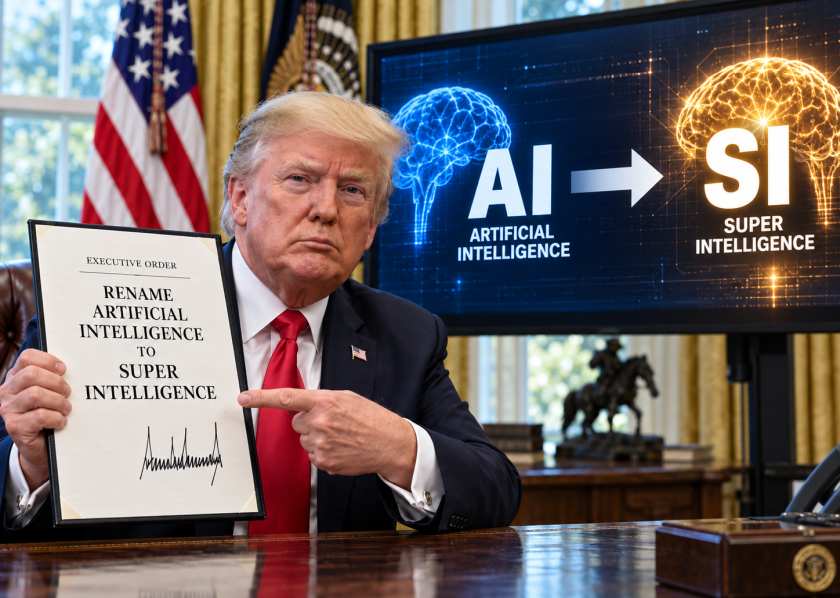
President Donald Trump pushed his effort to rename artificial intelligence into remarkable new territory on October 8, writing on Truth Social that the White House considers anyone who uses “Artificial Intelligence” rather than “Super Intelligence” to be “THE ENEMY!” The comment followed an executive order directing federal agencies to replace AI terminology with SI in official communications. Axios noted the contradiction: parts of the White House’s own digital infrastructure still used “AI,” even as AI.gov was visually changed to display “SI.gov.”
This is more than presidential wordplay because federal agencies have started adopting the terminology. The new label also collides with the technology industry’s established meaning of superintelligence, which traditionally refers to a hypothetical system exceeding human intelligence across a broad range of cognitive abilities. Rebranding today’s AI as SI therefore mixes political messaging with a term that already carries a specific technical meaning.
It also shows how deeply AI has moved into politics and culture. Governments are no longer debating only how to regulate the technology; they are fighting over how to describe it.
Why It Matters: The AI-to-SI campaign turns technology terminology into federal policy and political identity while potentially confusing a technical distinction the industry has used for decades.
Source: TechStartups via TruthSocial, Axios.
AI chip financing explodes as SpaceX seeks $40 billion and Wall Street syndicates $60 billion Anthropic deal
Two transactions this week showed just how dramatically the economics of AI infrastructure have changed. SpaceX is discussing roughly $40 billion in financing largely to buy Nvidia processors, according to the Financial Times. The proposed package includes around $10 billion in bank loans and $30 billion in investment-grade debt, with Apollo expected to play a major role in arranging the financing.
At the same time, Bank of America, Citigroup, and Morgan Stanley began distributing a $60 billion financing package tied to Broadcom and Anthropic. Roughly $42 billion consists of senior secured financing supported by Broadcom, while another $18 billion is structured as junior debt. Blackstone has reportedly committed $9 billion to the junior portion.
These deals represent a structural shift. AI processors are becoming expensive enough to require financing structures more familiar in aviation, energy, telecom, and commercial real estate. Rather than paying outright for every accelerator, companies can finance hardware and lease the resulting compute.
That spreads the cost of AI across banks, bond investors, private-credit funds, semiconductor companies, and AI labs — but it also connects their risks.
Why It Matters: GPUs and custom AI chips are becoming a new infrastructure asset class financed with tens of billions of dollars of institutional debt.
Source: Financial Times.
OpenAI launches GPT-6 with Intelligent UI, turning ChatGPT into an adaptive interface

OpenAI launched GPT-6 with Intelligent UI on October 7, allowing ChatGPT to create interactive interfaces around a user’s question rather than returning the same text-centric response format every time.
Responses can now include charts, diagrams, forms, buttons, maps, calculators, games, and other interactive elements generated directly inside the conversation. GPT-6 can decide which format is appropriate and can begin showing a response while it continues reasoning or using tools. OpenAI says more than 1.2 billion people now use ChatGPT each week.
The product direction may ultimately matter more than another benchmark improvement. Traditional software presents users with interfaces developers create ahead of time. Intelligent UI moves toward interfaces assembled dynamically around whatever the user wants to accomplish.
GPT-6 Sol powers ChatGPT for Plus, Pro, Business, and Enterprise users, while Free and Go users receive GPT-6 Luna. The rollout applies to the Chat experience rather than the models powering Work and Codex.
Why It Matters: If software interfaces can be generated around individual tasks, the boundary between chatbot, application, search engine, and operating interface starts to disappear.
Source: TechStartups via OpenAI.
SpaceX makes an $8 billion spectrum move toward becoming a nationwide wireless carrier
SpaceX took a major step beyond satellite broadband this week by agreeing to acquire Grain Management’s nationwide 800 MHz spectrum portfolio.
The deal gives SpaceX up to 14 MHz of paired low-band spectrum, subject to FCC approval. Low-band frequencies travel long distances and penetrate buildings much better than many higher-frequency satellite signals, addressing what SpaceX calls one of the remaining technical gaps in its Starlink Mobile strategy.
The reported price is roughly $8 billion, and investors immediately treated the transaction as a credible threat to conventional telecom companies. Wireless stocks fell sharply after the announcement, with the market beginning to price in the possibility that Starlink could eventually compete more directly with AT&T, Verizon, and T-Mobile rather than merely providing satellite backup coverage.
SpaceX envisions combining its satellite constellation with terrestrial wireless infrastructure, creating a network that can serve phones both from space and from the ground.
That is a much larger ambition than eliminating remote-area dead zones.
Why It Matters: SpaceX is assembling the spectrum and infrastructure needed to move from satellite connectivity partner to potential nationwide mobile carrier.
Sources: SpaceX; Grain Management.
Google locks in gigawatts of electricity as AI turns nuclear power into strategic infrastructure
Google and Constellation Energy announced a long-term agreement to add 890 megawatts of new nuclear generation to the PJM electricity grid through upgrades at 11 existing reactors in Illinois, Pennsylvania, and New Jersey.
The 20-year agreement will support more than $4 billion in upgrades intended to increase the output of existing plants, with the first additional electricity expected in 2028. The broader Google-Constellation arrangement also covers about 2.7 gigawatts of existing generation, bringing the overall relationship to roughly 3.59 GW.
The scale illustrates how radically AI has changed Big Tech’s relationship with the electricity system. Data centers once bought power largely as another operating expense. Gigawatt-scale AI campuses now require companies to secure generation years in advance, participate in grid planning, and sometimes help finance new capacity.
Google is also working with Constellation on what the companies describe as an “AI for Energy” blueprint using Google Cloud and Gemini Enterprise.
The irony is striking: building more artificial intelligence increasingly requires technology companies to invest deeply in some of the most physical infrastructure on Earth.
Why It Matters: Electricity supply is becoming a competitive advantage in AI, and Big Tech is moving directly into long-term generation strategy to secure it.
Source: Constellation Energy.
Samsung projects staggering Q3 profit as AI memory demand rewrites semiconductor economics
Samsung Electronics stunned markets with preliminary third-quarter guidance showing approximately 195 trillion won in revenue, and 107.4 trillion won in operating profit.
The October 8 guidance represents an extraordinary change in semiconductor economics as high-bandwidth memory and other memory products become essential components of large AI systems. Samsung said the figures remain preliminary and subject to the completion of its external audit.
The broader memory squeeze has created an unusual dynamic. AI infrastructure companies are competing aggressively for advanced memory capacity, while consumer electronics manufacturers still need DRAM and storage for smartphones, PCs, tablets, and other devices.
That gives memory manufacturers unusual pricing power while pushing costs downstream into other sectors.
The significance is therefore bigger than one company’s quarter. Nvidia GPUs receive most of the attention surrounding AI infrastructure, but those accelerators cannot operate without enormous quantities of advanced memory.
Why It Matters: AI demand is generating exceptional profits upstream in the semiconductor supply chain while increasing pressure on components elsewhere in the electronics industry.
Source: Samsung Electronics.
Tesla drops “Full Self-Driving” name in Europe after regulators call it misleading
Tesla has started calling its advanced driver-assistance system “Tesla Assisted Driving” across European websites, abandoning the “Full Self-Driving” label that regulators said could mislead drivers about what the software actually does.
Germany’s transport ministry said Tesla had proposed the change during discussions over broader European approval. The system can steer, accelerate, brake, and perform other driving functions, but drivers remain legally responsible and must be ready to take control.
Tesla’s U.S. site continues using “Full Self-Driving (Supervised).”
The rebrand matters because CEO Elon Musk has made autonomous-driving software central to Tesla’s long-term valuation thesis. Approval across Europe would open another large market for software subscriptions and provide a stepping stone toward more advanced autonomous services.
But European regulators have repeatedly challenged the gap between Tesla’s branding and the actual level of autonomy delivered. An EU-wide decision is expected by December, as several countries continue evaluating the system.
Why It Matters: Tesla’s name change is a rare concession that shows regulators can influence how autonomous-driving technology is marketed even before determining whether it can be deployed broadly.
Source: TechStarups via Reuters.
DeepSeek closes in on at least $12 billion as China builds another frontier AI heavyweight
Chinese AI company DeepSeek is close to raising at least 80 billion yuan, or about $12 billion, in a funding round that has exceeded its original target, according to Bloomberg.
Tencent and battery giant CATL are among the largest investors. DeepSeek initially sought roughly 50 billion yuan, but signed commitments could push the final total toward 100 billion yuan, or nearly $15 billion. The company is preparing for a possible domestic IPO in early 2027.
The round changes the financial profile of a company initially known for showing that competitive models could be built more efficiently than many Western rivals assumed.
Efficiency has not eliminated the cost of competing at the frontier. DeepSeek still needs accelerators, data centers, engineers, inference capacity, and distribution, while operating under U.S. restrictions that limit access to some advanced Nvidia chips.
Its closer relationship with Huawei also reflects China’s broader attempt to build a more independent AI technology stack.
Why It Matters: DeepSeek is moving from disruptive research lab to heavily capitalized AI institution capable of competing at industrial scale.
Source: Bloomberg
Mistral launches trillion-parameter Large 4 as Europe pushes for sovereign AI
French AI startup Mistral released a public preview of Mistral Large 4, a roughly 1.05-trillion-parameter open-weight multimodal model with a one-million-token context window.
The mixture-of-experts system activates roughly 49–52 billion parameters per token, depending on the model documentation, and is designed for coding, agentic workflows, multimodal tasks, and enterprise applications. Mistral says it will release full model weights after the preview period.
The release has geopolitical significance. The largest American frontier labs rely primarily on closed models, while Chinese developers have become increasingly influential in open-weight AI.
Mistral is positioning Europe as a third option: advanced models that governments and companies can operate inside infrastructure they control.
That appeals particularly to regulated industries and European institutions concerned about sovereignty, privacy, and dependence on U.S. or Chinese platforms.
Company-supplied benchmark claims will still need independent evaluation.
Why It Matters: Mistral Large 4 gives Europe a serious open-weight model around which enterprises and governments can build more independent AI infrastructure.
Source: Mistral AI.
Waymo borrows $5 billion as robotaxis move from experiment to capital-intensive transportation business

Waymo closed a $5 billion term loan on October 8, marking the Alphabet-owned autonomous-driving company’s first debt financing. PIMCO, Blackstone, and Sixth Street served as lead syndicated lenders, while investors including Capital Group, T. Rowe Price, Apollo, Fidelity, Oaktree, Blue Owl, and others participated. Goldman Sachs acted as sole lead bookrunner.
The financing follows a $16 billion equity investment earlier this year and arrives as Waymo expands its fully autonomous ride-hailing operation into additional U.S. and international cities.
Debt is a milestone because lenders typically demand more predictability than venture investors. Waymo describing itself as a “scaling commercial enterprise” signals that the company believes robotaxis are moving beyond an open-ended research effort.
But expansion remains expensive. Autonomous fleets require vehicles, maintenance facilities, charging infrastructure, mapping, operations teams, insurance, and continuous software development.
Why It Matters: Waymo’s first debt financing suggests autonomous ride-hailing is developing the financial structure of a real transportation industry rather than an experimental technology program.
Source: Waymo
Schneider Electric buys PTC for $22.6 billion as industrial AI moves deeper into engineering
Schneider Electric agreed to acquire PTC for approximately $22.6 billion in equity value, one of the week’s largest technology transactions. Schneider will pay $205 per share in cash, a 42.3% premium to PTC’s previous closing price, valuing the company at approximately $23.7 billion including debt.
PTC provides software used in product design, product lifecycle management, engineering, digital twins, and industrial operations. Schneider already operates across data centers, electrical systems, industrial automation, and energy management.
The combination reflects a major idea emerging in enterprise AI: proprietary industrial data may matter as much as access to the underlying model.
Engineering drawings, manufacturing workflows, machine telemetry, digital twins, and equipment histories contain context that generic AI systems do not naturally possess.
By bringing that data closer to its energy and automation platforms, Schneider wants to create a larger industrial software and AI business.
Why It Matters: Schneider is paying $22.6 billion for the engineering-data layer that could make AI far more valuable inside factories, infrastructure, and energy systems.
Source: PTC / Schneider Electric.
Qualcomm and Arm return to court in a semiconductor fight worth potentially billions
Qualcomm and Arm spent the week back in Delaware federal court as their long-running licensing dispute entered another high-stakes phase.
Qualcomm accuses Arm of violating agreements, withholding technical resources, and interfering with business relationships. One of the biggest financial questions is whether Qualcomm could stop paying certain Arm royalties for several years if it prevails — potentially putting billions of dollars at stake.
The dispute also reaches into Arm’s evolving business strategy. Arm historically made much of its money by licensing chip architectures to companies such as Qualcomm. Under SoftBank ownership, it has explored moving further into complete chip designs and demanding substantially higher royalty rates for future architecture generations.
Qualcomm argues that those moves conflict with existing agreements; Arm rejects that characterization. The fight matters because Arm technology sits beneath billions of smartphones and is moving deeper into PCs and data centers.
Why It Matters: The outcome could reshape the economics between one of the world’s most important chip architecture companies and one of its largest licensees.
Source: Reuters.
Trump administration blocks Microsoft, Adobe and major IT firms from key green-card program
The Trump administration suspended Microsoft, Adobe, Cognizant, Infosys, Tata Consultancy Services, Wipro, HCL, and Capgemini from participating in the federal Permanent Labor Certification program, commonly known as PERM.
PERM is a critical first step for many employer-sponsored green cards because companies must certify that qualified U.S. workers are unavailable for a position before sponsoring a foreign employee for permanent residency. The move does not suspend the H-1B visa program, meaning affected employees can continue holding temporary work visas where otherwise eligible. But it significantly complicates their path toward permanent residency.
Vice President JD Vance framed the measure as part of an effort to protect American technology workers, pointing specifically to layoffs at companies that continue sponsoring foreign employees.
Critics argue that restrictions on long-term residency could make the United States less attractive to international engineers and researchers at precisely the moment Washington is trying to maintain leadership in AI and semiconductors.
Why It Matters: Immigration policy is becoming another competitive variable in the global technology race because companies compete for engineering talent as aggressively as they compete for chips.
Source: Axios
AI-assisted bank attacks in South Korea show how autonomous security tools can be repurposed
South Korean investigators found traces of ARTEX, a Chinese-developed autonomous penetration-testing tool, in a series of attacks against financial institutions. Banks including Shinhan, KB Kookmin, Hana, Yegaram Savings Bank, and BNK Busan reported data exposures, while other institutions detected attempted intrusions. ARTEX can autonomously scan systems, identify vulnerabilities, and develop potential attack paths while connecting to large language models.
CrowdStrike subsequently said the attacker appeared likely to be a Chinese-speaking, financially motivated individual, although attribution remains unconfirmed. The attacker reportedly used multiple AI models at different points in the activity. The developer behind ARTEX later removed the tool from public access following reports that it had been misused.
The incident is important because penetration-testing agents are intended to help defenders automate work historically performed by skilled security researchers. The same automation can also lower the expertise and time required for offensive hacking.
Why It Matters: Autonomous AI security systems can compress hours of manual reconnaissance into automated workflows, potentially increasing the speed and scale of cyberattacks.
Source: The Korea Times
Firmus pulls blockbuster Australian IPO as investors push back on AI data-center economics
Australian AI data-center operator Firmus Technologies withdrew its planned ASX listing after struggling to generate enough institutional investor demand.
The Nvidia-backed company had been seeking one of Australia’s largest public-market debuts in decades, but investors raised concerns over its valuation, borrowing requirements, and the fact that much of its proposed data-center capacity remains under development rather than in operation. Firmus says it will pursue private financing instead.
The failed float is an important counterweight to the extraordinary amounts of capital flowing into AI infrastructure.
Demand for compute may be real, but that does not automatically mean every data-center developer deserves any valuation or financing structure it requests.
Public investors tend to demand clearer visibility into utilization, customer contracts, construction costs, electricity access, debt, and eventual cash flow.
That discipline could become increasingly important as enormous amounts of new capacity compete for the same customers.
Why It Matters: Firmus shows that public markets are beginning to distinguish between genuine AI infrastructure demand and the price investors are willing to pay for future capacity.
Source: TechStartups via CNBC, ABC News Australia. Read ABC’s Firmus report
Ransomware hits Japan’s IDCF Cloud, disrupting 495 companies and local governments
Japanese cloud provider IDC Frontier confirmed that a ransomware attack disrupted part of its IDCF Cloud East Japan Region 1 beginning early October 7. The company said virtual servers in several availability zones stopped operating and could not be restarted. Approximately 495 companies and local governments using the affected environment were impacted.
IDC Frontier isolated systems while investigating the attack and directly warned affected customers.
The incident demonstrates why cloud concentration can amplify cybersecurity failures. An attacker doesn’t need to compromise hundreds of organizations individually if they depend on the same underlying infrastructure.
It also reminds us that cloud hosting does not eliminate the need for independent backups and disaster-recovery planning.
Organizations often assume a cloud provider can recover infrastructure automatically after a failure. Ransomware can make that assumption dangerously optimistic.
Why It Matters: Attacking a shared cloud provider can turn one intrusion into hundreds of simultaneous business disruptions.
Source: IDC Frontier
Seven-month-old quantum startup Oratomic raises $475 million at a $5.4 billion valuation
Quantum computing startup Oratomic raised $475 million in a Series B round, taking total funding to $775 million only months after the company launched.
The financing values the Pasadena-based company at $5.4 billion, according to transaction disclosures. ARCH Venture Partners, Spark Capital, Khosla Ventures, Index Ventures, General Catalyst, and Bezos Expeditions were among the round’s lead investors.
Oratomic is building quantum systems based on reconfigurable neutral-atom arrays and advanced error-correction techniques, with the stated goal of producing utility-scale fault-tolerant computers.
The company is still far from proving that it can build a commercially useful machine at scale, making the valuation particularly striking.
Yet the round reflects investors’ growing belief that quantum computing may finally be moving from laboratory physics toward a manufacturing and systems-engineering race.
It also comes during a week in which several other quantum companies announced large financings or manufacturing partnerships.
Why It Matters: Quantum computing is starting to attract funding levels once reserved for major AI companies — years before commercially useful machines are guaranteed.
Source: Oratomic.
FBI and Justice Department seize Flax Typhoon hacking infrastructure
The U.S. Justice Department and FBI announced the seizure of seven domains supporting two tools known as Microscan and FishHub, which authorities say actors connected to the China-linked hacking campaign commonly called Flax Typhoon used.
Microscan allegedly scanned networks for vulnerable systems, while FishHub supported spear-phishing and related intrusion activity. U.S. authorities linked the infrastructure to Integrity Technology Group, a China-based cybersecurity company with government contracts. China has repeatedly rejected U.S. allegations of state-sponsored cyberattacks.
According to the Justice Department, targets associated with the infrastructure included U.S. and foreign critical systems.
The operation follows an increasingly proactive cybersecurity strategy in which law-enforcement agencies seize domains, botnets, and servers before attackers can continue using them.
Such disruptions rarely eliminate sophisticated threat groups entirely, but they can force operators to rebuild infrastructure and expose information useful to investigators.
Why It Matters: Governments are increasingly treating attacker infrastructure as something to dismantle proactively rather than simply investigating compromises after the damage is done.
Source: U.S. Department of Justice.
GlobalFoundries and TSMC sign $2 billion deal to bring advanced AI chip packaging capacity to New York
GlobalFoundries signed a multi-year $2 billion manufacturing agreement with TSMC to produce silicon interposers for TSMC’s CoWoS advanced packaging ecosystem at GlobalFoundries’ Malta, New York facility.
Production is expected to begin ramping in the first half of 2028. GlobalFoundries says the agreement will establish the first U.S.-based source of silicon interposers supporting advanced AI packaging.
Interposers do not receive the attention GPUs do, but they are critical to modern accelerators because they connect processors with high-bandwidth memory and other components inside advanced packages.
That has turned packaging into another constraint on AI chip supply.
The agreement is also unusual because GlobalFoundries and TSMC are semiconductor manufacturers, but they do not compete directly at every process node. Instead, GlobalFoundries is becoming part of the manufacturing ecosystem supporting TSMC’s advanced packaging capacity.
It is another example of AI reshaping relationships across the semiconductor supply chain.
Why It Matters: Producing enough AI processors increasingly depends on packaging capacity as much as wafer fabrication, making interposers and CoWoS infrastructure strategically important.
Source: GlobalFoundries.
The Week in Perspective
This week produced five signals worth carrying into the rest of October.
AI is becoming a capital-markets story. SpaceX’s proposed $40 billion chip financing, the $60 billion Anthropic-related package, Waymo’s first $5 billion loan, and DeepSeek’s enormous funding round show that technology companies increasingly need banks, bond investors, private credit, and sovereign capital to fund the next stage of expansion.
AI is becoming a physical-infrastructure story. Google is securing gigawatts of electricity. GlobalFoundries is building packaging capacity for TSMC. Samsung is benefiting from a historic memory squeeze. The bottlenecks are increasingly measured in megawatts, wafers, interposers, and construction timelines rather than model parameters alone.
Telecom could be the next industry SpaceX disrupts. The 800 MHz spectrum deal fundamentally changes the Starlink story. SpaceX is no longer simply trying to fill holes in terrestrial coverage. It is assembling pieces that could eventually let it compete directly in mobile communications.
Regulators are beginning to shape the products themselves. Tesla changed the name of one of its most important software products to satisfy European concerns. Washington restricted the long-term immigration pipeline used by major technology employers. And Trump’s attempt to replace “AI” with “SI” shows that even the language surrounding technology has become political territory.
AI-assisted cyberattacks are moving from theory to operations. The South Korean banking incidents show what happens when autonomous penetration-testing tools fall into the wrong hands, while the IDCF Cloud ransomware attack demonstrates how infrastructure concentration can amplify a single breach.
The next phase of the technology cycle will therefore be about much more than who builds the smartest model.
It will be about who can finance the infrastructure, secure the chips, generate the electricity, attract the engineers, control the spectrum, survive regulatory scrutiny — and defend the systems when automation begins working for the attackers too.