Elon Musk’s Tesla and SpaceX lose $456 billion in market value after Democrats sweep midterm elections
 Daniel Levi
Posted On November 6, 2026
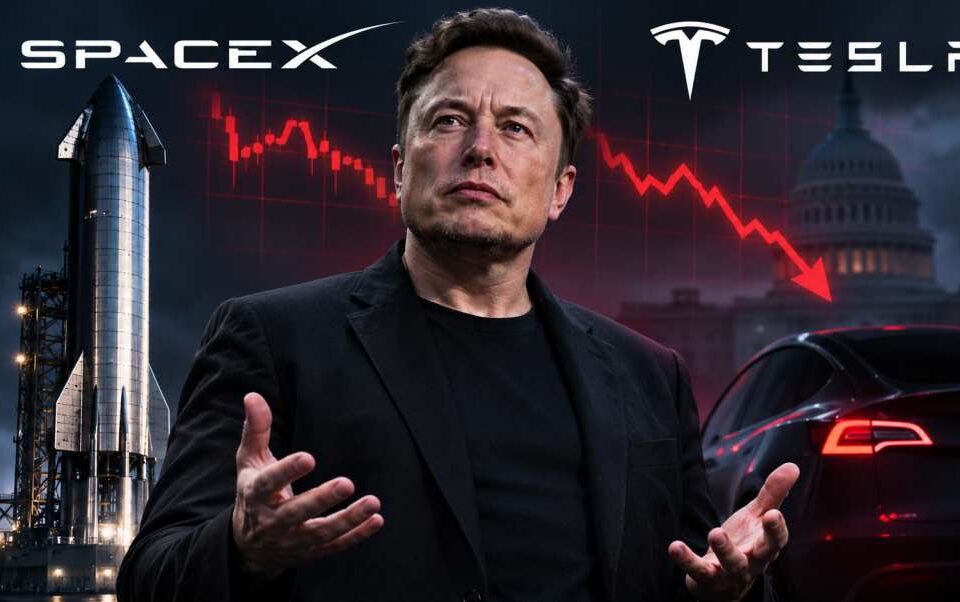
Elon Musk’s two biggest companies, Tesla and SpaceX, lost a staggering $456 billion in combined market value in just two trading days after Democrats swept the 2026 U.S. midterm elections, handing the billionaire a financial setback just days after he spent nearly half a billion dollars backing Republican candidates.
Tesla shares plunged nearly 11% on Thursday, November 5, and SpaceX fell about 9%, extending losses that began Wednesday. By Thursday’s closing bell, the companies’ combined market capitalization had fallen from roughly $3.5 trillion on Election Day to $3.04 trillion, according to CNBC.
The sell-off came amid a broader downturn in technology stocks, fueled by concerns over AI spending and potential restrictions on data center construction. For Musk, the election results introduced another problem: a new political environment that could bring congressional investigations, tighter regulations, and fresh obstacles to his companies’ ambitious AI projects.
Democrats won control of both chambers of Congress in Tuesday’s elections, reversing the Republican majority Musk had spent heavily to protect.
According to the Financial Times, Musk contributed more than $470 million to Republican candidates and political causes, making him the party’s largest financial backer during the midterm cycle. Many of the candidates he supported lost, including prominent Republican allies in Texas, home to Tesla and SpaceX.
Democrat James Talarico defeated Republican Ken Paxton in the Texas Senate race, and Gina Hinojosa defeated incumbent Gov. Greg Abbott.
The election fallout has taken a toll on Musk’s personal fortune. Forbes estimates that his wealth has fallen below $800 billion after surpassing $1 trillion following SpaceX’s June initial public offering.
Musk’s AI ambitions face a new political reality
The biggest uncertainty may lie in Texas, where Musk is betting billions on the AI infrastructure needed to support artificial intelligence.
Tesla and SpaceX are developing Terafab, a massive semiconductor manufacturing and data center project planned for Grimes County. SpaceX is pursuing additional computing infrastructure at its Starbase facility.
Those projects could face new hurdles under incoming Democratic leadership.
Texas Gov.-elect Gina Hinojosa made data center development a major campaign issue, calling for a pause on new approvals until lawmakers establish stronger protections covering electricity prices, water consumption, local oversight, and tax incentives.
Deutsche Bank analysts warned Wednesday that the political shift could complicate SpaceX’s expansion plans.
“While policy is naturally hard to predict, we could envision SpaceX facing some incremental headwinds in this type of backdrop.”
The analysts raised concerns about possible delays to SpaceX’s Texas computing projects and higher construction costs from future regulatory requirements.
The risks extend beyond Texas.
With Democrats preparing to take control of Congress, Musk could face renewed scrutiny over government contracts, his political activities, and decisions involving his companies.
CNN reported that Musk and SpaceX have been directed to preserve records related to restrictions imposed on a military version of Starlink used by Ukraine. The restrictions reportedly affected Ukraine’s ability to defend itself against Russian attacks.
Another potential casualty is Musk’s interest in combining Tesla and SpaceX. Such a transaction would require shareholder approval and regulatory clearance, adding uncertainty in a more skeptical political environment.
None of these regulatory outcomes is guaranteed. The incoming congressional majority has yet to take office, and proposed restrictions on Texas data centers have not become law.
The broader technology sell-off contributed substantially to the companies’ losses, making it difficult to isolate how much of the $456 billion decline investors attributed to the election.
Still, the market reaction exposes a growing challenge for Musk. His companies remain deeply tied to government policy, public infrastructure, and regulatory approvals, even as his political influence faces new limits.
For Musk, the immediate loss is $456 billion in market value. The longer-term question is how much the election results could cost Tesla and SpaceX in future growth.