Startup Funding News Today, November 3, 2026: Moffett AI, Tutor Intelligence, Larridin, nPhase & More
 Nickie Louise
Posted On November 3, 2026
Venture capital continues to flow into technologies that make artificial intelligence cheaper, more useful, and better able to operate in the physical world. From specialized AI chips and warehouse robots to distributed computing networks and brain-computer interfaces, the latest startup funding announcements reveal investors backing businesses with significant engineering requirements and potentially valuable positions in emerging technology markets.
China’s Moffett AI announced a Series C+ financing approaching RMB 1 billion for its AI inference technology. Quantum-sensing company Guoce Quantum secured more than RMB 500 million, while brain-computer interface developer Nuanxinjia raised RMB 500 million to advance technology intended to help restore visual perception. In the United States, Tutor Intelligence raised $75 million from investors led by Andreessen Horowitz to expand its industrial robotics business.
The activity extends beyond those headline transactions. Chinese startup Gongji Technology secured several hundred million yuan to connect underutilized computing resources. Autonomous industrial vehicle developer Yicheng Innovation raised RMB 200 million, while battery equipment manufacturer Gaoneng Shuzao secured nearly RMB 100 million. American startups Larridin and nPhase each raised $30 million for enterprise AI measurement and clinical research software, respectively. India’s PowerUp Money added $10 million to expand its wealth-management platform.
The 10 selected announcements include $145 million in dollar-denominated financing, alongside substantial investments reported in Chinese yuan. Six companies are headquartered in China, three in the United States, and one in India. A precise combined total is not available because several companies disclosed approximate financing amounts rather than exact figures.
The larger story is the changing nature of AI investment. Investors are financing specialized computing, measurable enterprise productivity, autonomous industrial operations, and scientific technologies that could take years to commercialize. The question is increasingly whether these businesses can turn technical advantages into reliable products and sustainable economics.
Beyond AI Hype: Where Investors Are Putting Their Money
Artificial intelligence remains the strongest connecting theme in today’s funding announcements, but investors are pursuing several different opportunities within the sector. Moffett AI develops specialized inference chips. Gongji Technology connects available GPU capacity with customers. Tutor Intelligence is training AI systems through robots working in industrial facilities. Larridin measures whether AI adoption produces meaningful business results.
These companies address different constraints. Moffett and Gongji are focused on computing costs and availability. Tutor is tackling the difficulty of training robots to work in unpredictable physical environments. Larridin addresses a financial question facing enterprises: whether the cost of adopting AI is justified by measurable productivity gains. Taken together, the transactions suggest investors are looking for businesses that solve specific adoption problems rather than relying solely on growing enthusiasm for AI.
China’s concentration of announcements is also notable. Six selected companies operate in semiconductors, computing infrastructure, quantum sensing, medical devices, industrial autonomy, and battery manufacturing. These sectors overlap with national priorities involving technological independence and industrial capacity. Participation by state-backed investment institutions and corporate investors across several rounds shows how strategic industrial objectives and commercial venture investment can intersect.
The American transactions present a different combination of priorities. Tutor is financing robots that customers can use without purchasing the machines outright. Larridin is building software to quantify the return on AI spending. nPhase is expanding a platform that connects clinical trial data, statistical analysis, and regulatory submissions. These businesses target existing operational expenses and processes, making customer economics central to their investment cases.
Capital intensity remains an important dividing line. Software businesses can often expand without investing heavily in physical equipment. Semiconductor manufacturers, robotic systems developers, and advanced medical technology companies face different economics. They must finance engineering, manufacturing, testing, and deployment before realizing the full commercial benefit. Today’s rounds show investors accepting those requirements in selected markets, but the financings do not establish that capital is becoming easier to obtain across the entire startup ecosystem.
The strongest common signal is investor interest in technologies that can control costs, increase productivity, or establish defensible positions in important industrial systems. Whether those investments succeed will depend on the commercial evidence that follows.
Tutor Intelligence raises $75M to expand AI-powered warehouse robots
Massachusetts-based Tutor Intelligence raised $75 million in Series B financing led by Andreessen Horowitz. Union Square Ventures and Neo, which previously led the company’s Series A and seed rounds, also participated. The investment brings Tutor’s total funding to $117 million.
The company announced the completed financing on November 2, with plans to expand robot manufacturing, AI model development, and commercial deployments.
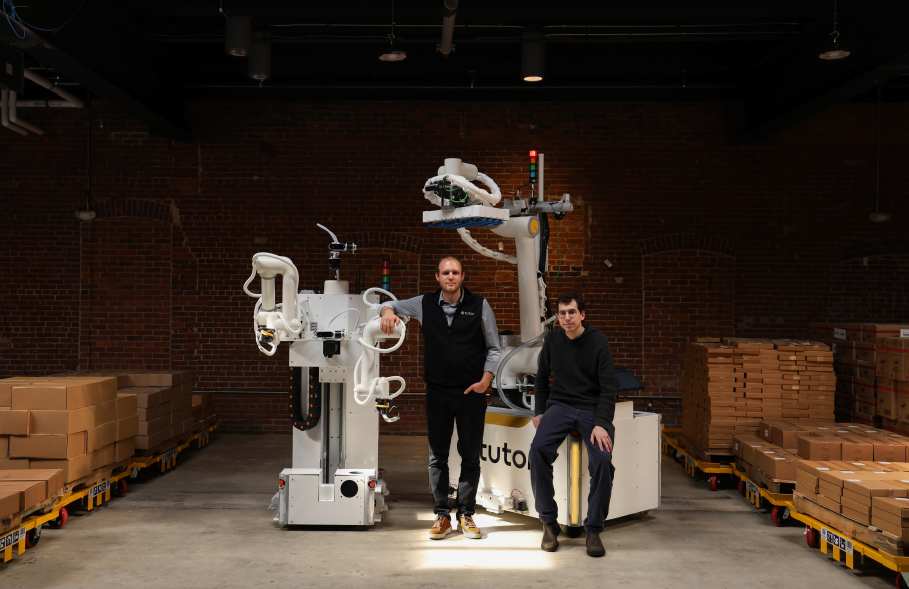
Founded by Josh Gruenstein and Alon Kosowsky-Sachs, Tutor develops robotic systems that perform tasks in warehouses and manufacturing facilities. Its robots include Sonny, designed for more complex manipulation tasks, and Cassie, which focuses on material handling.
The company combines robotic hardware with AI models trained using information collected during real industrial operations. Remote human operators, whom the company calls tutors, help guide robots through tasks and provide training information.
Tutor’s business model differs from conventional industrial equipment sales. Customers pay for robotic work by the hour or by the item handled rather than purchasing the machines. Tutor maintains the equipment and provides software updates.
Robots as a service
The company’s approach addresses two barriers to robotics adoption: equipment cost and the difficulty of training robots to perform different tasks. By retaining ownership and operating responsibility, Tutor can reduce the upfront expense for customers. However, that model shifts substantial capital and maintenance responsibilities to Tutor.
The company must finance its robot fleet and operate it efficiently enough to generate attractive returns. Tutor says its robots now operate in almost four times as many facilities as a year ago. It also reports that nearly one-third of organizations that received robots in the past 12 months were existing customers expanding their deployments.
Those figures suggest customer interest but do not disclose revenue, profitability, or fleet utilization. Tutor aims to have more than 1,000 robots under contract by the end of 2027. That is a future objective, not an existing deployment figure.
Funding Details
Startup: Tutor Intelligence
Investors: Andreessen Horowitz, Union Square Ventures, Neo
Amount Raised: $75 million
Total Raised: $117 million
Funding Stage: Series B
Funding Date: November 2, 2026
Headquarters: Watertown, Massachusetts, United States
Sector: Robotics / embodied AI / industrial automation
Valuation: Not disclosed
Moffett AI raises nearly RMB 1B to expand specialized AI inference chips
Shenzhen-based Moffett AI announced a Series C+ financing approaching RMB 1 billion. The investment included participation from Renai Capital, Haitang Fund, Dongheng Petroleum, Biqiu Capital, Paila Capital, Zhongcai Capital, and other industrial and financial investors.
The announcement follows another financing of nearly RMB 1 billion completed about five months earlier. Together, those two rounds represent nearly RMB 2 billion in financing, but today’s report includes only the latest Series C+.
Moffett develops specialized computing technology for AI inference, the process of running trained AI models to generate predictions and responses. Its approach focuses on sparse computation, which seeks to avoid unnecessary mathematical operations during model execution. Reducing required computation can lower inference costs and improve AI infrastructure efficiency.
The company designs hardware and software together, including specialized chips, computing boards, and supporting software. Moffett says it has deployed its inference systems across several regions of China and integrated them into computing services offered through telecommunications partners. It is also preparing its next-generation SP200 computing board and an upgraded software architecture called SECA. Those products are expected to support additional AI model deployments and cluster operations.
Why investors care
AI inference is becoming a major cost consideration for companies running AI applications. Training large models attracts considerable attention, but operating those models at scale can also require substantial computing resources. This creates opportunities for specialized chipmakers that can reduce the cost of running AI workloads.
However, Moffett faces competition from established semiconductor companies and other inference accelerator developers. Its technical claims must translate into measurable advantages involving performance, energy consumption, software compatibility, and total deployment costs.
The company reports that quarterly revenue increased severalfold during the third quarter of 2026, although it has not disclosed absolute revenue figures. For investors, the most important commercial question is whether Moffett’s specialized architecture can deliver attractive economics across a sufficiently broad range of AI applications.
Funding Details
Startup: Moffett AI
Investors: Renai Capital, Haitang Fund, Dongheng Petroleum, Biqiu Capital, Paila Capital, Zhongcai Capital, and others
Amount Raised: Nearly RMB 1 billion
Total Raised: Not disclosed on a fully reconciled lifetime basis; the latest two rounds total nearly RMB 2 billion
Funding Stage: Series C+
Funding Date: November 3, 2026
Headquarters: Shenzhen, China
Sector: AI semiconductors/inference infrastructure
Valuation: Not disclosed
Larridin raises $30M in funding to help enterprises measure the financial return on AI spending

South San Francisco-based Larridin raised $30 million in Series A financing led by Pelion Ventures. Existing investors Andreessen Horowitz and Gradient Ventures also participated, along with GFT, W23, Thayer, DG Daiwa Ventures, Alumni Ventures, and Cougar Capital. The round brings Larridin’s total funding to $47 million.
Larridin develops software that helps enterprises measure how employees and AI systems use computing resources and complete work. Its platform connects AI adoption, spending, productivity, and business outcomes. The company addresses a problem that grows more important as enterprises move beyond experimental AI deployments.
Organizations can often measure how frequently employees use AI tools. It is harder to determine whether those tools improve productivity enough to justify their costs. For example, an AI coding assistant may help developers generate more code without reducing the time needed to review, test, and deploy it. Larridin attempts to evaluate the broader workflow rather than measuring AI activity alone.
The company says its platform has analyzed more than two billion AI sessions and tracked over 82,000 workflows. It also reports an average 47% increase in measurable team output among customers and median first-year AI spending optimization of $2.4 million.
A different kind of AI investment opportunity
Larridin is not attempting to develop a competing foundation model. Its business depends on AI adoption growing across other software products. If enterprises continue spending heavily on AI, tools that evaluate those investments could become more valuable. However, measuring productivity is technically and economically complicated. More output does not necessarily mean better output.
For investors, Larridin’s advantage will depend on its ability to connect AI activity with credible operating metrics that companies use to make spending decisions. Its customers include SurveyMonkey, Vertiv, and Klaviyo.
Funding Details
Startup: Larridin
Investors: Pelion Ventures, Andreessen Horowitz, Gradient Ventures, GFT, W23, Thayer, DG Daiwa Ventures, Alumni Ventures, Cougar Capital
Amount Raised: $30 million
Total Raised: $47 million
Funding Stage: Series A
Funding Date: November 2, 2026
Headquarters: South San Francisco, California, United States
Sector: Enterprise AI/productivity analytics / AI spending management
Valuation: Not disclosed
Guoce Quantum raises over RMB 500M to expand quantum precision sensing
Chinese quantum technology company Guoce Quantum announced the completion of a Series B financing exceeding RMB 500 million. CICC Capital and Zhejiang Financial Innovation jointly led the round. Other investors included Yanhai Fund, Yongshang Private Equity, Shenzhen High-Tech Investment, and Jiuxian Capital, along with existing investors. The financing values the company at more than RMB 5 billion and brings cumulative disclosed funding to more than RMB 1 billion.
Based in Huzhou, Zhejiang province, Guoce develops quantum precision measurement technologies. Its products include chip-scale atomic clocks, stabilized lasers, quantum magnetometers, and systems used for precise time synchronization.
Unlike companies developing general-purpose quantum computers, Guoce focuses on commercial quantum measurement applications. That distinction matters because precision sensing and timekeeping already serve established industrial markets. Atomic clocks help provide highly accurate timing for communications, navigation, and other systems.
Quantum sensors can support applications involving magnetic field measurement, industrial testing, and scientific instrumentation. Guoce says it has established manufacturing capabilities for domestically produced chip-scale atomic clocks. It is also developing technologies involving gravity measurement and other specialized sensors.
The commercial opportunity
Guoce’s investment case depends on translating advanced physics into reliable industrial products. Precision timing and sensing equipment can serve customers that require performance beyond conventional electronic devices. Potential markets include telecommunications, aerospace, electrical infrastructure, and defense applications.
The company will use the financing to expand production capacity, improve manufacturing processes, and develop additional products. Its reported valuation reflects investor expectations for commercialization. However, the company has not disclosed sufficient financial information to assess its valuation against revenue or profitability.
Investors should distinguish established product manufacturing from technologies that remain under development.
Funding Details
Startup: Guoce Quantum
Investors: CICC Capital, Zhejiang Financial Innovation, Yanhai Fund, Yongshang Private Equity, Shenzhen High-Tech Investment, Jiuxian Capital, and others
Amount Raised: More than RMB 500 million
Total Raised: More than RMB 1 billion
Funding Stage: Series B
Funding Date: November 3, 2026
Headquarters: Huzhou, Zhejiang, China
Sector: Quantum sensing/precision measurement
Valuation: More than RMB 5 billion
nPhase raises $30M in funding to modernize clinical trial data management with AI
Florida-based nPhase raised $30 million in Series D financing led by Viking Global Investors. According to nPhase, the investment represents its first equity financing since 2017. The funding will support international expansion and further development of its clinical data management and AI software.
Based in Atlantic Beach, Florida, nPhase develops technology used by pharmaceutical companies and clinical research organizations. Clinical trials generate information from hospitals, laboratories, patients, medical devices, and other sources. That data must be collected, validated, standardized, analyzed, and prepared for regulatory submissions. Traditional processes often involve disconnected software systems and substantial manual work.
nPhase is attempting to combine these activities within a single platform. Its technology includes a Unified Data Management System and Statistical Computing Environment. The company is also developing AI agents intended to perform selected administrative and analytical tasks. Human specialists retain responsibility for important decisions and approvals.
Why clinical data infrastructure attracts capital
The investment opportunity is connected to the costs and complexity of clinical research. Pharmaceutical companies can spend substantial amounts managing information across trials. Reducing unnecessary manual work could improve efficiency and shorten certain administrative processes.
However, clinical research software must meet demanding requirements involving data integrity, security, traceability, and regulatory compliance. AI-generated outputs cannot simply be accepted without validation. nPhase says its platform can reduce some data preparation processes that previously took several months to a matter of weeks. That is a company claim, not a universal benchmark.
For investors, the opportunity depends on the company’s ability to modernize clinical data operations without compromising research quality or regulatory requirements. Its long period without additional equity financing is also notable, although the company has not disclosed enough financial information to assess its historical profitability.
Funding Details
Startup: nPhase
Investors: Viking Global Investors
Amount Raised: $30 million
Total Raised: Not disclosed
Funding Stage: Series D
Funding Date: November 2, 2026
Headquarters: Atlantic Beach, Florida, United States
Sector: Clinical research technology/enterprise AI/life sciences software
Valuation: Not disclosed
Nuanxinjia raises RMB 500M to advance visual brain-computer interfaces
Hangzhou-based Nuanxinjia secured RMB 500 million in Series C+ financing led by Gaorong Capital. Backers included PICC Equity, Monolith Capital, Jianfa Emerging Investment, Dongfang Jiafu, Danhe Capital, and Hangzhou Industrial Investment Group. Existing investors, including Legend Capital, also participated. The financing brings Nuanxinjia’s cumulative funding to approximately RMB 1 billion.
Founded in 2014, Nuanxinjia develops implanted electronic systems intended to help people with severe visual impairment regain limited visual perception. Its technology combines electrodes, specialized chips, image processing, and electrical stimulation. Rather than repairing damaged eyesight through conventional medical treatment, the systems aim to transmit visual information by stimulating remaining neural pathways.
The company is researching approaches involving both retinal implants and the brain’s visual cortex. Nuanxinjia has reported early clinical experiences involving three patients. According to the company, participants demonstrated abilities such as identifying certain letters or shapes and performing selected tasks after receiving implants. These reports are preliminary and do not establish that the technology restores normal sight.
A promising technology with substantial clinical risk
Brain-computer interfaces attract investor interest because they could address serious medical conditions for which conventional treatments offer limited benefits. However, implanted medical devices face demanding safety, effectiveness, and regulatory requirements.
Nuanxinjia must demonstrate that reported improvements can be reproduced across larger patient groups and maintained over time. The company must also establish implantation safety, long-term device performance, and practical rehabilitation requirements. Its financing will support further research, engineering, clinical development, and commercialization preparations.
The round illustrates investor willingness to finance technologies with potentially significant medical value despite long development cycles. But early clinical results should not be interpreted as evidence of regulatory approval or established commercial viability.
Funding Details
Startup: Nuanxinjia
Investors: Gaorong Capital, PICC Equity, Monolith Capital, Jianfa Emerging Investment, Dongfang Jiafu, Danhe Capital, Hangzhou Industrial Investment Group, Legend Capital, and others
Amount Raised: RMB 500 million
Total Raised: Approximately RMB 1 billion
Funding Stage: Series C+
Funding Date: November 3, 2026
Headquarters: Hangzhou, Zhejiang, China
Sector: Brain-computer interfaces / medical devices
Valuation: Not disclosed
Gongji Technology raises several hundred million yuan to connect distributed GPU infrastructure
Beijing-based Gongji Technology announced a financing worth several hundred million yuan. The company did not disclose an exact amount or conventional funding-stage designation. Investors included the China Internet Investment Fund, CATL-affiliated investment entities, Yuanhe Puhua, Saime Technology, Deshi Investment, and Qiheng Gongchuang. Existing investors also participated.
Founded in 2023, Gongji operates a distributed computing platform. Its technology connects available GPU resources across different locations and makes that computing capacity accessible to customers developing AI applications.
The company is attempting to address a familiar problem in computing infrastructure: expensive equipment is not always operating at full capacity. Some organizations need additional computing resources only during periods of peak demand. Others own equipment that remains underutilized.
Gongji seeks to connect those needs through software that schedules workloads across distributed hardware. The approach resembles a marketplace for computing capacity, although making different systems operate reliably together requires more than matching buyers and sellers.
The economics of unused computing capacity
Gongji says it has served more than 10,000 businesses and teams. It also reports annual recurring revenue exceeding RMB 200 million, alongside year-over-year revenue growth above 800%. Those figures are company-reported and have not been independently audited in the reviewed disclosures.
The company’s investment case depends on improving the utilization of expensive GPUs. If customers can access suitable computing capacity at lower prices, distributed infrastructure could compete for selected workloads against conventional cloud providers. However, the company must manage hardware differences, network performance, data security, scheduling complexity, and service reliability.
A GPU available at a low hourly price is not necessarily the cheapest option if workloads experience delays or require extensive configuration.
For investors, the question is whether Gongji can turn fragmented infrastructure into a dependable service with attractive margins.
Funding Details
Startup: Gongji Technology
Investors: China Internet Investment Fund, CATL-affiliated investors, Yuanhe Puhua, Saime Technology, Deshi Investment, Qiheng Gongchuang, and existing investors
Amount Raised: Several hundred million yuan; exact amount not disclosed
Total Raised: Not disclosed
Funding Stage: Not disclosed
Funding Date: November 3, 2026
Headquarters: Beijing, China
Sector: AI infrastructure / distributed computing / GPU scheduling
Valuation: Not disclosed
PowerUp Money raises $10M to expand AI-assisted wealth management in India
Bengaluru-based PowerUp Money raised $10 million in financing led by Flourish Ventures. Existing investors Peak XV Partners, Accel, Blume Ventures, Kae Capital, 8i Ventures, and DeVC participated.
Founder and CEO Prateek Jindal told The Economic Times that the financing valued the company at approximately $73 million. The funding follows a previously reported $12 million Series A round. The reviewed announcement did not disclose the latest transaction’s formal stage designation.
Founded in 2024, PowerUp Money develops digital investment and wealth-management services for Indian consumers. Its platform helps investors track mutual fund holdings, evaluate portfolios, and access investment advisory services.
The company is developing additional AI-assisted capabilities intended to make personalized financial guidance accessible to more customers. PowerUp says more than 1.5 million users track portfolios worth over ₹2.5 lakh crore through its platform.
That figure represents investments monitored through the service, not assets owned or directly managed by PowerUp Money. This distinction matters when evaluating the company’s commercial scale.
Wealth management moves beyond portfolio tracking
PowerUp’s opportunity comes from the growing demand for digital financial services among individual investors. Portfolio tracking can attract users, but advisory subscriptions and other financial services may provide more direct opportunities for recurring revenue.
The company is attempting to move from helping consumers view their investments toward helping them make financial decisions. That transition introduces additional responsibilities. Investment advice must account for customer circumstances, risk tolerance, regulatory obligations, and the limits of automated recommendations.
For investors, the main questions concern customer acquisition costs, conversion into paid services, retention, and the economics of providing personalized advice. PowerUp’s reported valuation suggests investor interest in its commercial potential, but the reviewed reporting did not disclose revenue or profitability.
Funding Details
Startup: PowerUp Money
Investors: Flourish Ventures, Peak XV Partners, Accel, Blume Ventures, Kae Capital, 8i Ventures, DeVC
Amount Raised: $10 million
Total Raised: At least $22 million across the latest round and previously reported Series A financing
Funding Stage: Not disclosed; follow-on financing after Series A
Funding Date: November 3, 2026, Indian reporting date
Headquarters: Bengaluru, India
Sector: Fintech/wealth management / AI-assisted financial advisory
Valuation: Approximately $73 million, according to the founder’s statement to The Economic Times
Yicheng Innovation raises RMB 200M to expand autonomous industrial vehicles
Shenzhen-based Yicheng Innovation raised a RMB 200 million Series C financing. Investors included Guangdong Science and Technology Investment Group, Shanda Investment, Anhui State Investment, and Foshan Venture Capital. The company will use the investment to expand manufacturing capacity, improve its AI technology, and increase commercial deployments.
Founded in 2017, Yicheng develops autonomous-driving technology for industrial vehicles. Its systems are designed for operations involving factories, industrial parks, warehouses, ports, and mining facilities. These environments differ from public roads because vehicles often operate within defined boundaries and follow recurring routes.
However, industrial operations still present challenges involving workers, other vehicles, equipment, and changing conditions. Yicheng combines vehicle-control technology with AI models intended to interpret industrial environments and plan movements. The company says its technology supports Level 4 autonomous operations in suitable environments.
That designation should be interpreted within the operating conditions for which the system has been developed and validated. Yicheng also reports industrial orders worth several hundred million yuan.
The company has not disclosed enough detail to establish how much of that amount represents completed revenue rather than orders awaiting delivery.
Why investors are backing industrial autonomy
Autonomous vehicles operating in controlled industrial environments may reach commercial viability through a different path from self-driving passenger cars. Customers can evaluate the technology against measurable operating expenses, including labor, vehicle utilization, and transport efficiency.
Industrial sites may also provide more predictable operating conditions than public roads. However, the systems must still meet safety requirements and perform consistently. For Yicheng, commercial success depends on reliable deployments, manufacturing capacity, customer integration, and service economics.
Its financing reflects interest in AI systems that can complete physical tasks rather than merely generate digital outputs.
Funding Details
Startup: Yicheng Innovation
Investors: Guangdong Science and Technology Investment Group, Shanda Investment, Anhui State Investment, Foshan Venture Capital
Amount Raised: RMB 200 million
Total Raised: Not disclosed
Funding Stage: Series C
Funding Date: November 3, 2026
Headquarters: Shenzhen, China
Sector: Autonomous vehicles / industrial automation / embodied AI
Valuation: Not disclosed
Gaoneng Shuzao raises nearly RMB 100M to develop solid-state battery manufacturing equipment
Chinese industrial technology company Gaoneng Shuzao announced a Series B equity financing approaching RMB 100 million. Participants included investment institutions associated with Shaanxi Financial Investment, Changzhou Tianning Industrial Investment, and Guangzhou Liwan Industrial Investment. This is the company’s second financing in about a year.
Based in Xi’an, Gaoneng develops manufacturing equipment for battery producers. Its technology focuses on dry-electrode manufacturing and production systems used in solid-state battery development. Dry-electrode processes aim to reduce or eliminate some of the solvent-based steps used in conventional electrode production.
Depending on the battery chemistry and production process, this approach could reduce energy consumption, equipment requirements, or manufacturing costs. Gaoneng develops equipment ranging from laboratory and pilot-scale systems to production-line installations. The company reports holding 18 core patents. It also operates a dry-electrode pilot demonstration line in Guangzhou with a stated capacity of 200 megawatt-hours.
That facility supports testing and process validation. Its stated capacity should not be interpreted as evidence of equivalent commercial battery output.
Manufacturing equipment as an investment opportunity
Advanced battery technology attracts considerable investment, but new battery chemistries require production methods that can work at industrial scale. A promising material does not automatically translate into an economically viable battery.
Manufacturers must solve challenges involving electrode quality, production consistency, processing speed, equipment cost, and manufacturing yields. Gaoneng aims to supply the equipment needed to address some of those problems.
For investors, the opportunity lies in selling technology to battery manufacturers rather than competing directly as a battery producer.
However, demand will depend on which battery designs and manufacturing processes customers ultimately adopt. Gaoneng must demonstrate that its equipment can support reliable production at commercially attractive costs.
Funding Details
Startup: Gaoneng Shuzao
Investors: Shaanxi Financial Investment-affiliated investors, Changzhou Tianning Industrial Investment, Guangzhou Liwan Industrial Investment, and others
Amount Raised: Nearly RMB 100 million
Total Raised: Not disclosed
Funding Stage: Series B
Funding Date: November 3, 2026
Headquarters: Xi’an, Shaanxi, China
Sector: Battery manufacturing equipment/energy technology
Valuation: Not disclosed
What Today’s Funding Activity Reveals
AI investment is moving across the entire computing and application stack
Moffett AI, Gongji Technology, Tutor Intelligence, Larridin, and nPhase represent substantially different businesses.
Moffett is developing specialized chips.
Gongji is improving access to computing resources.
Tutor is combining AI models with robots.
Larridin is measuring the financial results of AI adoption.
nPhase is incorporating AI into regulated clinical research processes.
This pattern suggests that investors are pursuing opportunities created by AI adoption at multiple levels. It also demonstrates why treating every AI startup as part of a single market can be misleading. Their competitive advantages, capital requirements, and potential customers differ considerably.
Specialized hardware remains attractive despite high development costs
Moffett and Guoce are developing technically demanding components. Moffett focuses on reducing inference costs.
Guoce builds precision measurement technology. Both require specialized engineering and manufacturing capabilities.
Their commercial advantages may depend on intellectual property, production expertise, and integration with customer systems. However, these businesses also face longer development schedules and greater physical production requirements than many software startups.
Robotics investment is becoming increasingly connected to operating economics
Tutor and Yicheng are developing machines that perform physical work. Tutor offers robotic labor through an operating-expense model.
Yicheng is selling autonomous industrial systems for defined commercial environments. Both companies need to demonstrate that customers can achieve measurable financial benefits.
For Tutor, relevant measures include robot utilization, maintenance costs, task performance, and the cost of human supervision. For Yicheng, investors should examine vehicle reliability, operating costs, safety performance, and customer contract economics.
Clinical and medical technologies require a different standard of evidence
Nuanxinjia and nPhase both operate in healthcare, but their technical and regulatory challenges differ.
Nuanxinjia is developing implanted medical technology and must establish clinical safety and effectiveness.
nPhase develops software used in clinical research and must demonstrate data integrity, regulatory compliance, and operational reliability. Both can benefit from technical innovation, but neither can rely on AI-related enthusiasm as a substitute for validation.
Industrial capital is supporting domestic technological capabilities
Several Chinese rounds involve state-backed investment institutions, corporate investors, or both.
Moffett, Guoce, Yicheng, and Gaoneng operate in sectors where domestic engineering and manufacturing capacity is strategically significant. Those relationships may provide access to industrial customers, financing, or regional manufacturing resources. However, strategic importance does not guarantee profitability.
Companies must still compete on product performance, cost, reliability, and customer demand.
The largest rounds do not tell the entire story
Today’s selected announcements range from PowerUp Money’s $10 million financing to Moffett’s nearly RMB 1 billion round. A smaller transaction can still be strategically meaningful.
Larridin, for example, is addressing the problem of measuring enterprise returns from AI spending.
PowerUp is expanding financial advisory services for consumers.
Gaoneng is targeting equipment used to manufacture emerging battery technologies.
The commercial opportunities differ, making funding size an incomplete measure of investment significance.
Startup Funding Table
| Startup | Amount Raised | Sector | Funding Stage | Lead/Key Investors | Country |
|---|---|---|---|---|---|
| Moffett AI | Nearly RMB 1B | AI semiconductors | Series C+ | Renai Capital, Haitang Fund, Dongheng Petroleum, Biqiu Capital | China |
| Tutor Intelligence | $75M | Robotics / embodied AI | Series B | Andreessen Horowitz, Union Square Ventures, Neo | United States |
| Guoce Quantum | >RMB 500M | Quantum sensing/precision measurement | Series B | CICC Capital, Zhejiang Financial Innovation | China |
| Nuanxinjia | RMB 500M | Brain-computer interfaces | Series C+ | Gaorong Capital, PICC Equity, Monolith Capital | China |
| Gongji Technology | Several hundred million RMB | AI infrastructure / GPU computing | Not disclosed | China Internet Investment Fund, CATL-affiliated investors, Yuanhe Puhua | China |
| Yicheng Innovation | RMB 200M | Industrial autonomy / embodied AI | Series C | Guangdong Science and Technology Investment Group, Anhui State Investment | China |
| Larridin | $30M | Enterprise AI/productivity analytics | Series A | Pelion Ventures, Andreessen Horowitz, Gradient Ventures | United States |
| nPhase | $30M | Clinical research technology / AI | Series D | Viking Global Investors | United States |
| PowerUp Money | $10M | Fintech/wealth management | Not disclosed | Flourish Ventures, Peak XV Partners, Accel | India |
| Gaoneng Shuzao | Nearly RMB 100M | Battery manufacturing equipment | Series B | Shaanxi Financial Investment-affiliated investors, Changzhou Tianning Industrial Investment | China |
Funding note: The selected rounds include $145 million in disclosed U.S.-dollar financing, plus substantial renminbi-denominated investments. A precise consolidated total is not provided because Moffett, Gongji, Guoce, and Gaoneng reported approximate amounts. Today’s total excludes previous financing rounds.
Strategic Takeaways for Founders and Investors
1. Lowering the cost of AI can be as valuable as developing more capable models. Moffett and Gongji are pursuing different approaches to computing economics. Moffett wants to reduce inference processing, while Gongji is trying to improve hardware utilization. Founders addressing AI infrastructure should demonstrate savings using real customer workloads rather than theoretical performance alone.
2. Robotics businesses must demonstrate their economics at the task level. Tutor’s hourly and per-item pricing model lets customers compare robotic services with existing labor expenses. But investors must also evaluate Tutor’s equipment costs, maintenance requirements, and human supervision. Yicheng faces similar questions concerning autonomous industrial vehicles.
3. Specialized scientific hardware can create defensible positions. Guoce’s precision measurement equipment and Moffett’s inference processors require expertise that is difficult to reproduce quickly. Their competitive advantages may come from engineering, manufacturing knowledge, and software integration. Investors should verify that those advantages remain meaningful at commercial production volumes.
4. Medical technology milestones must be evaluated against clinical evidence. Nuanxinjia’s early patient reports are potentially significant, but a few encouraging cases do not establish clinical effectiveness. Founders should design development programs around repeatable results, patient safety, regulatory requirements, and long-term device performance.
5. Enterprise AI spending is creating demand for financial accountability. Larridin’s financing reflects the need to understand whether AI tools improve business outcomes. Founders selling AI products should be prepared to demonstrate measurable savings, improved quality, faster processes, or increased revenue. User activity alone is not sufficient evidence of value.
6. Regulatory knowledge can become a competitive advantage. nPhase operates in a market where data standards, traceability, and compliance affect purchasing decisions. Software companies serving regulated industries may find opportunities in solving these operational requirements. However, regulatory expertise must be supported by dependable products and customer adoption.
7. Industrial automation benefits from clearly defined operating environments. Yicheng’s focus on factories, ports, and other industrial sites illustrates how autonomous systems can target specific environments. Founders may achieve commercial progress by solving constrained problems before attempting broader applications.
8. Investors should separate reported revenue from verified customer economics. Gongji reports annual recurring revenue above RMB 200 million, while Tutor reports substantial growth in deployment locations. Those are useful indicators, but they do not establish profitability. Investors should examine margins, retention, cash requirements, and the cost of supporting customers.
9. Manufacturing equipment can provide exposure to emerging technologies without betting on a single product winner. Gaoneng sells technology used in battery production. Its prospects depend on manufacturers adopting processes that require its equipment. The opportunity may extend across multiple battery developers, but equipment compatibility and customer investment cycles remain important risks.
10. Financing size should be evaluated alongside commercialization maturity. Today’s startups range from companies with deployed products to businesses pursuing early clinical or scientific development. A large round may reflect expensive engineering requirements rather than established market leadership. Founders and investors should measure progress against milestones appropriate to each business.
Conclusion
November 3’s startup funding activity reveals a venture market directing capital toward specialized computing, industrial robotics, enterprise AI measurement, advanced sensing, medical technology, and manufacturing infrastructure.
Moffett AI’s nearly RMB 1 billion financing underscores investor interest in reducing AI computing costs. Tutor Intelligence’s $75 million Series B reflects confidence in robots that can perform commercially valuable work. Nuanxinjia’s RMB 500 million investment demonstrates continued interest in ambitious medical technologies, even where substantial clinical development remains necessary.
The other transactions reinforce the broader pattern.
Gongji is attempting to improve GPU utilization. Guoce is expanding quantum precision sensing. Yicheng is bringing autonomy to industrial operations. Larridin is helping businesses measure AI productivity, while nPhase is modernizing clinical research data.
PowerUp Money is extending technology-assisted financial advice to Indian consumers, and Gaoneng is developing equipment for emerging battery manufacturing processes.
The diversity of these businesses matters because no single formula creates value from advanced technology.
Some companies are trying to reduce operating costs. Others are building new capabilities or improving the infrastructure established industries depend on. What connects them is the need to turn technical progress into products that customers can use, trust, and afford. Investors are financing those possibilities, but the capital itself is only the beginning.
Technology creates the opportunity. Capital fuels the ambition. But execution ultimately determines whether an investment succeeds.