The AI money loop: How Nvidia, AI companies, neoclouds, and Wall Street are financing the AI boom
 Daniel Levi
Posted On October 28, 2026
Nearly four years after OpenAI forever changed artificial intelligence with the launch of ChatGPT, cracks are emerging in the AI boom, and Wall Street is taking notice.
In mid-October, yields on some of Nvidia-backed CoreWeave’s bonds surged past 16%, signaling growing fears about the AI cloud provider’s ability to manage its roughly $50 billion debt burden. Days later, Meta reported its first quarterly negative free cash flow since 2012, posting a $2.12 billion deficit as its massive AI infrastructure spending kept climbing.
These aren’t struggling startups betting their last dollars on artificial intelligence. CoreWeave is one of the most prominent suppliers of the computing infrastructure fueling the AI boom, and Meta is one of the world’s most profitable technology companies. Yet both are exposing a growing tension at the heart of the industry: the enormous cost of building AI infrastructure is putting even ambitious players under financial pressure.
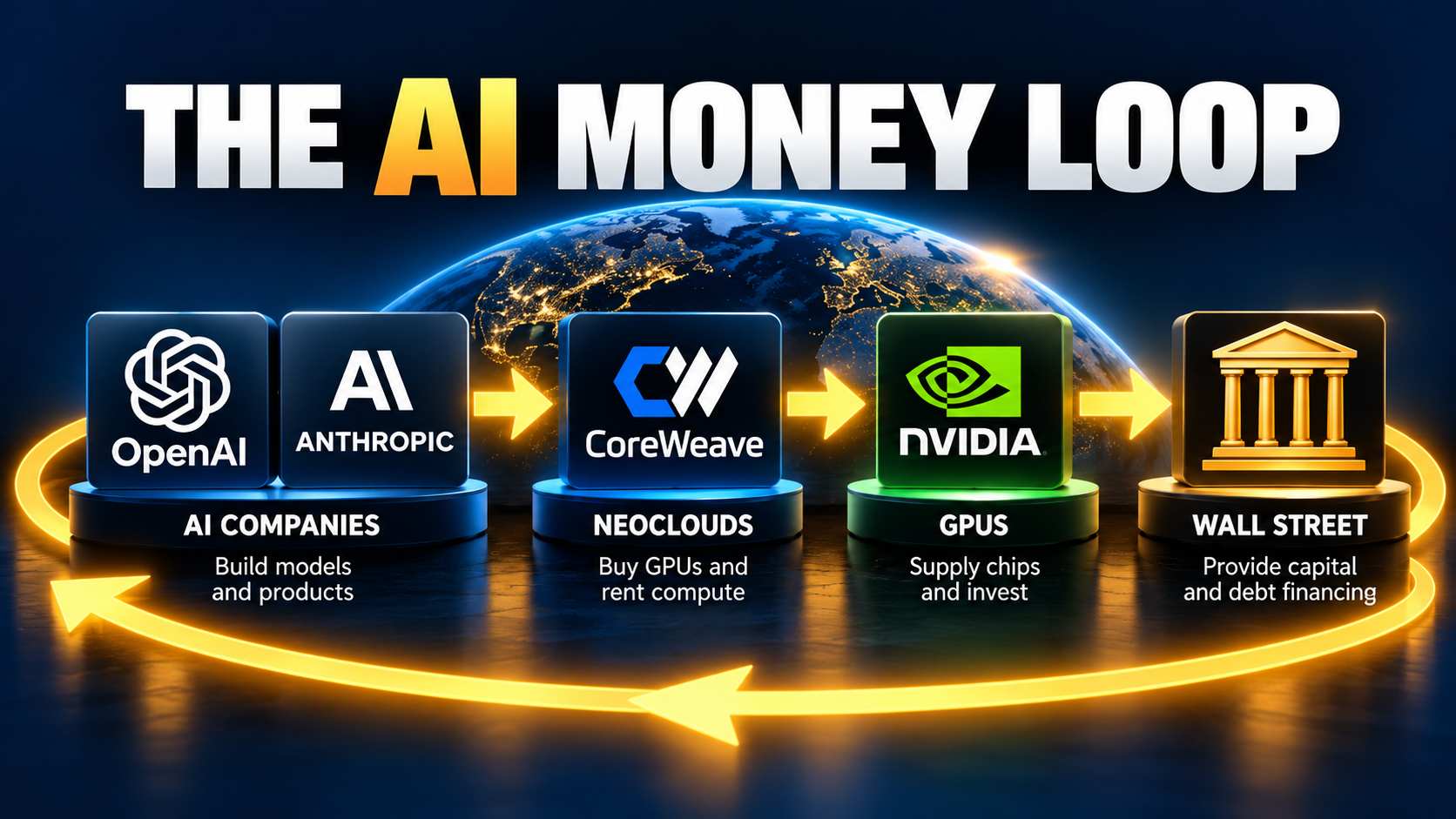
Behind the spending lies an increasingly interconnected financial system. Nvidia invests in companies that buy its chips. Specialized cloud providers, known as neoclouds, borrow billions to buy GPUs and rent computing capacity to AI developers. Wall Street finances the buildout, sometimes using those same GPUs and future customer contracts as collateral.
The money keeps moving. The GPUs keep selling. The debt keeps growing.
But how much of that demand ultimately comes from independent customers paying for AI, rather than investors and lenders financing the next round of expansion?
The AI money loop: Following the billions
To see how this financial system works, start with Nvidia.
The chipmaker has become the primary supplier of the processors needed to train and run advanced AI models. Companies such as OpenAI, Anthropic, Microsoft, Meta, and a growing collection of specialized cloud providers use its GPUs.
Selling those chips is an enormously profitable business. But Nvidia’s role in the AI economy increasingly extends beyond manufacturing and selling hardware.
The company has become an investor, strategic partner, and participant in financing arrangements that help its customers purchase more computing infrastructure.
Consider what happens when an AI infrastructure company needs billions of dollars to build a new GPU cluster.
The company can raise equity from investors, secure loans from banks and private-credit funds, and use the proceeds to purchase Nvidia hardware. Once the GPUs are installed, the company rents computing capacity to AI developers and enterprise customers.
Those customer payments help service the debt and finance additional infrastructure.
The arrangement is straightforward when the customers paying for the compute generate enough revenue to cover the underlying costs.
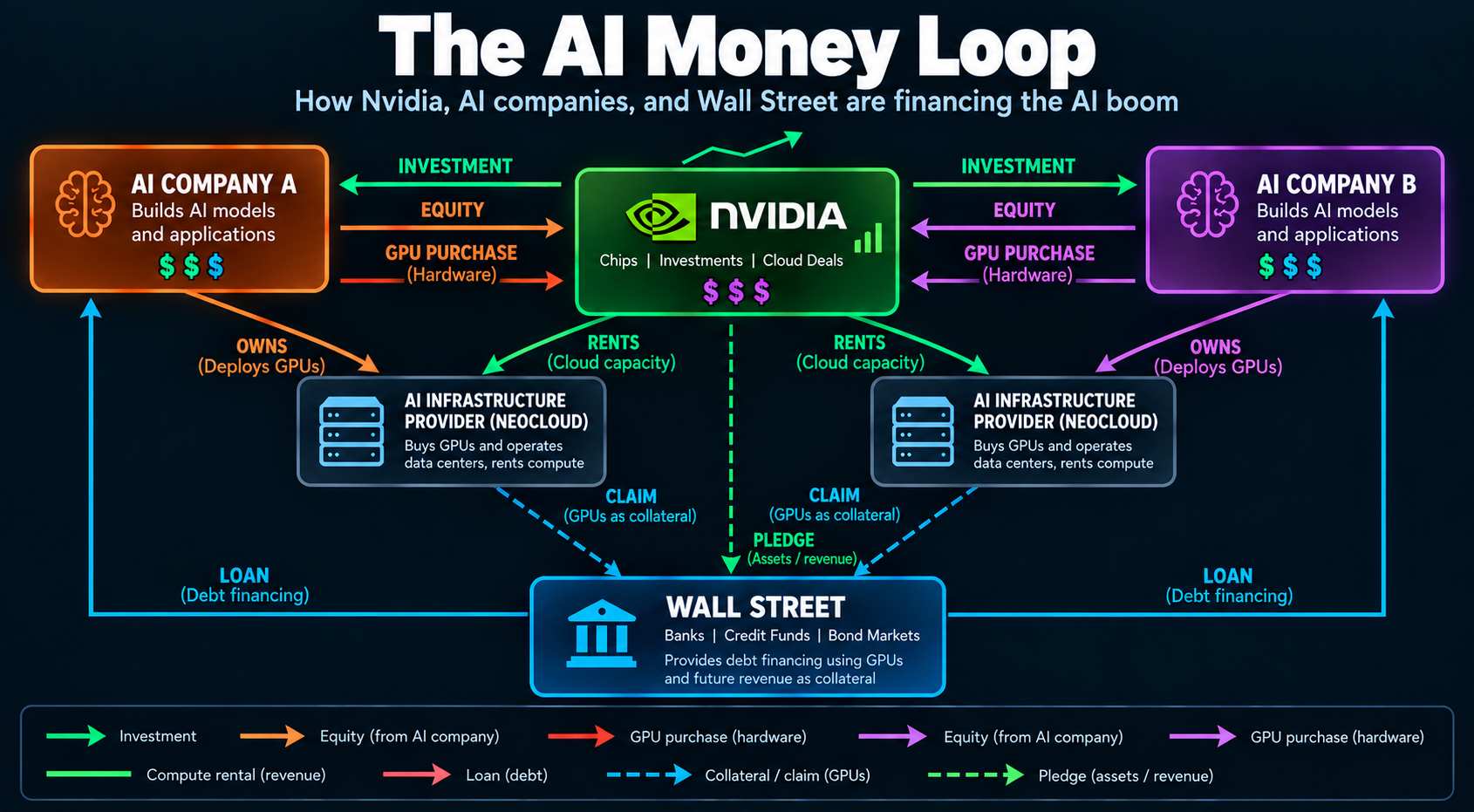
The AI money loop – How Nvidia, AI companies, neoclouds, and Wall Street are financing the AI boom (Click to see larger image)
Things become more complicated when the chip supplier is also an investor in the infrastructure provider, or when the supplier agrees to purchase computing capacity that the provider cannot sell to other customers.
At that point, investment capital and commercial spending can begin circulating among financially connected companies.
The supplier invests in a customer. The customer purchases equipment from the supplier. The supplier may purchase services from that same customer. Lenders finance additional equipment purchases based on expectations that the demand will continue.
These relationships can support legitimate business growth. They can help young companies acquire expensive infrastructure and provide lenders with stronger revenue commitments.
But they can make it harder to determine how much demand comes from independent customers and how much depends on financing arrangements within the AI industry.
That distinction matters when investors are using reported revenue growth to justify increasingly large valuations.
CoreWeave: The neocloud at the center of the financing debate

CoreWeave offers one of the clearest examples of how these relationships work.
The New Jersey-based company began as a cryptocurrency mining operation before shifting into cloud infrastructure optimized for AI workloads. It is now one of the best-known neocloud providers, a category of specialized companies that rent GPU computing capacity to AI developers and businesses.
Unlike Amazon Web Services, Microsoft Azure, and Google Cloud, which operate across a broad range of cloud services, neoclouds concentrate heavily on computationally intensive AI workloads.
Their business model depends on acquiring expensive hardware, securing sufficient electricity and data-center capacity, and keeping their GPU clusters occupied by paying customers.
CoreWeave has built relationships with major AI companies and cloud customers. It has attracted substantial financing to support that growth.
Nvidia is both a supplier and shareholder.
A September 2025 filing with the U.S. Securities and Exchange Commission reveals an arrangement that illustrates the overlapping interests.
Under an agreement initially valued at $6.3 billion, Nvidia committed to purchasing qualifying residual cloud computing capacity that CoreWeave could not sell to other customers. The arrangement runs through April 13, 2032, subject to contractual conditions.
In practical terms, Nvidia agreed to buy certain unused capacity.
For CoreWeave, such a commitment can reduce revenue uncertainty and strengthen the financial case for infrastructure investment.
For Nvidia, it can support the development of a broader market for its chips and help secure access to computing resources.
But the arrangement creates an unusual relationship: the company supplying the hardware is also an investor and a potential customer for computing services delivered using that hardware.
The filing provides no evidence that the agreement is improper. Nor does it establish that CoreWeave’s other customer contracts lack genuine commercial demand.
The concern is how these overlapping relationships affect assessments of independent revenue, financial exposure, and future demand.
And those questions have become more urgent as investors reassess CoreWeave’s debt.
According to Reuters, citing LSEG data, CoreWeave had approximately $50 billion in debt in October. Yields on some bonds climbed to around 15% to 16%, and the cost of insuring its debt against default rose sharply.
A bond yield of 16% does not mean CoreWeave pays that interest rate on its entire debt balance. It reflects the return investors were demanding to hold particular securities at their prevailing market prices.
Still, the signal was difficult to ignore.
Investors were demanding significantly more compensation for exposure to one of the companies helping finance the AI infrastructure boom.
That warns of credit risk, even without evidence of an imminent default.
Wall Street turns GPUs into a new financing asset
The financial stakes extend far beyond CoreWeave.
On August 10, Nvidia announced partnerships with Apollo, BlackRock, Blackstone, Brookfield, Goldman Sachs, and KKR to establish AI infrastructure financing platforms. On August 10, Nvidia announced plans to mobilize more than $500 billion in third-party infrastructure financing over time
That is not $500 billion already committed or deployed. The figure represents the financing capacity Nvidia and its partners aim to assemble through the proposed platforms.
Still, the ambition is remarkable.
Nvidia is helping create financial structures that let institutional investors fund infrastructure built around its hardware.
The business logic is familiar. Infrastructure projects often rely on long-term financing backed by assets and predictable future revenue.
Airports, energy facilities, telecommunications networks, and other capital-intensive businesses use similar arrangements.
The difference is that AI infrastructure relies heavily on computing hardware whose economic value can change dramatically as newer generations become available.
A physical data-center building may remain useful for decades. A GPU purchased today could face competition from far more efficient chips long before the financing used to acquire it is repaid.
That creates a difficult question for lenders.
How much will today’s GPU be worth in three, five, or seven years?
And will it continue generating enough rental income to justify the debt secured against it?
An October 1 Reuters investigation reported that lenders were scrutinizing Nvidia’s assumptions about the productive life of its chips. Nvidia believes leading GPUs can remain commercially useful for years, but lenders often evaluate such hardware using shorter depreciation periods.
Nvidia argues that software improvements, broad customer demand, and the ability to redeploy computing resources can extend their economic usefulness.
Lenders face a different calculation. They need to know what happens when a borrower cannot repay.
If GPU rental rates decline, utilization falls, or newer hardware makes older systems less competitive, collateral value could weaken at precisely the moment lenders need it.
The danger is not simply that AI companies borrow money.
It is that lenders may finance assets whose future earning capacity depends on the same optimistic assumptions driving the industry’s investment boom.
Even Meta’s cash machine is feeling the pressure
Meta’s latest financial results offer another perspective on the enormous cost of the AI buildout.
The social media giant reported negative $2.12 billion in free cash flow during the third quarter of 2026, its first quarterly deficit by that measure since 2012, according to Reuters.
“Meta reported negative free cash flow of $2.12 billion in the third quarter, compared with positive free cash flow of $10.63 billion a year earlier. It was the first cash burn at Meta in more than a decade,” Reuters reported.
The company generated $32.79 billion in cash from operating activities during the quarter.
That distinction is important. Meta’s advertising business remains a substantial source of revenue and cash. Its negative free cash flow reflects the scale of capital spending and finance-lease payments, not an inability to generate operating cash.
Meta reported $33.94 billion in purchases of property and equipment during the quarter, alongside $964 million in principal payments on finance leases.
Its full-year capital expenditure forecast stands at $135 billion to $145 billion.
Meta can afford investment at a scale that most neocloud companies cannot approach. It has an established advertising business, substantial cash reserves, and multiple revenue sources.
Yet even its financial performance illustrates the strain created by the infrastructure race.
For investors, the question is increasingly whether these enormous expenditures will produce returns comparable to the businesses already generating the cash.
Building more computing capacity is one thing. Turning that investment into sustained earnings growth is another.
The Bank of England warns about circular financing
The risk has attracted attention beyond technology investors.
In its July 2026 Financial Stability Report, the Bank of England warned that AI financing arrangements could make the industry more vulnerable to financial shocks.
The central bank identified circular financing as one source of concern, describing situations in which AI companies’ projected revenues may depend partly on financing arrangements connecting suppliers, investors, and customers.
In September, its Financial Policy Committee cited estimates from Morgan Stanley indicating that approximately $450 billion in AI-related debt had been issued globally by early September 2026.
That was more than twice the total issued during all of 2025.
The committee also cited JPMorgan estimates projecting approximately $4.1 trillion in debt-financed AI capital expenditures between 2026 and 2030.
These are analyst estimates and forecasts, not audited amounts already spent.
Their significance is the scale of potential financial exposure.
The committee warned that increasing leverage, opaque transactions, and circular arrangements could make it harder to identify who ultimately bears the financial risk.
That risk could extend into private-credit funds, bond markets, structured financing vehicles, and institutions that may appear removed from the AI industry itself.
A failed AI startup might be a relatively contained problem.
A broader decline in the value of GPU-backed collateral, accompanied by simultaneous stress across multiple heavily indebted infrastructure providers, could have wider financial consequences.
The Bank of England did not conclude that such a crisis was inevitable.
It warned that the financial system’s exposure to AI-related investment is growing, potentially increasing the consequences of a sharp reassessment of expected returns.
Elon Musk predicts a neocloud shakeout
The mounting debt concerns have prompted unusually stark warnings from technology executives.
On October 25, Elon Musk predicted that many specialized AI cloud providers would struggle to survive as financing conditions tightened.
In a post on X, Musk wrote:
“200+ neoclouds are going to see guppy-level death and consolidation. Some will make it through, but not many.”
Pretty much.
As of the past few weeks, debt markets have almost entirely shut off access to money for any company that doesn’t have substantial revenue independent of AI data centers.
SpaceX closed $40B of debt for GPUs, but we’re investment grade and have Starlink & launch revenue.
That means the 200+ neoclouds are going to see guppy-level death and consolidation. Some will make it through, but not many.
— Elon Musk (@elonmusk) October 25, 2026
Musk argued that lenders had become increasingly reluctant to finance companies relying almost entirely on AI data-center revenue.
His warning came as debt markets were reassessing the risks associated with infrastructure providers such as CoreWeave and Nebius.
Musk’s prediction is not evidence that 200 companies will go bankrupt. Consolidation could take several forms, including acquisitions, mergers, restructurings, and failures.
But he is not alone in questioning whether the current number of neocloud providers is sustainable.
On October 14, Gartner projected that more than 80% of neocloud providers could cease operating independently by 2030, citing cost pressures and insufficient differentiation.
The research firm warned that more than $3.5 trillion in AI infrastructure spending could be impaired by the end of the decade under current investment trends.
Gartner estimated that AI data-center owners would need to generate approximately $8.5 trillion in cumulative revenue through 2030 to cover projected investment costs, financing expenses, and an assumed 12% return on invested capital.
It projected substantially less revenue attributable to AI data centers over the same period.
Those figures reflect a forecasting model and its assumptions, not a confirmed future shortfall.
For neocloud operators, the implications are serious.
They must compete for customers against some of the most financially capable technology companies ever created, yet many lack the diversified revenue streams that allow larger cloud providers to absorb extended periods of heavy spending.
A neocloud can have customers and growing revenue and still encounter financial distress if its borrowing costs rise faster than expected or its equipment fails to earn sufficient returns.
But AI demand is real, and the evidence is growing
The simplest version of the AI bubble argument has a major problem.
It overlooks the substantial commercial demand already emerging for AI products.
Anthropic’s October 26 IPO filing provides one of the clearest illustrations.
The company reported about $16.3 billion in revenue in the first six months of 2026, up from about $1.16 billion in the same period a year earlier.
Its customer figures are equally striking.
As of September 30, Anthropic reported more than 11,900 customers generating at least $100,000 in trailing-12-month revenue, including more than 1,900 generating at least $1 million and approximately 250 generating at least $10 million.
These are meaningful commercial relationships, not hypothetical future customers.
The filing demonstrates that enterprises are paying substantial amounts for access to advanced AI models and services.
It does not establish that every customer is earning a positive return on AI spending, nor does it reveal the source of every customer’s budget.
Anthropic’s filing presents another revealing financial contrast.
The company reported a net loss of approximately $80.7 billion for the first half of 2026, but most of that figure reflected noncash changes in the accounting value of convertible securities and related instruments.
Its operating loss was substantially smaller.
That distinction illustrates why investors need to look beyond dramatic headline figures when evaluating AI companies.
Revenue, operating losses, cash spending, infrastructure commitments, and valuation-related accounting charges tell different parts of the financial story.
Stanford University’s 2026 AI Index Report provides broader evidence of adoption.
The report found that 88% of surveyed organizations used AI in at least one business function in 2025.
It also estimated that generative AI delivered $172 billion in annual consumer surplus in the United States by early 2026.
Consumer surplus measures the economic benefits users receive. It is not the same as revenue AI providers earn.
That difference matters.
AI can deliver considerable value to customers without allowing the companies supplying it to capture enough revenue to recover the full cost of their infrastructure.
An employee might save hours using AI coding tools. A business might automate customer support. A consumer might receive valuable assistance from a free chatbot.
Those benefits are real.
The financial question is how much of that value can be converted into profitable revenue for the companies funding the underlying infrastructure.
The biggest risk may be the gap between economic value and financial returns
The AI industry is experiencing two developments simultaneously.
Demand for AI tools and services is growing, supported by genuine commercial adoption.
At the same time, the infrastructure required to serve that demand is attracting extraordinary investment, increasingly financed through debt, long-term commitments, and interconnected business relationships.
The two trends are related, but they are not interchangeable.
A company can generate significant economic value for its customers without producing enough revenue to justify its own valuation.
An infrastructure provider can report growing sales without earning sufficient returns on the capital required to deliver those services.
A chipmaker can see strong demand today, only to watch orders weaken later if customers begin cutting infrastructure spending.
Lenders can also suffer losses on assets that remain technologically useful but no longer generate enough cash to repay the financing used to acquire them.
That vulnerability is at the center of the AI money loop.
When suppliers, customers, infrastructure providers, and financiers are deeply connected, a slowdown in one part of the system can affect the others.
The supplier may lose equipment orders. The infrastructure provider may see rental revenue decline. The lender may discover that the collateral is worth less than expected. The AI developer may lose access to affordable computing capacity.
Each participant has its own business model, but many depend on the same underlying assumption: that future demand for AI will be large enough, profitable enough, and sustained long enough to justify the capital already committed.
None of this proves that AI demand is fabricated or that the industry’s financing structures are inherently unsound.
Some of these investments will generate substantial returns. Others may fail.
The difficult part is determining which revenue streams reflect durable customer demand and which depend heavily on capital continuing to circulate through the same ecosystem.
The AI revolution could succeed even if its financing boom fails
A historical precedent is worth considering. During the late-1990s internet boom, telecommunications companies and equipment suppliers invested heavily in networks built to serve an expected explosion in internet traffic.
The internet did transform the economy.
But many companies that financed the infrastructure never earned the returns investors anticipated.
Excess capacity, aggressive borrowing, and unrealistic revenue expectations contributed to financial losses and corporate failures.
The technology succeeded. Many investments did not.
The AI industry could experience a similar separation between technological progress and financial returns.
AI models could become more capable and useful. Businesses could adopt them across more functions. Computing costs could decline as hardware improves and competition intensifies.
At the same time, some infrastructure providers could face restructuring, acquisitions, or bankruptcy after failing to earn adequate returns on their investments.
For developers and customers, falling compute prices could be welcome news.
For investors holding equity in heavily indebted AI infrastructure companies, the same price declines could undermine the economics behind their investments. The outcome will depend on more than AI models’ capabilities.
It will depend on what customers are prepared to pay, how efficiently computing infrastructure can serve them, how long hardware remains commercially competitive, and whether the companies financing the buildout can meet their obligations.
The Bank of England’s warnings, CoreWeave’s bond-market stress, Meta’s extraordinary capital spending, and Gartner’s projections all point to a financial system making enormous commitments against future AI demand.
Anthropic’s revenue growth and Stanford’s adoption findings show that the demand is far from imaginary.
Both realities can exist at once.
The question isn’t whether AI has value. It’s whether the value AI creates can justify the trillions being spent to build it.
And as Wall Street commits more capital to the AI boom, the answer will matter far beyond Silicon Valley.
Editor’s note: The inspiration behind this investigation
This article was inspired in part by Fireship’s October 28, 2026, YouTube video, “Did the AI bubble just pop?“ In the video, Fireship creator Jeff Delaney uses humor and a visual explanation of circular financing to examine the financial relationships connecting Nvidia, neocloud providers, and Wall Street.
TechStartups independently researched and expanded on those questions using SEC filings, financial disclosures, central-bank reports, and reporting from established news organizations.
We encourage readers to watch Fireship’s original video for an entertaining and accessible explanation of the financial arrangements behind the AI boom.