Startup Funding News Today, October 7, 2026: Nous Research, Monid, Multiply Labs, Quanfluence & More
 Nickie Louise
Posted On October 7, 2026

Startup funding is moving in two directions today. Investors are still pouring money into large AI platforms, but a growing share of capital is also flowing into quantum computing, physical technology, regulated industries, and specialized AI companies where the model is just one part of a much larger product.
The 10 companies selected for today’s report disclosed roughly $231 million in equivalent new funding, led by Nous Research’s $90 million Series B and Multiply Labs’ $75 million Series B. Those two rounds alone account for roughly 71% of the capital. Seven of today’s 10 companies are AI-native or use AI as a central product layer, but the group spans open-source AI agents and robotic drug manufacturing, photonic quantum computing, drones, cardiac diagnostics, clinical trials, financial-services automation, education, and agent infrastructure.
Geographically, the split is striking. Five of the 10 selected companies are based in India, four are U.S.-based, and one is British. Yet the U.S. rounds account for more than 80% of the represented capital because Nous Research and Multiply Labs dominate the dollar total. India’s activity is broader by category: quantum computing, drones, medtech, AI education, and regulated enterprise AI all appear in the same morning.
The strict freshness test also removed several attractive rounds that are still circulating through funding feeds. Melius, for example, announced its $20 million Series A as part of $25 million in total funding, while Ampersand announced its $15 million Series A. Both occurred before the 16-hour window opened, even though later articles made them appear fresh. They are excluded rather than backfilled.
The bigger signal from today’s qualifying deals is not simply that AI continues to attract money. It is that investors are increasingly separating model access from durable company value. Nous is betting on open models plus enterprise distribution. Multiply is putting AI and robotics into factories. Monid is building transaction infrastructure for agents. Cori and Desible are embedding AI inside regulated workflows. Quanfluence is building hardware that could take years to reproduce.
The Macro Environment: AI Splits Into Models, Physical Systems, and Vertical Workflows
The broader venture market remains extraordinarily concentrated. Global startup funding reached $159 billion in the third quarter of 2026, according to Crunchbase, down 25% from Q2 but up 53% from a year earlier. AI companies captured $102 billion, or 64% of all venture capital, while a record 27 startups raised rounds of at least $1 billion. Those 27 companies absorbed roughly one-third of all venture funding during the quarter.
Today’s report looks very different from that mega-round market. No billion-dollar financing appears here, and only two rounds exceed $20 million. Most of the money is going into Seed-through-Series B companies trying to prove a technical advantage can become a durable operating business.
Nous Research sits closest to the model layer, but even its financing tells a more nuanced story. The company is taking an open-source agent that developers can run and modify themselves and pushing it toward enterprise use, where security, support, reliability, integrations, and data control can become paid products. The model may be open; the enterprise relationship does not have to be.
Multiply Labs represents the physical side of the same shift. AI can discover more drug candidates, but discoveries mean little if advanced biologics cannot be manufactured affordably and consistently. Its robots operate where software meets regulated production. Quanfluence is even further down the hardware stack, attempting to assemble photonic chips, control electronics, optics, and software into a quantum computing system.
Then there are the workflow companies. Santé is building around the peculiar operating rules of independent beverage retailers. Desible is building AI agents around banking and insurance regulations. Cori is organizing the scattered evidence and decisions behind clinical trials. Monid is creating a marketplace through which AI agents can buy external capabilities as they need them. The foundation models underneath these products can change; the context surrounding the work is much slower to reproduce.
Nous Research raises $90M to take open-source AI agent Hermes into the enterprise
Nous Research has secured $90 million in Series B funding at a $1.5 billion valuation, according to The Wall Street Journal. Robot Ventures led the round, with Nvidia, Microsoft’s M12, Samsung, and other investors participating.
There is an important freshness distinction here. TechCrunch reported in July that Nous was finalizing a round of at least $75 million at the same valuation, but the financing had not yet closed. Today’s reporting says the company ultimately secured $90 million, making this the completed financing rather than a recycled version of the earlier fundraising discussion. Before the round, Nous had raised roughly $70 million, according to that earlier reporting, which would put cumulative capital at about $160 million.
The startup’s best-known product is Hermes, an open-source AI agent that can browse the web, edit files, write code, and learn additional skills from user activity. The Journal reports that Hermes has been downloaded more than 22.7 million times since February. Nous provides the software openly while offering hosted and premium enterprise services around it
The monetization question is what makes the round interesting. Open-source projects can build enormous developer adoption without capturing much revenue. Nous is trying to turn openness into distribution while charging companies for deployment, security, management, and enterprise features around the model.
Management expects annualized revenue to exceed $100 million by year-end, up from $36 million in mid-September, according to the Journal. That is a company forecast, not realized full-year revenue, and the enterprise push will test whether developer enthusiasm translates into durable corporate spending.
Funding Details
Startup: Nous Research
Investors: Robot Ventures, Nvidia, Microsoft M12, Samsung and others
Amount Raised: $90 million
Total Raised: Approximately $160 million based on previously reported funding
Funding Stage: Series B
Funding Date: October 7, 2026
Headquarters: New York, United States
Sector: Artificial intelligence / open-source AI / AI agents
Valuation: $1.5 billion
Multiply Labs raises $75M to automate the manufacturing bottleneck behind advanced medicines
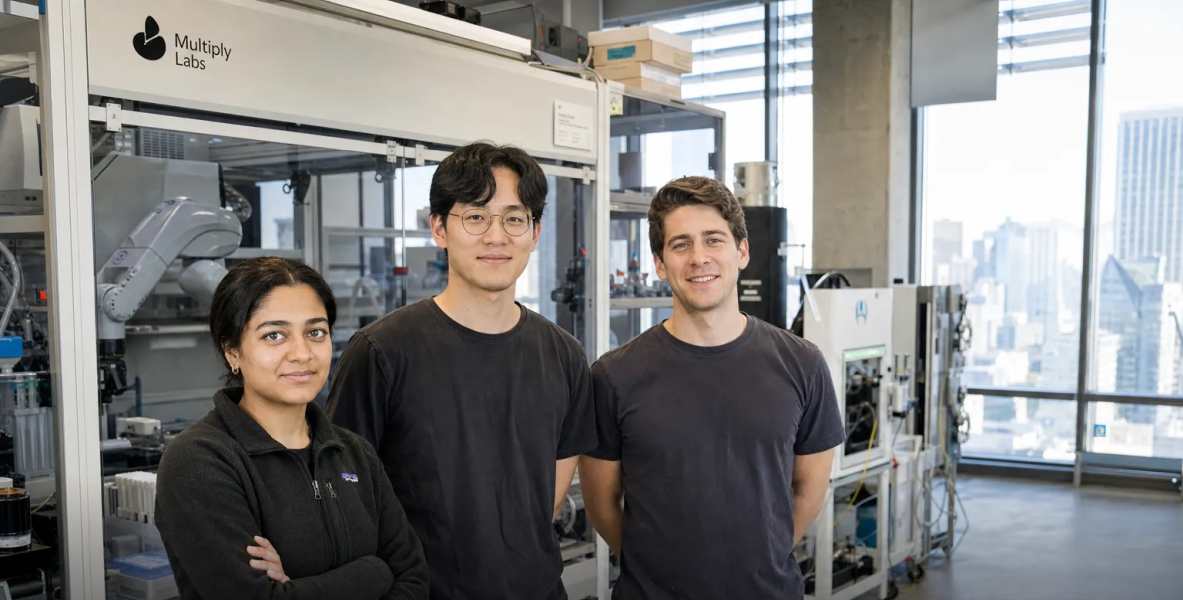
Image Credit: Traded VC
San Francisco-based Multiply Labs raised $75 million in Series B funding led by Dr. Patrick Soon-Shiong and NantWorks, bringing total capital raised to more than $100 million. AstraZeneca, Lingotto, Teradyne, and Strange Ventures joined as new investors, while Casdin Capital, Lux Capital, Fifty Years, Ora Global, and Founders Fund returned.
Multiply builds robotic manufacturing clusters for cell therapies, gene therapies, antibodies, viral vectors, mRNA products, and other biologics. Rather than replacing an entire pharmaceutical factory, its systems work with existing instruments and production processes inside GMP-regulated environments.
The company says its robotic clusters can cut cost per dose by 74% and increase throughput by as much as 100 times compared with manual production. Those figures come from Multiply and will need to prove durable across more commercial deployments, but they illustrate why investors view manufacturing as an increasingly valuable companion market to AI-driven drug discovery.
Drug discovery is getting faster. Manufacturing advanced therapies often is not. Cell and gene therapies still rely on labor-intensive procedures where timing, contamination, documentation, and quality control can determine whether a batch succeeds.
That creates an unusual physical-AI opportunity. The smarter drug-design systems become, the greater the potential mismatch between how many therapies scientists can design and how many manufacturers can actually produce. Multiply bets that robotics will bridge the gap.
Funding Details
Startup: Multiply Labs
Investors: NantWorks, AstraZeneca, Lingotto, Teradyne, Strange Ventures, Casdin Capital, Lux Capital, Fifty Years, Ora Global, Founders Fund and others
Amount Raised: $75 million
Total Raised: More than $100 million
Funding Stage: Series B
Funding Date: October 6, 2026
Headquarters: San Francisco, California, United States
Sector: Robotics / physical AI/biomanufacturing
Valuation: Not disclosed
Santé raises $15M in funding to build an AI operating system for independent beverage retailers
New York-based Santé raised $15 million in Series A funding led by FINTOP, with returning investors Bonfire Ventures, Operator Collective, Y Combinator, and Veridical Ventures participating. The financing follows a $7.6 million Seed round six months ago, bringing disclosed funding to $22.6 million.
Santé combines point-of-sale software, ecommerce, delivery services, inventory, marketing, subscriptions, and embedded financial tools for independent wine and spirits retailers. It layers AI agents over the resulting operating data to handle jobs including purchasing, invoice processing, merchandising, marketing, employee scheduling, and product catalog management.
The vertical looks narrow until the underlying complexity becomes visible. Independent retailers deal with state and local rules, distributor relationships, unusual inventory structures, delivery platforms, keg and bottle tracking, vintages, pricing, and slow-moving stock. Generic retail software often treats those details as edge cases. Santé is trying to turn them into the product.
The company says it now serves nearly 1,000 retailers representing roughly $2 billion in annual GMV and that its business has grown 500%. Those are company-reported figures, but they give FINTOP a tangible reason to double down only months after Santé’s Seed round.
The larger lesson is that vertical AI can become more valuable when it sits on top of the system of record. Santé sees transactions, inventory, customers, invoices, staffing, and ecommerce activity. An outside chatbot sees none of that unless the retailer first gives it access.
Funding Details
Startup: Santé
Investors: FINTOP, Bonfire Ventures, Operator Collective, Y Combinator, Veridical Ventures
Amount Raised: $15 million
Total Raised: $22.6 million
Funding Stage: Series A
Funding Date: October 6, 2026
Headquarters: New York, United States
Sector: Vertical SaaS / retail technology / enterprise AI / fintech
Valuation: Not disclosed
Garuda Aerospace raises nearly $10M in funding ahead of planned IPO
Chennai-based drone company Garuda Aerospace has raised around $10 million in pre-IPO funding at a reported $320 million pre-money valuation, according to The Economic Times, citing people familiar with the transaction. The round was led by the Motherson family office and Dubai-based Aditum Investment Group. Garuda has not publicly confirmed the financing terms, so treat the valuation as reported rather than company-verified.
The financing arrives as Garuda prepares for a possible public listing in the first quarter of 2027. The company confidentially filed IPO documents in April and received observations from India’s securities regulator on August 5, according to ET.
Garuda makes drones and provides drone services across agriculture, infrastructure inspection, mapping, surveillance, and defense. The company has increasingly pushed into defense applications as India seeks greater domestic capability in unmanned systems.
Its operating numbers also add context to the pre-IPO financing. Garuda’s revenue from operations rose about 67% to ₹206 crore in FY26, while net profit increased roughly 41% to ₹26 crore, according to published financial data.
The $320 million pre-money valuation is only modestly above the $250 million valuation reported around an earlier financing. That makes this round less about a huge private-market markup and more about bringing additional institutional capital onto the cap table before a potential IPO.
Funding Details
Startup: Garuda Aerospace
Investors: Motherson family office, Aditum Investment Group, according to ET reporting
Amount Raised: Approximately $10 million
Total Raised: Not disclosed on a fully reconciled basis
Funding Stage: Pre-IPO
Funding Date: Publicly reported October 7, 2026
Headquarters: Chennai, India
Sector: Drones/aerospace / defense technology
Valuation: Reported $320 million pre-money
Quanfluence raises $10M to build a full-stack photonic quantum computer in India
Bengaluru-based Quanfluence raised $10 million in fresh funding led by Chiratae Ventures, with Rainmatter by Zerodha and existing investor Pi Ventures participating. Pi Ventures previously led a $2 million Seed round in 2024, bringing disclosed funding to at least $12 million.
Quanfluence is attempting something far harder than building another software layer on top of existing quantum machines. The company is developing the underlying photonic chips, control electronics, optics, algorithms, and software required for a full computing system.
Its roadmap calls for early processors beginning in 2027 and progressively larger systems by 2029. Quanfluence has already designed and fabricated photonic and electronic integrated circuits and has commercialized a photonic Ising machine used for optimization work, according to the company.
The round therefore represents both a deep-tech bet and a sovereignty bet. Quantum computing is attracting government and strategic attention because the hardware, intellectual property, and supply chains behind it could eventually matter in cryptography, materials, optimization, and scientific computing.
India has historically imported much of its highest-end computing hardware. Quanfluence’s investors are explicitly betting that photonics gives the country a route to building more of the quantum stack domestically rather than consuming systems designed elsewhere.
Funding Details
Startup: Quanfluence
Investors: Chiratae Ventures, Rainmatter by Zerodha, Pi Ventures
Amount Raised: $10 million
Total Raised: At least $12 million disclosed
Funding Stage: Not disclosed
Funding Date: October 7, 2026
Headquarters: Bengaluru, India
Sector: Quantum computing/photonics / deep tech
Valuation: Not disclosed
byteXL raises $9M in funding to embed AI and technology training inside engineering colleges
Hyderabad-based byteXL raised $9 million in Series B funding led by Elevar Equity, with existing investors Kalaari Capital and the Michael & Susan Dell Foundation participating. The company previously raised a $5.9 million Series A in 2024, putting disclosed cumulative funding at at least $14.9 million.
Rather than competing directly in consumer online education, byteXL works with engineering colleges and embeds technology and job-oriented training into students’ existing degree programs. The company currently works with about 60 colleges across 10 states and reaches roughly 200,000 students, according to CEO Karun Tadepalli.
The new capital will support expansion to 120 colleges and 500,000 students across 15 states over the next two years. byteXL also plans to invest in an AI coach and mentor and is experimenting with generative and agentic AI inside its learning platform. Those expansion goals are management targets, not guaranteed outcomes.
Its business model is the more interesting part of the investment case. Consumer edtech often fights expensive acquisition costs and weak retention. Selling through universities shifts distribution into institutions where students remain for several years. byteXL says it is already EBITDA-profitable and expects to reach net break-even this year.
If that holds, Elevar is backing an education company that is scaling AI without relying on the subsidy-heavy direct-to-consumer economics that damaged many earlier edtech businesses.
Funding Details
Startup: byteXL
Investors: Elevar Equity, Kalaari Capital, Michael & Susan Dell Foundation
Amount Raised: $9 million
Total Raised: At least $14.9 million disclosed
Funding Stage: Series B
Funding Date: October 7, 2026
Headquarters: Hyderabad, India
Sector: Edtech / AI learning/workforce skills
Valuation: Not disclosed
Monid raises $7.7M to become the transaction layer between AI agents and external tools
San Francisco-based Monid raised $7.7 million in Seed funding led by Long Journey Ventures, with Madrona, Essence VC, Pioneer Fund, and previous investor 1984 Ventures participating. The financing follows a $2.1 million pre-seed announced on September 1, bringing disclosed funding to $9.8 million.
Monid is building a marketplace and checkout system for AI agents. Instead of developers opening separate accounts, purchasing subscriptions, storing API keys, and managing billing with every tool provider, they can fund one Monid balance. An agent can then search for a capability, compare available tools, call one, and pay per use.
The company launched in April with roughly 200 tools. By September, its catalog had grown to more than 1,700 endpoints from dozens of providers, and Monid said it had processed more than four million agent transactions. Those figures are early company metrics, but they suggest the emerging agent economy is starting to build its own transaction infrastructure.
Monid charges tool-provider pricing plus a 10% platform fee, with entry-level calls costing fractions of a cent. That creates a difficult but interesting economic equation: the platform can become a large business only if machine-to-machine transactions eventually reach enormous volume.
This round matters because it points toward a different software market. Humans currently choose SaaS tools, enter payment details, and decide which API to integrate. Autonomous agents may eventually make some of those choices themselves. If that happens, discovery, pricing, identity, billing, reliability, and permissions become infrastructure for machine buyers.
Funding Details
Startup: Monid
Investors: Long Journey Ventures, Madrona, Essence VC, Pioneer Fund, 1984 Ventures
Amount Raised: $7.7 million
Total Raised: $9.8 million disclosed
Funding Stage: Seed
Funding Date: October 6, 2026
Headquarters: San Francisco, California, United States
Sector: AI infrastructure/agent tools / developer infrastructure
Valuation: Not disclosed
Sunfox Technologies raises $7M to take portable cardiac diagnostics beyond India
Dehradun-based Sunfox Technologies raised $7 million in Series A funding, its largest financing to date. Investors include Ashish Kacholia, Lashit Sanghvi, Alchemy Capital, and 3one4 Capital.
Sunfox makes Spandan, a portable electrocardiogram platform that lets frontline health workers or patients capture heart data and share it with doctors remotely. Its Spandan One software layer supports remote review, case coordination, and tele-ECG networks.
The company says it has deployed roughly 60,000 Spandan devices across more than 20,000 Indian villages, while Spandan One supports screening about five million patients each year. Those deployment figures come from Sunfox. It holds regulatory approvals in India, Ghana, Kenya, Tanzania, and South Africa and is pursuing approvals in the United States and European Union.
For investors, the opportunity is not simply smaller ECG hardware. Cardiac specialists are unevenly distributed, especially outside major cities. A portable device paired with remote review can move part of the diagnostic process closer to the patient without requiring a cardiologist to be physically present.
International expansion will raise a different set of hurdles: clinical validation, regulatory approvals, reimbursement, physician adoption, and competition with established medical-device companies. The Series A gives Sunfox capital to find out whether an Indian deployment model can travel.
Funding Details
Startup: Sunfox Technologies
Investors: Ashish Kacholia, Lashit Sanghvi, Alchemy Capital, 3one4 Capital
Amount Raised: $7 million
Total Raised: Not disclosed on a fully reconciled basis
Funding Stage: Series A
Funding Date: October 7, 2026
Headquarters: Dehradun, India
Sector: Medtech / cardiac diagnostics / remote healthcare
Valuation: Not disclosed
Cori Clinical raises €3.56M to put AI inside clinical-trial design and execution
London-based Cori Clinical raised €3.56 million, roughly $4 million, in Seed funding led by Breega, with Enzo, Heartfelt, Together Ventures, and Bynd participating.
Cori is building an AI workspace intended to connect the many decisions involved in designing and starting a clinical trial. The platform pulls together previous trial knowledge, registries, regulatory guidance, internal documents, budgets, operational assumptions, and protocol decisions into what the company calls a living blueprint.
That may sound administrative, but clinical-trial setup is one of drug development’s expensive bottlenecks. Protocol changes can delay enrollment, increase CRO costs, create additional regulatory work, and extend the time before the first patient is treated.
Cori estimates its system could reduce average trial setup costs by at least 33%, based on its internal modeling. That is not independently verified, and the company remains very early. It does, however, say it is already working with two of the world’s five largest enterprise contract research organizations and with Erasmus MC, where its software supported two neuroscience trials.
The investment thesis resembles other vertical AI businesses in today’s report: the advantage is not simply generating a protocol faster. It is connecting regulatory evidence, prior trial decisions, institutional knowledge, timelines, budgets, and operational consequences in one system.
Funding Details
Startup: Cori Clinical
Investors: Breega, Enzo, Heartfelt, Together Ventures, Bynd
Amount Raised: €3.56 million / approximately $4 million
Total Raised: €3.56 million disclosed
Funding Stage: Seed
Funding Date: October 7, 2026
Headquarters: London, United Kingdom
Sector: Clinical trials/healthcare AI / life sciences software
Valuation: Not disclosed
Desible.ai raises ₹32 crore to turn AI agents into an operating layer for financial services
Bengaluru-based Desible.ai raised ₹32 crore in Seed Plus funding led by Prime Venture Partners, with existing investor Invention Engine participating.
Founded in 2025, Desible builds AI agents for banking, financial services, and insurance companies. The platform currently supports more than 25 workflows across collections, underwriting, customer service, renewals, claims, lead qualification, risk, and compliance, operating across voice, WhatsApp, SMS, and email.
The company says its systems handle more than 10 million customer engagements each month and are being used or evaluated by more than 40 financial institutions. Those are company-reported metrics, but they show why Prime is viewed as more than another voice-AI provider.
Financial services also impose constraints that generic agents are poorly equipped to handle. Desible says disclosures, consent, escalation, and other actions can be bound to predefined rules and audited, with workflows designed around requirements from regulators including the RBI, IRDAI, India’s telecom regime, and data-protection law.
That control layer may become the real product. Banks don’t just need an AI agent that can talk to a customer. They need one that knows when it can act, what it must disclose, when it must stop, and how to reconstruct every step later.
Funding Details
Startup: Desible.ai
Investors: Prime Venture Partners, Invention Engine
Amount Raised: ₹32 crore
Total Raised: Not disclosed
Funding Stage: Seed Plus
Funding Date: October 7, 2026
Headquarters: Bengaluru, India
Sector: Enterprise AI / fintech / insurance technology / agentic workflows
Valuation: Not disclosed
What Today’s Funding Activity Reveals
The first pattern is capital concentration. Nous Research and Multiply Labs account for roughly 71% of the capital represented in today’s top 10. The remaining eight companies span a much wider range of smaller Seed, Series A, and growth financings. That makes October 7 another reminder that aggregate venture totals can hide very different financing markets underneath them.
Second, open-source AI is starting to collide directly with enterprise software economics. Nous can give Hermes away while charging for hosting, management, security, support, and business deployment. If that strategy works, open source does not eliminate enterprise monetization; it shifts where monetization occurs.
Third, physical bottlenecks are attracting capital alongside software intelligence. Multiply is automating factories. Garuda is manufacturing drones. Sunfox is shipping medical hardware. Quanfluence is developing photonic processors. These businesses need factories, regulatory work, supply chains, testing, service networks, and specialized engineering. Their capital requirements are higher, but so are many of the barriers facing new competitors.
Fourth, India’s five appearances matter even though the amounts remain modest compared with Silicon Valley’s largest rounds. The companies are not all copies of U.S. SaaS models. Quanfluence is building quantum hardware. Garuda is moving toward public markets around drones. Sunfox is building medical devices for distributed healthcare. Desible is designing AI around local financial regulation. byteXL is using institutions as its education distribution network. The common thread is technology adapted to market structure rather than technology imported unchanged.
Fifth, agent infrastructure is becoming a category of its own. Nous supplies an agent. Monid supplies the marketplace through which agents can buy tools. Santé embeds agents in commerce workflows. Desible embeds them in financial operations. Cori is building institutional context that AI systems can use when making trial decisions. As agents gain greater autonomy, the surrounding layers — context, permissions, tools, payment, evidence, and auditability — may prove as valuable as the model.
Sixth, today offers almost no broad valuation signal. Nous is priced at $1.5 billion and Garuda is reportedly raising at a $320 million pre-money valuation, while the other eight companies did not disclose pricing. Investors appear more willing to disclose capital raised than the valuations attached to younger companies.
Comparative Funding Table
| Startup | Amount Raised | Sector | Funding Stage | Lead/Key Investors | Country |
|---|---|---|---|---|---|
| Nous Research | $90M | Open-source AI / AI agents | Series B | Robot Ventures, Nvidia, M12, Samsung | U.S. |
| Multiply Labs | $75M | Physical AI/biomanufacturing robotics | Series B | NantWorks, AstraZeneca, Lingotto, Teradyne + others | U.S. |
| Santé | $15M | Vertical SaaS / retail AI/fintech | Series A | FINTOP, Bonfire Ventures, Operator Collective, YC | U.S. |
| Garuda Aerospace | ~$10M | Drones/aerospace / defense tech | Pre-IPO | Motherson family office, Aditum Investment Group | India |
| Quanfluence | $10M | Photonic quantum computing | Not disclosed | Chiratae Ventures, Rainmatter, Pi Ventures | India |
| byteXL | $9M | Edtech / AI learning | Series B | Elevar Equity, Kalaari Capital, Michael & Susan Dell Foundation | India |
| Monid | $7.7M | AI agent infrastructure/developer tools | Seed | Long Journey Ventures, Madrona, Essence VC, Pioneer Fund, 1984 Ventures | U.S. |
| Sunfox Technologies | $7M | Medtech / cardiac diagnostics | Series A | Ashish Kacholia, Lashit Sanghvi, Alchemy Capital, 3one4 Capital | India |
| Cori Clinical | €3.56M (~$4M) | Clinical trials/healthcare AI | Seed | Breega, Enzo, Heartfelt, Together Ventures, Bynd | U.K. |
| Desible.ai | ₹32Cr | Enterprise AI / BFSI automation | Seed Plus | Prime Venture Partners, Invention Engine | India |
Strategic Takeaways for Founders and Investors
- Open source can be distribution rather than a business-model weakness. Nous Research is testing whether a freely available agent can create enough developer adoption to support enterprise hosting, security, management, and support revenue. The company does not need to close Hermes to monetize the organizations deploying it.
- Follow the bottleneck created by the technology boom. AI drug discovery creates more candidate medicines; Multiply is attacking the manufacturing constraint that follows. AI agents need external capabilities; Monid is building the transaction layer. The largest opportunity is often one step downstream from the headline innovation.
- Physical AI requires a different capital model. Multiply, Garuda, Sunfox, and Quanfluence cannot scale purely by hiring more software engineers. Manufacturing capacity, hardware validation, regulatory approvals, inventory, suppliers, and field deployment consume capital, but they can also create barriers that software competitors cannot cross quickly.
- Context is becoming more defensible than model access. Santé accumulates retail transaction and inventory history. Desible embeds financial rules and institutional workflows. Cori connects protocol decisions to clinical and regulatory evidence. byteXL sits inside university curricula and student learning histories. The same foundation model may be available to every competitor; the operating context is not.
- Agents create demand for an entirely new software stack. If AI systems increasingly choose tools and act autonomously, markets will emerge around tool discovery, permissions, identity, payments, auditing, reliability, and orchestration. Monid may be early, but its financing shows investors are already placing bets on machine-to-machine commerce.
- Sovereign deep tech is becoming investable. Quanfluence is not merely selling India access to somebody else’s quantum machine; it is trying to build domestic photonic hardware. Garuda is moving deeper into Indian drone manufacturing. As governments place more value on control over strategic computing and defense technologies, local ownership of the stack can become commercially relevant.
- Institutional distribution still matters. byteXL sells through colleges, Sunfox works through healthcare networks, Santé becomes the operating system of retailers, and Desible integrates with banks and insurers. Distribution built inside existing institutions is difficult for a new AI interface to displace overnight.
Conclusion
October 7 is not another day dominated by a single multi-billion-dollar AI financing. That makes the underlying investment pattern more revealing.
Nous Research is testing whether open-source AI can become a major enterprise business. Multiply Labs is taking intelligence into the factory that produces advanced medicines. Quanfluence is assembling an indigenous quantum stack. Monid is building commerce infrastructure for machines. Santé, Cori, byteXL, and Desible are putting AI inside specific operating environments, while Garuda and Sunfox are pairing software with physical systems.
The capital is still following AI, but investors are becoming more specific about where the durable value sits.
Model capability can spread quickly. A manufacturing process, a regulated workflow, proprietary operating history, institutional distribution, specialized hardware, trusted data, or a network of integrations does not.
That is increasingly where today’s venture money is going.