Zuckerberg’s Biohub lands Google and U.S. Government backing for $1.8 billion AI biology push
 Daniel Levi
Posted On October 7, 2026
Mark Zuckerberg’s Biohub has pulled Google, Meta, and the U.S. government into a $1.8 billion effort to generate the biological data needed to train AI systems that can predict how living cells behave.
The project, called the Virtual Biology Initiative, is aiming at one of AI’s hardest scientific problems: building models capable of simulating cells closely enough that researchers can test ideas digitally before committing years of lab work and millions of dollars to physical experiments.
Biohub says the combined commitment is the greatest coordinated effort yet to generate AI-ready biological data.
“Biohub, the U.S. Department of Energy, the National Institutes of Health, and new funding partners today announced a major expansion of an international effort to generate and make accessible the data enabling predictive AI models of biology. Together, the organizations are investing $1.8 billion in funding, data, computation, and new measurement technology, the largest coordinated commitment to generating AI-ready biological data to date,” Biohub said in a news release.
The money comes from several directions. Google DeepMind, Isomorphic Labs, and Meta are committing a combined $300 million. The U.S. Department of Energy plans to invest more than $500 million over five years in laboratory measurement, modeling, computation, and cell research. The National Institutes of Health will bring datasets and repositories developed through more than $500 million in previous federal funding.
Biohub itself committed $500 million to the initiative in April.
That takes the total commitment to roughly $1.8 billion across funding, existing datasets, computing resources, and new measurement technologies.
AI needs far more biological data
The bet is straightforward: AI has made major progress in protein structure, drug discovery, and other areas of computational biology, but predicting an entire living cell is a much bigger problem.
Current datasets contain information on hundreds of millions of cells. Biohub researchers believe useful predictive models may require data covering billions, then eventually trillions, of cells and cellular states.
“We need to capture the language of biology; we need to capture the language of the cell. And that doesn’t exist today,” Biohub Head of Science Alex Rives told Reuters.
The initiative plans to collect data showing how cells respond to changes in their environment, genetic modifications, drugs, and other interventions. Techniques will include spatial transcriptomics, advanced microscopy, cryo-electron tomography, and large-scale cellular screening.
The goal is to give AI systems enough high-quality biological observations to predict what happens inside a cell after a particular intervention.
“An accurate predictive model of biology could dramatically accelerate scientific discovery by enabling scientists to perform experiments digitally. The insights that come from this could unlock a far greater understanding of disease and open up completely new paths for cures,” Rives said.
That vision turns biological research into something closer to simulation. A scientist could ask a model how a cell might respond to a drug or genetic change, then use the answer to narrow the experiments worth testing in a lab.
Biohub expects the first dataset from the project in roughly a year and says accurate predictive models could emerge within five years.
The datasets are expected to become public, though private companies funding some of the work will receive temporary early-access periods before those datasets are released more broadly. Government-funded data will not carry the same restrictions, according to Biohub.
The effort is attracting some of the biggest names in AI and science. Google DeepMind has spent years developing AI systems for biology, including AlphaFold. Isomorphic Labs is applying AI to drug discovery. NVIDIA is providing computing infrastructure and technical support. Research organizations involved include the Broad Institute, the Allen Institute, the Human Cell Atlas, the Human Protein Atlas, the Gladstone Institutes, and the Wellcome Sanger Institute.
Other AI labs are moving deeper into biology too. Anthropic has built out wet-lab capabilities, and the OpenAI Foundation has launched a grant program worth more than $125 million aimed at biological and medical datasets.
Biohub’s project goes after a bottleneck that money and bigger models alone cannot solve: AI cannot learn biological behavior that scientists have never measured.
If the initiative succeeds, one of the next major AI breakthroughs may come less from building a larger model and more from giving existing models a vastly richer picture of how life actually works.
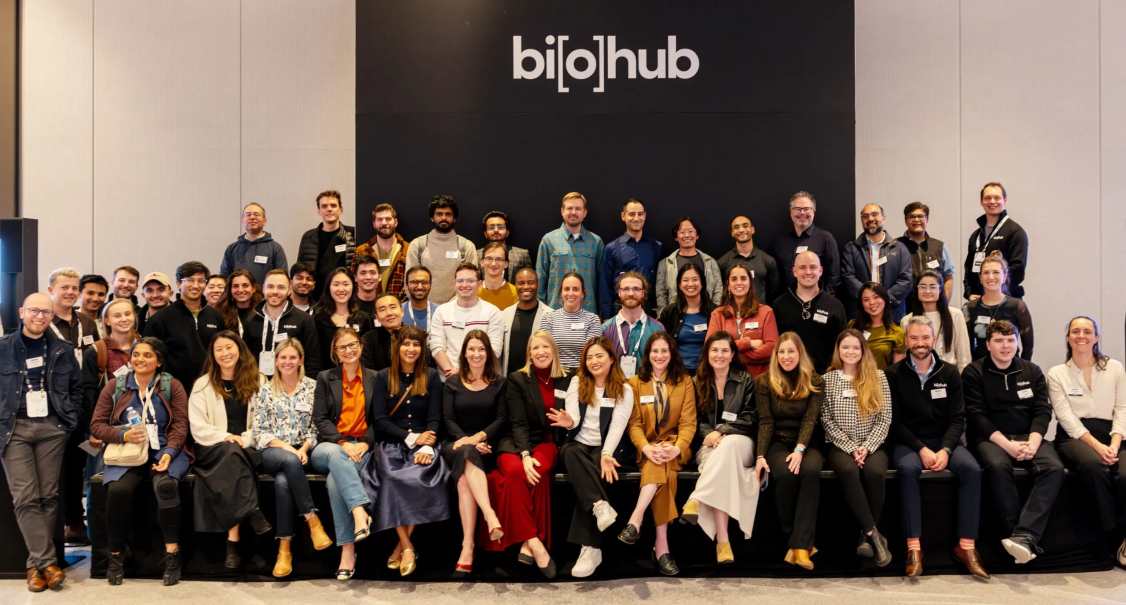
BioHub team