Parents are using ChatGPT to create their kids’ school photos instead of paying up to $60 for traditional photo packages
 Daniel Levi
Posted On October 6, 2026

Parents looking to cut the cost of school picture day are turning to ChatGPT, using ordinary smartphone photos to create polished school portraits that resemble the ones families have purchased for decades.
According to USA Today, parents are photographing their kids against a plain wall, uploading the image to ChatGPT, and asking the model to regenerate it “like a school picture,” complete with the familiar gradient backdrops used by school photography companies such as Lifetouch.
“Parents are taking to social media to share affordable “hacks” for do-it-yourself-style school portraits. Some snap a smartphone photo of their kids in front of a white wall before uploading the photo to a software like ChatGPT, asking the chatbot to regenerate the photo “like a school picture,” USA Today reported.
The trend picked up steam on TikTok after Carlie Bond shared how she used the same approach for her three children. Fast Company reported that the video drew responses from parents frustrated by the cost of buying school photos for multiple children, which can easily push a family’s bill above $100. Traditional school-photo packages typically run about $25 to $60 per child, with some costing more.
Those costs can add up quickly.
USA Today reported examples ranging from $43 to $65 for school photo packages. A family buying portraits for three children could easily spend more than $100 each year, particularly when digital downloads and printed copies are included.
For parents already carrying a smartphone and access to an AI image generator, that price gap is creating an obvious alternative.
AI gives parents another option for school picture day
School photography has long relied on scale. Companies send photographers into schools, photograph hundreds of students, process the images, organize them by classroom, prepare yearbook files, print packages, and distribute the finished photos.
That process carries real costs.
Photographers must be paid, equipment transported, images corrected, orders processed, prints produced, and packages delivered. Some schools receive commissions from picture sales, adding another layer to the economics behind the annual ritual.
AI removes much of that process for parents who simply want a nice portrait of their child.
A phone camera already captures a high-quality source image. Generative AI can handle the background and presentation. Families can print later through a retailer or skip printing entirely if they only want a digital copy.
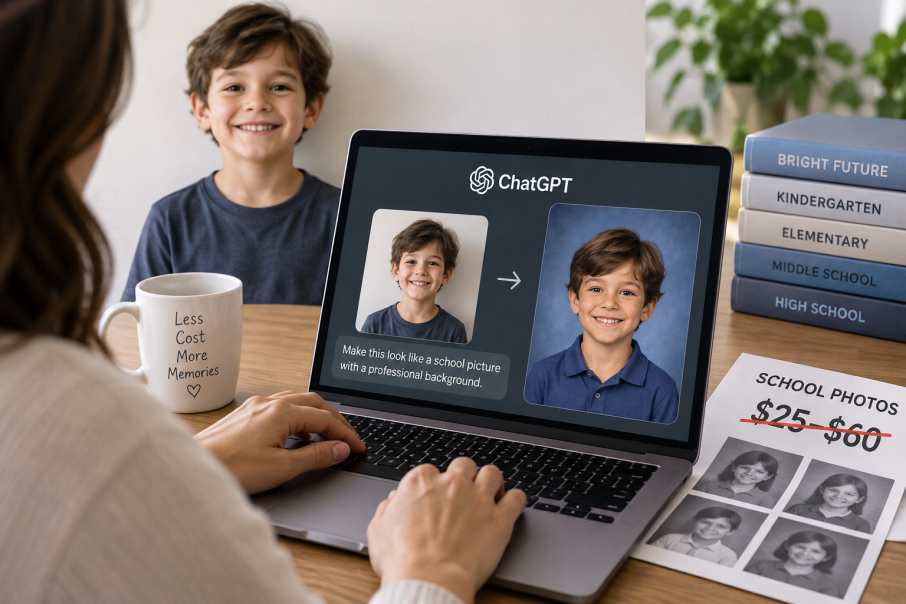
A parent uses ChatGPT on a laptop to turn a casual photo of a child into a polished school-style portrait, with a school photo pricing sheet nearby highlighting the cost savings. (Image credit: TechStartups with ChatGPT)
The result is a small example of how generative AI is changing consumer spending. Rather than replacing an entire industry at once, AI can remove individual transactions that people previously paid for out of habit or convenience.
School pictures fit that pattern unusually well. Families have bought them for generations, yet the final product is highly standardized. That makes the category particularly easy for AI to imitate.
There is an important line between creating a photo and removing a watermark
Some parents are taking a different route, and that approach carries legal risks.
Social media posts have encouraged people to upload watermarked school photo proofs to AI tools and ask the software to remove the photographer’s logo.
“Parents, if you wanna save some money, get your children’s school pictures and (upload) them to ChatGPT. Ask (ChatGPT) to remove the logos and bam! Thank me later,” one TikTok account shared in a video, according to USA Today.
However, attorneys cited by USA Today said removing those watermarks can violate federal copyright law.
The distinction matters.
A parent taking a new photo of a child at home and using AI to create a school-style portrait is creating a new image from material the parent owns. Removing a watermark from an unpaid professional photograph involves an image whose copyright belongs to the photographer or photography company.
Another tradeoff parents may need to weigh is privacy.
Uploading a child’s photograph to an AI service means sending that image to the company’s systems. OpenAI says uploaded files can remain associated with a conversation until the user deletes it, and deleted chats may remain in its systems for up to 30 days, according to OpenAI’s ChatGPT retention policy. Whether content is used to improve models can depend on the product and the user’s data settings.
That may give some families pause.
Still, the popularity of the school-photo workaround points to something larger than picture day. AI image tools are becoming good enough that ordinary consumers can recreate products and services they once had little choice but to buy.
For parents staring at another $60 school photo package, that change is suddenly very tangible.