The U.S. government is offering startups up to $1.55 million in funding and taking 0% equity. Here’s how to apply
 Daniel Levi
Posted On October 6, 2026

Quick Highlights
Three funding tracks:
- Phase I: Up to $305,000 to prove technical feasibility
- Phase II: Up to $1.25 million to further develop the technology
- Fast-Track: Up to $1.55 million, combining both phases in one proposal
Who can apply:
- U.S.-based small businesses with fewer than 500 employees
- At least 51% owned and controlled by U.S. citizens or permanent residents, subject to NSF eligibility rules
- Companies that meet NSF ownership requirements, including restrictions on certain VC, private equity, and hedge fund ownership structures
- Funded R&D must be performed in the United States
How it works:
- Start with a 3-page Project Pitch
- NSF reviews the pitch and invites qualifying companies to submit a full proposal
- Next full proposal deadline: November 4, 2026
The U.S. government is offering qualifying startups up to $1.55 million in non-dilutive funding through the National Science Foundation, with no equity taken and no claim on the company’s intellectual property.
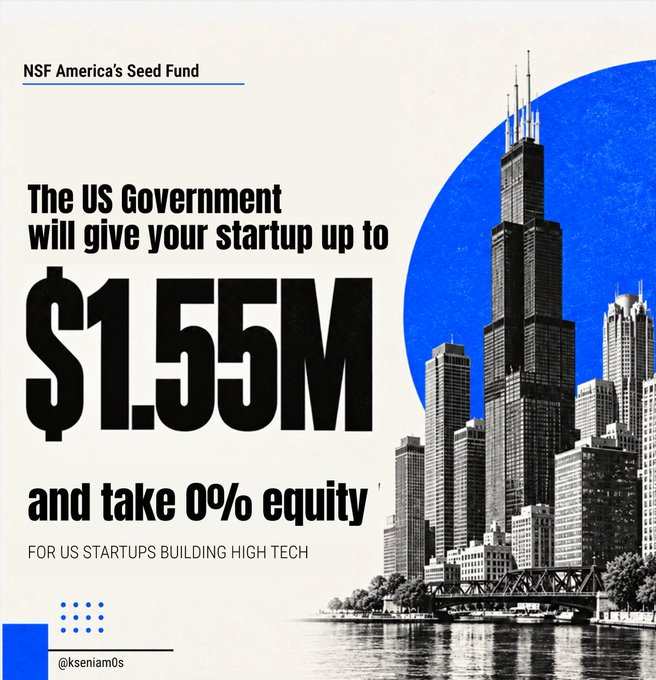
The US government will give your startup up to $1.55M and take 0% equity.
The money comes through NSF’s relaunched Small Business Innovation Research and Small Business Technology Transfer programs, better known as America’s Seed Fund. NSF restarted the programs in May with $250 million in funding for U.S. startups and small businesses developing high-risk technologies with commercial potential.
For founders, the appeal is straightforward. This is R&D funding, not venture capital. NSF says award recipients keep full ownership of their companies and intellectual property.
The standard Phase I program provides up to $305,000 for projects lasting six to 18 months. Companies that move on to Phase II can seek up to $1.25 million for further development. NSF’s Fast-Track program combines the two stages into one proposal, with up to $400,000 for the Phase I portion and up to $1.155 million for Phase II, bringing the total to roughly $1.55 million.
Who qualifies for NSF startup funding?
The program is aimed at U.S.-based small businesses with fewer than 500 employees, including affiliated companies. At least 51% of the business must be owned and controlled by U.S. citizens or permanent residents, or qualifying U.S.-owned small businesses. Funded R&D must take place in the United States.
The company’s principal investigator must spend the majority of their working time employed by the startup during the funded project. NSF does not require the PI to hold an advanced degree.
One big distinction founders need to know.
The headline $1.55 million Fast-Track route is reserved for a narrower group of companies. Applicants need qualifying NSF-funded research from the past five years, recent formal customer-discovery training such as I-Corps, a complete team, and an invitation from NSF after submitting a Fast-Track Project Pitch.
Startups without that background can still pursue the regular Phase I path, which can lead into Phase II funding later.
Here’s how to apply
The process starts with a Project Pitch instead of a full grant proposal.
Founders submit a short overview describing the technology, the technical risk involved, the problem it addresses, and its potential commercial or societal impact. NSF reviews the pitch and decides whether the company should move forward. Startups considered a fit receive an official invitation to submit a full Phase I proposal. America’s Seed Fund
That screening step can save founders from spending weeks preparing a full federal grant application for a project NSF is unlikely to fund.
Companies invited to continue must complete the required federal registrations and submit their proposal through Research.gov. NSF says Project Pitch reviews typically take about one to two months, with funding decisions arriving about six months after a full proposal is submitted. America’s Seed Fund
The next full-proposal deadline is November 4, 2026, at 5 p.m. in the submitting organization’s local time. Future deadlines are scheduled for March 4 and July 7, 2027.
Competition is real. NSF expects roughly 180 SBIR Phase I awards and 50 STTR Phase I awards per year under the current solicitation. Fast-Track is much smaller, with about 15 SBIR awards and three STTR awards expected annually.
For a technical founder facing the usual choice between raising venture capital and stretching limited runway, the tradeoff is unusual: federal money to prove the technology, with the cap table left untouched.