Anthropic launches Claude Opus 5.5, claims it beats OpenAI’s GPT-5.6 Sol at one-third the cost
 Daniel Levi
Posted On September 23, 2026
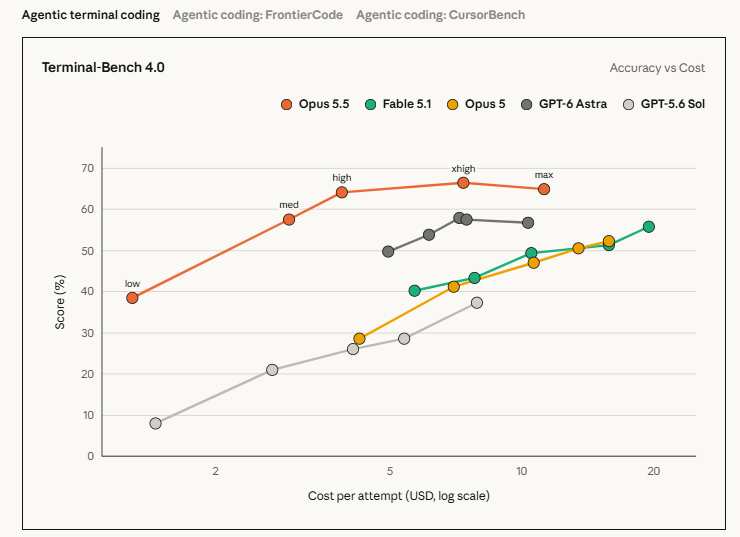
Anthropic launched Claude Opus 5.5 on Tuesday, taking another swing at OpenAI with a new flagship AI model that the company says can beat GPT-5.6 Sol on a software development benchmark at roughly one-third the cost.
The new model arrives with another big selling point: Anthropic says typical workloads cost about 40% less to run than with Opus 5. That matters in an AI market where model performance keeps climbing, but the cost of putting frontier models to work across large companies remains a major constraint.
Opus 5.5 is priced at $4 per million input tokens and $20 per million output tokens, 20% below Opus 5. Cache reads cost $0.20 per million tokens, a 60% reduction. Anthropic says the model generates output more than 30% faster than its predecessor.
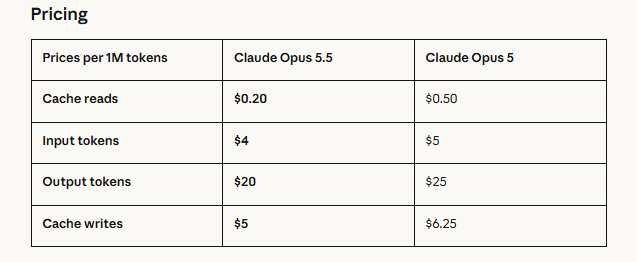
Opus 5.5 Token Pricing
The company is positioning Opus 5.5 as its new leading model, with performance comparable to its top-tier Claude Fable 5.1 across some demanding tasks.
“Claude Opus 5.5 is our first release since we called for pacing the frontier. It was tested before release by external evaluators, including Frontier Design and METR. On our automated behavioral audit, the most comprehensive alignment test we run, Opus 5.5 is the strongest-performing model we’ve tested to date. It also comes with the safeguards we’ve developed for our most capable models,” Anthropic said in a blog post.
Anthropic pushes price and coding performance
Anthropic says Opus 5.5 scored higher than OpenAI’s GPT-5.6 Sol on a software development benchmark and cost roughly one-third as much to run in that test. Benchmark results don’t necessarily translate directly to every real-world workload, but the claim points to where the AI model race is heading: performance per dollar is becoming almost as important as raw capability.
Early testing cited by Anthropic produced some striking results. One tester reportedly used Opus 5.5 to complete a 680,000-line code migration in less than a day. In another test, the model successfully reduced load times across every page of a web application in 39 out of 40 attempts. Anthropic said Opus 5 made smaller improvements and sometimes changed the application’s behavior.
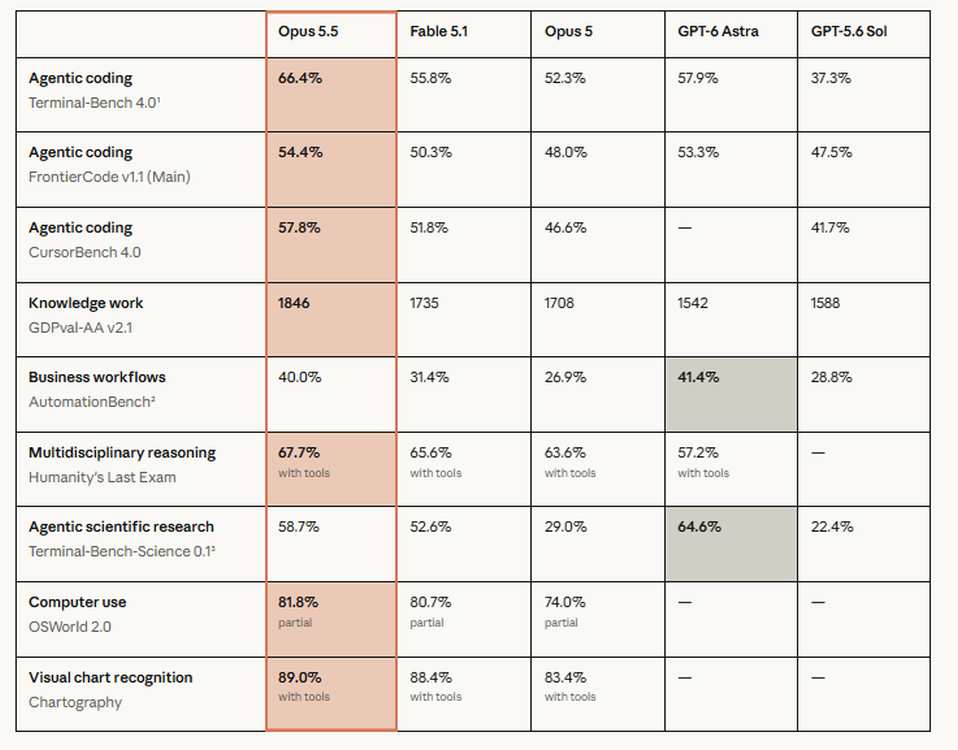
Opus 5.5 Benchmark Performance
The economics could prove just as consequential. AI companies have spent years chasing larger models and higher benchmark scores. Enterprises deploying agents and coding systems face a different calculation. A model that can complete the same work using less compute can translate into significant savings once usage reaches billions of tokens.
Opus 5.5 is available through Anthropic and major cloud platforms, including Amazon Web Services, Google Cloud and Microsoft Azure. The company is increasing five-hour usage limits for Pro, Max, Team and seat-based Enterprise subscribers.
A frontier model released amid calls to slow the frontier
The launch carries an unusual tension. Anthropic CEO Dario Amodei earlier this month called on the global AI community to slow the release of new capabilities as concerns grow over the risks posed by increasingly capable AI systems.
Anthropic is making safety central to its case for releasing Opus 5.5.
Independent AI safety research groups Frontier Design and METR evaluated the model before launch. Anthropic says Opus 5.5 recorded the strongest results yet on its automated behavioral audit, a suite involving thousands of simulated scenarios used to test model behavior and alignment.
The company said Opus 5.5 was about 85% less likely than Opus 5 or Mythos 5.1 to attempt to bypass containment boundaries in a dedicated evaluation. Anthropic says the model is more resistant to prompt injection and less likely to take actions that are difficult to reverse or fall outside instructions it has been given.
Those results come from Anthropic’s own testing framework and should be read as company-reported findings rather than independent proof that the model is safer across every deployment. External testing by Frontier Design and METR adds another layer of scrutiny before release, Reuters said.
Anthropic is applying safeguards similar to those used for Claude Fable 5.1, citing comparable capabilities in biology and cybersecurity. Vetted life-sciences researchers can apply for broader access through the company’s verification program, with expanded access for verified cybersecurity practitioners planned in the coming weeks.
The company says Claude Sonnet 5.5 and Claude Haiku 5.5 are next, with both models expected in the coming weeks.
Opus 5.5 points to a shift in the frontier AI race. Bigger benchmark numbers still matter, but model makers are now fighting over something customers can measure directly on their bills: how much useful work each dollar of compute can buy.