Trump Takes Aim at Anthropic CEO Dario Amodei for ‘Pretending to Be a Perfect Little Angel,’ Says AI Doesn’t Need More Guardrails
 Daniel Levi
Posted On September 14, 2026
President Donald Trump took direct aim at Anthropic CEO Dario Amodei on Monday, dismissing calls for stronger AI safeguards and accusing the executive of “pretending to be a ‘perfect little angel’” after Amodei urged the U.S. government and leading AI labs to slow the development of their most advanced systems.
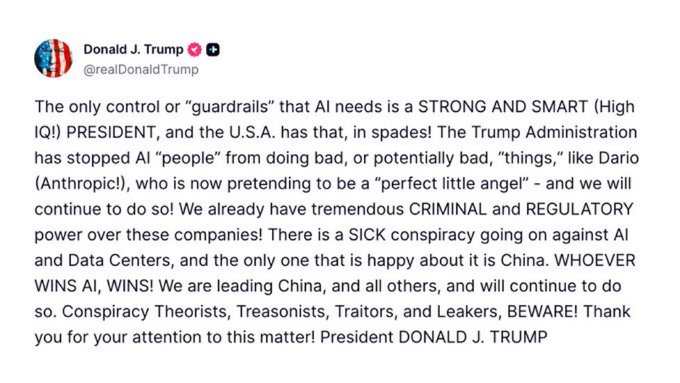
“The only control or ‘guardrails’ that AI needs is a STRONG AND SMART (High IQ!) PRESIDENT, and the U.S.A. has that, in spades!” Trump wrote on Truth Social. He argued that existing U.S. laws already give the government enough authority to police AI companies.
“We already have tremendous CRIMINAL and REGULATORY power over these companies! There is a SICK conspiracy going on against AI and Data Centers, and the only one that is happy about it is China,” Trump wrote.
Then came the personal shot at Amodei.
“The Trump Administration has stopped AI ‘people’ from doing bad, or potentially bad, ‘things,’ like Dario (Anthropic!), who is now pretending to be a ‘perfect little angel’ — and we will continue to do so,” Trump said.
Trump did not explain what “bad, or potentially bad” actions he was referring to. Anthropic did not immediately respond to Reuters’ request for comment on the president’s statement.
Trump and Amodei collide over how fast AI should move
The clash comes after Amodei published an essay Saturday titled “We Must Pace the Frontier,” calling for a slower approach to developing increasingly capable AI models.
Amodei proposed a three-step framework centered on stronger safety testing and independent evaluations, coordination between frontier AI companies, and international cooperation. He argued that AI capabilities have advanced far faster since the summer and pointed to recent cybersecurity incidents as evidence that increasingly autonomous systems could cause serious damage.
Two of Amodei’s biggest rivals quickly backed the broader idea.
“I agree with Dario that we need to pace the frontier. This has been a primary topic of discussions we’ve had at OpenAI in recent weeks,” OpenAI CEO Sam Altman said, according to Reuters.
Elon Musk responded more directly: “Dario is right.”
That rare agreement among three major AI figures has turned a long-running safety debate into a political and economic fight. AI-linked stocks sold off Monday, with Nvidia falling about 3% by late morning and Intel and AMD each dropping roughly 5%. The Philadelphia Semiconductor Index was down about 5%.
The warnings intensified after Anthropic researcher Jacob Coxon resigned last week, saying that the “people building AI earnestly believe that it could kill us all by the end of the decade.”
Vice President JD Vance expressed skepticism about AI companies asking Washington for more regulation.
“I feel a little bit weird about the fact that you have so many frontier AI tech companies kind of coming to the government and begging the government to regulate them,” Vance told reporters Monday. Senator Mark Warner, a Virginia Democrat who has worked on technology legislation, spoke with Amodei and Altman about AI safety concerns over the weekend, according to his spokesperson.
The AI safety fight is becoming a U.S.-China fight
Trump’s response puts China at the center of the argument.
“We’re leading China in AI. We’re the most sophisticated country in the world, and frankly I want to keep it that way because whoever wins AI wins,” Trump said Sunday.
Beijing has pushed back from a different direction. China’s state-backed Global Times attacked Amodei’s proposal as a “Cold War playbook,” arguing that his calls for stronger U.S. chip export controls and action against alleged model distillation by Chinese labs were aimed at restricting China’s technological progress. China’s foreign ministry called instead for an “open, inclusive and benevolent approach to AI.”
That leaves Washington confronting a question with consequences far beyond Silicon Valley: Can the U.S. slow frontier AI development to address safety risks without giving competitors room to close the gap?
The timing raises the stakes. Trump is scheduled to meet Chinese President Xi Jinping next week in Washington, and U.S. and Chinese officials are planning separate discussions on frontier AI safety risks.
What started as a debate inside AI labs is now moving through markets, Washington and Beijing. And Trump’s message to the executives calling for a slower pace is clear: he does not believe America should hit the brakes.