Samsung backs Dutch AI chip startup Euclyd in $231M funding round to challenge Nvidia
 Daniel Levi
Posted On September 15, 2026

Samsung is putting money behind a new attempt to loosen Nvidia’s grip on AI computing.
Dutch AI chip startup Euclyd has raised more than €200 million, about $231 million, in a Series A round co-led by Samsung, Somerset Capital Partners, EQT-managed Scaleup Europe Fund, and Innovation Industries. The Eindhoven-based company plans to build an AI inference system around a chip-and-memory architecture that takes a different path from the GPUs that have come to dominate artificial intelligence.
Founded in 2024 by Bernardo Kastrup and Atul Sinha, Euclyd is going after one of the biggest problems facing the AI industry: the growing cost and energy demands of running increasingly capable models.
“AI is becoming a foundation of economic growth, scientific discovery, and national competitiveness, but its potential will remain constrained unless we fundamentally change the infrastructure beneath it,” said Bernardo Kastrup, Founder and Chief Executive Officer of EUCLYD. “This financing accelerates our mission to make intelligence abundant through greater efficiency, lower cost per token, and broader access to advanced AI.”
That pitch arrives at a good time. Nvidia turned GPUs, chips once best known for gaming, into the computing engine behind the generative AI boom. Its success has left cloud giants and startups searching for other ways to train and run AI models, particularly as data centers consume more electricity and companies spend billions of dollars building AI infrastructure.
Euclyd is focused on inference, the work that happens when a trained AI model processes requests and generates responses. The company says its approach combines custom processors, memory architecture, and data-center systems to lower energy use and the cost of producing AI tokens.
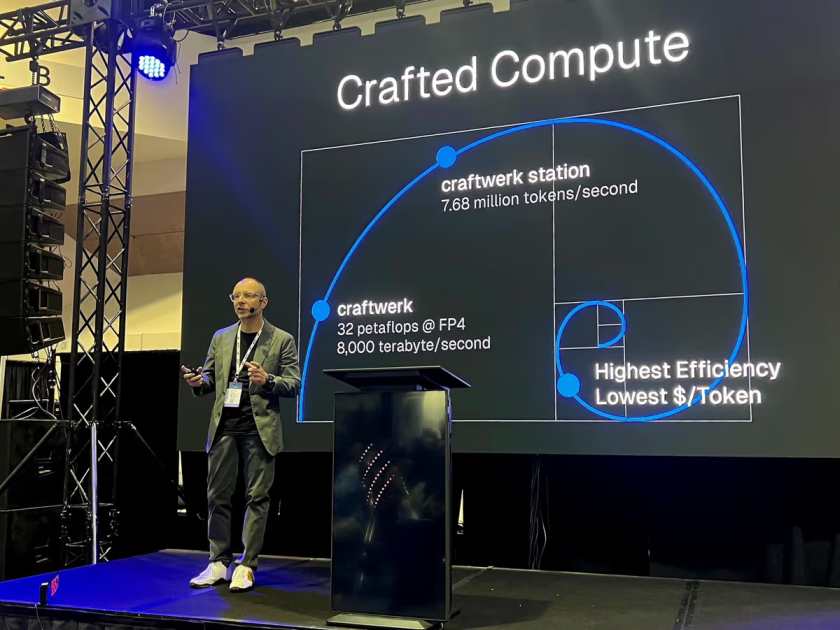
Crafted Compute (Image Credit: Euclyd)
Samsung brings more than a check
Samsung’s involvement could prove more valuable than its share of the funding round.
“Samsung can help us in more ways than money,” Kastrup said. “They are one of the biggest memory manufacturers in the world. They do a lot of engineering, they know a lot about systems, they know the supply chain, they have a huge network.”
That relationship gives Euclyd access to expertise in an area becoming increasingly important to AI computing. Memory bandwidth and chip packaging can determine how efficiently processors handle large AI workloads, making memory suppliers an important part of the race to build alternatives to GPU-based systems.
The funding comes as Samsung deepens its ties across the AI chip industry. The Korean electronics giant is working with OpenAI on next-generation chips and is expected to supply memory for the Stargate data-center project, CNBC reported.
Euclyd has another semiconductor heavyweight in its corner. Peter Wennink, the former CEO of Dutch chip-equipment giant ASML, is joining the startup as chairman of its board.
The company plans to make money in two ways. It wants to sell physical rack systems to enterprises that prefer to run AI inference on their own infrastructure, and license its intellectual property to companies building their own chips.
The bigger question is whether the technology works as promised outside the lab.
Euclyd’s systems have yet to prove themselves at scale in commercial deployments, putting considerable distance between the startup’s ambitions and Nvidia’s position today. Euclyd plans to begin rolling out physical chip systems in 2028 and hopes to serve thousands of enterprise customers by 2030.
That makes Euclyd a potential Nvidia challenger, rather than an established rival.
Still, a $231 million Series A backed by Samsung gives the two-year-old startup considerable resources to test its thesis. Nvidia owns the dominant position in AI computing today. Euclyd is betting that the next chapter of AI infrastructure won’t be built entirely around GPUs.