Venture Capital & Startup Funding Roundup, May 19, 2026
 Nickie Louise
Posted On May 19, 2026
Nickie Louise
Posted On May 19, 2026

The venture capital landscape on Tuesday, May 19, 2026, is defined by an aggressive transition from model experimentation to industrial-scale deployment. This shift, colloquially termed the “Agentic Infrastructure Super-Cycle,” follows a historic first quarter where global venture investment surged to $300 billion, representing nearly 70% of the total capital deployed in all of 2025.
Today’s deal flow underscores a broader market thesis: the most significant value is no longer being captured by foundational models, but by the physical and institutional layers required to operationalize them.
The Macro Environment: Capital Concentration and Physical Intelligence
The current funding climate is characterized by a “flight to quality” and an unprecedented concentration of firepower. In the first quarter of 2026, just four companies—OpenAI, Anthropic, xAI, and Waymo—accounted for 65% of all global venture investment. This concentration has created a secondary market of highly specialized infrastructure providers. As frontier labs reach valuations approaching $730 billion, investors are pivoting toward the “intelligence-per-watt” paradigm, prioritizing hardware-intensive sectors, robotics, and aerospace.
This shift is partly driven by geopolitical necessity. The tightening of U.S.-China relations has accelerated the “reshoring” of manufacturing, creating a massive opportunity for startups providing on-demand, AI-driven production of hardware components. Furthermore, the energy bottleneck—characterized by 10-year wait times for grid interconnection—has made grid optimization and frontier energy systems top-tier venture categories.
Armada Raises $230M Series B for Sovereign AI Infrastructure
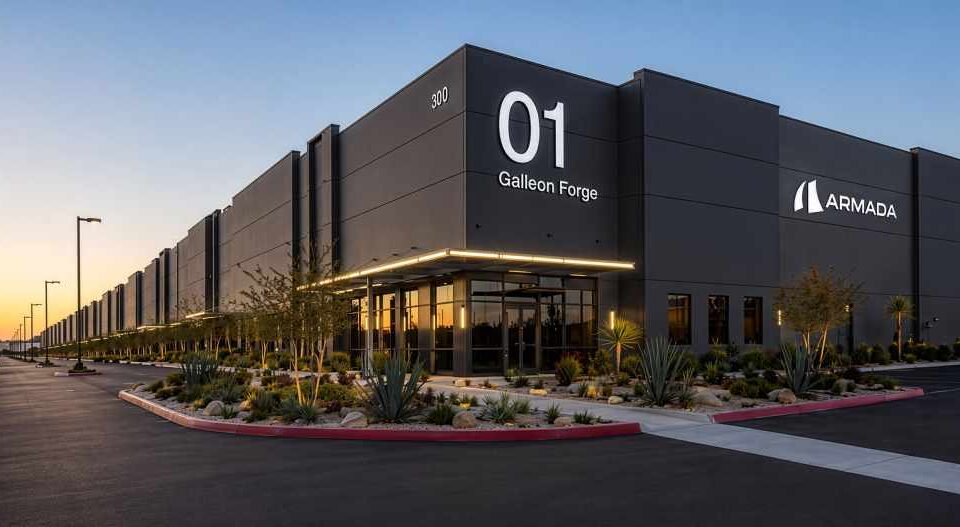
Armada, the company building modular AI data centers designed for remote environments, has closed a $230 million oversubscribed Series B round co-led by Overmatch, BlackRock, and 8090 Industries. The round values the company at $2 billion and brings its total funding to nearly $0.5 billion. Alongside the raise, Armada announced a global framework agreement with Johnson Controls to produce modular data center systems at a dedicated 400,000-square-foot factory in Arizona.
Armada’s technology addresses the “infrastructure gap” by deploying mobile, megawatt-scale modular data centers (Leviathan) that can operate beyond the walls of traditional hyperscale facilities. This is critical for industrial, energy, and defense sectors operating in remote areas—such as oil fields, mines, or U.S. Navy ships—where centralized cloud infrastructure is unavailable or limited. By providing localized compute at the edge, Armada enables organizations to run high-density AI training and inference workloads with speed, scale, and data sovereignty.
The strategic partnership with Johnson Controls provides Armada with thermal management expertise and a global manufacturing footprint. As the AI race shifts toward the physical ability to manufacture and deploy hardware, Armada is positioning itself as a foundational layer of the Western AI technology stack.
Funding Details
-
Startup: Armada
-
Investors: Overmatch (Co-lead), BlackRock (Co-lead), 8090 Industries (Co-lead), Johnson Controls, NightDragon, Mitsui, Singtel Innov8, Felicis, Marlinspike, Shield Capital, Lux Capital, Founders Fund, Silent Ventures, Veriten, Gladebrook
-
Amount Raised: $230M
-
Total Raised: nearly $500M
-
Funding Stage: Series B
-
Funding Date: May 19, 2026
Radar Raises $170M Series B to Modernize Retail Inventory Intelligence

Radar, the AI-powered retail intelligence platform, has reached a $1 billion valuation following a $170 million Series B funding round. Co-led by Gideon Strategic Partners and Nimble Partners, the round supports the global deployment of Radar’s proprietary hardware, which uses ceiling-mounted sensors and RFID technology to track inventory with 99% accuracy.
The strategic importance of Radar lies in its ability to solve the “last mile” of inventory visibility. Traditional retail inventory accuracy typically hovers around 65-70%, leading to billions in lost sales and high order-cancellation rates in omnichannel services. Radar’s technology has demonstrated the ability to drop cancellation rates for “buy online, pick up in store” (BOPIS) services from 25% to just 3%, providing a clear ROI for major retailers like Old Navy and American Eagle.
Beyond replenishment, Radar is emerging as a critical tool for loss prevention. The system provides a real-time audit of supply chain deliveries, allowing managers to flag shipment discrepancies immediately. One pilot location reported a 60% reduction in “shrink.” As physical retail continues to integrate AI, Radar is becoming the foundational sensory layer for the “smart store” of the future.
Funding Details
-
Startup: Radar
-
Investors: Gideon Strategic Partners (Co-lead), Nimble Partners (Co-lead), Align Ventures
-
Amount Raised: $170M
-
Total Raised: $233M+
-
Funding Stage: Series B
-
Funding Date: May 19, 2026
Senkatason Secures $110M for Rapid Custom Manufacturing
Senkatason, a leader in on-demand custom manufacturing, has raised $110 million in a round led by Sequoia Capital and Paradigm Capital, achieving a $1 billion unicorn valuation. The startup focuses on the hardware-intensive components required for AI data centers, robotics, and aerospace, reporting annual revenue of $200 million.
The funding reflects a significant pivot in venture capital trends, as firms direct capital toward tangible manufacturing enterprises rather than pure-play software projects. Senkatason’s success is a direct consequence of the “reshoring” movement. As businesses seek alternatives to international supply chains amid tightening U.S.-China relations, Senkatason provides a domestic solution that integrates rapid delivery systems—akin to Amazon’s—into industrial manufacturing.
The company plans to use the new capital to expand its operations across multiple states, positioning itself as the primary provider of the mechanical infrastructure that underpins the digital economy. In a market where speed-to-market is the ultimate competitive advantage, Senkatason’s ability to deliver precision-engineered parts at software development speeds is a transformative development for the hardware industry.
Funding Details
-
Startup: Senkatason
-
Investors: Sequoia Capital (Lead), Paradigm Capital (Lead)
-
Amount Raised: $110M
-
Total Raised: Unspecified
-
Funding Stage: Venture Round
-
Funding Date: May 19, 2026
Nourish Raises $100M Series C for Metabolic Health Infrastructure
Nourish has secured $100 million in Series C funding to scale its AI-powered metabolic healthcare platform. Led by Menlo Ventures, the round brings the company’s total equity funding to $215 million. Nourish provides dietitian-led virtual care, using AI to manage the administrative and diagnostic burdens of metabolic health management.
Metabolic health has become a focal point of the modern healthcare crisis, with conditions like diabetes and obesity driving a disproportionate share of healthcare spending. Nourish’s platform uses AI to automate the translation of lab data and nutritional habits into actionable care plans, allowing a single dietitian to manage significantly more patients than a traditional clinic.
This scalability is critical as both private insurers and government health programs move toward value-based care models. By focusing on metabolic health—the “root cause” of many chronic diseases—Nourish is building the infrastructure for a more efficient and effective healthcare system. The participation of blue-chip investors like Index Ventures and J.P. Morgan Growth Equity Partners signals a long-term conviction in the company’s ability to dominate the personalized nutrition category.
Funding Details
-
Startup: Nourish
-
Investors: Menlo Ventures (Lead), Thrive Capital, Index Ventures, J.P. Morgan Growth Equity Partners, Maverick Ventures, Y Combinator, BoxGroup, Atomico, Daybreak, Operator Partners
-
Amount Raised: $100M
-
Total Raised: $215M
-
Funding Stage: Series C
-
Funding Date: May 19, 2026
Moment Raises $78M Series C for Institutional Investment AI
Moment, the fintech platform developing an “AI operating system” for investment management, has raised $78 million in Series C funding. Led by Index Ventures, the round follows a $36 million Series B raised less than a year ago and brings the total reported equity funding to $134 million.
Moment’s platform integrates trading, portfolio management, and compliance into a unified data model. The core value proposition is the deployment of AI agents that can safely and effectively execute workflows traditionally requiring a large workforce of analysts and operations staff. By providing a “unified data model” and regulatory-grade controls, Moment allows financial institutions to modernize their core infrastructure without compromising on security or governance.
The demand for such an operating system is high among large financial institutions struggling with fragmented legacy systems. Moment’s modular design allows these firms to progressively unlock AI capabilities as their internal governance frameworks evolve. This “infrastructure-first” approach to AI in finance is seen as more sustainable than the standalone chatbot solutions that defined the early wave of generative AI.
Funding Details
-
Startup: Moment
-
Investors: Index Ventures (Lead), Andreessen Horowitz, Avra
-
Amount Raised: $78M
-
Total Raised: $134M
-
Funding Stage: Series C
-
Funding Date: May 19, 2026
Viktor Raises $75M Series A for Slack-Integrated AI Coworkers
Viktor has secured $75 million in a Series A round led by Accel. The company provides an “AI coworker” service that lives in Slack and Teams, connecting to over 3,000 workplace tools, such as Google Drive, Meta Ads, and Notion, to automate operational work.
The round featured an extraordinary list of angel investors, including the co-founders of Slack, Stewart Butterfield and Cal Henderson, as well as the founder of Vercel and executives from DeepMind and Figma. Viktor’s success lies in its choice of interface. Embedding AI within the communication tools employees already use minimizes adoption friction.
Viktor is a key player in the “agentic productivity” space, where the goal is not just to answer questions but to “do the work.” The platform is used to create reports, dashboards, and recurring automations across a company’s existing business systems. This “background automation” is expected to save companies millions of dollars in operational costs.
Funding Details
-
Startup: Viktor
-
Investors: Accel (Lead), Bek Ventures, Kaya VC, Inovo VC, Tenacity Capital, Stewart Butterfield, Cal Henderson, and others
-
Amount Raised: $75M
-
Total Raised: $80M+
-
Funding Stage: Series A
-
Funding Date: May 19, 2026
GridCARE Raises $64M Series A to Accelerate Data Center Deployment
GridCARE has announced a $64 million Series A round led by Sutter Hill Ventures to scale its AI-powered platform, designed to identify and activate underutilized power grid capacity. Large-scale AI data centers often face interconnection timelines of six to ten years; GridCARE aims to compress these timelines to months.
The platform uses physics-based AI to evaluate quadrillions of grid conditions in real-time—modeling congestion, outages, and demand variability—to identify capacity that traditional processes cannot detect. By optimizing existing grid capacity, GridCARE helps data center developers secure available power for their facilities without the need for immediate, costly infrastructure upgrades.
This investment establishes “Power Acceleration” as a new category focused on delivering power infrastructure for the AI economy. GridCARE is currently engaged in projects to accelerate power for over two gigawatts of new AI compute capacity across more than a dozen markets.
Funding Details
-
Startup: GridCARE
-
Investors: Sutter Hill Ventures (Lead), Emerson Collective, Future Energy Ventures, National Grid Partners, John Doerr, Stanford University
-
Amount Raised: $64M
-
Total Raised: $77.5M
-
Funding Stage: Series A
-
Funding Date: May 19, 2026
Lexroom Raises $50M Series B for Civil-Law Legal AI
Milan-based legaltech firm Lexroom has secured a $50 million Series B funding round led by Left Lane Capital. Lexroom builds AI tools specifically for lawyers and corporate legal teams operating in civil law jurisdictions, which rely on codified statutes rather than the case precedent of common law systems used in the U.S. and UK.
The platform is built on a proprietary database of more than six million verified legal documents designed to eliminate “hallucinations.” Every output cites a traceable source, addressing a critical pain point for attorneys who cannot risk fabricating citations. Lexroom plans to use the fresh capital to expand its data-first infrastructure into Spain and Germany.
The raise marks a significant challenge to U.S. legal-AI giants, as Lexroom targets the structural gap that generic models leave across continental Europe. By focusing on localized legal datasets and multilingual reasoning, Lexroom is positioning itself as the essential infrastructure for the one million lawyers operating within European civil law systems.
Funding Details
-
Startup: Lexroom
-
Investors: Left Lane Capital (Lead), Base10 Partners, Eurazeo, Acurio Ventures, Entourage, View Different
-
Amount Raised: $50M
-
Total Raised: over $73M
-
Funding Stage: Series B
-
Funding Date: May 19, 2026
Unframe Raises $50M Series B for Managed AI Delivery
Unframe, a managed AI delivery platform, has closed a $50 million Series B round led by Highland Europe, bringing its total funding to $100 million. Founded in 2024 by former Noname Security executives, the company has hit $100 million in total contract value (TCV) within just 12 months of its formal launch.
Unframe’s platform, “The Framery,” addresses the “pilot purgatory” problem where enterprise AI projects stall before reaching production. By plugging directly into a customer’s existing systems and data, Unframe turns business requirements into tailored, production-ready AI applications in days. The platform is model-agnostic and can be operated in the customer’s cloud, on-premises, or as a managed service.
The company’s rapid growth is reflected in its 400% net revenue retention. The new capital will be used to expand delivery capacity, deepen technological investment, and strengthen the management team as Unframe scales its model for enterprise-grade AI deployment.
Funding Details
-
Startup: Unframe
-
Investors: Highland Europe (Lead), Bessemer Venture Partners, Craft Ventures, TLV Partners, Third Point Ventures, Cerca Partners, Vintage Investment Partners
-
Amount Raised: $50M
-
Total Raised: $100M
-
Funding Stage: Series B
-
Funding Date: May 19, 2026
bunch Raises $35M Series B to Modernize Private Market Operations
bunch, a Berlin-based fintech developing an AI-native fund operations platform, has raised $35 million in Series B funding led by Portage. The platform provides end-to-end infrastructure for European asset managers, replacing fragmented, manual processes with a “single source of truth” for the entire fund lifecycle.
bunch’s platform handles digital investor onboarding, capital calls, fund administration, and tax reporting. The system is specifically designed to handle unstructured fund documentation, extracting relevant data in a traceable way for human oversight. The company grew its ARR by 300% in 2025, demonstrating the high demand for operational scalability in private markets.
With over $58 million raised, bunch now has the resources to expand its commercial reach across Germany, the UK, and Luxembourg. As private markets scale faster than the legacy infrastructure supporting them, bunch is positioning itself as the structurally necessary operating layer for the next decade of alternative assets.
Funding Details
-
Startup: bunch
-
Investors: Portage (Lead), Illuminate Financial, Motive Partners, Cherry Ventures, Fintech Collective
-
Amount Raised: $35M
-
Total Raised: over $58M
-
Funding Stage: Series B
-
Funding Date: May 19, 2026
Cross-Sector Analysis: The Interplay of Energy, Compute, and Capital
The funding activity of May 19 reveals a deep interdependence between seemingly disparate sectors. The energy bottleneck on the terrestrial grid (addressed by GridCARE’s $64 million Series A) mirrors the energy constraints in orbit (addressed by Star Catcher). This confirms that the “energy layer” is the current frontier of venture capital, effectively replacing the “model layer” as the primary constraint on growth. As AI models scale, the physical limit is no longer just intelligence, but the joules required to sustain it.
Comparative Valuation Dynamics (Selected Mid-Market Deals)
| Startup | Amount Raised | Valuation (Post-Money) | Focus Area |
| Radar | $170M | $1.0B | Retail Inventory |
| Senkatason | $110M | $1.0B | Custom Manufacturing |
| Suno | $250M | $2.45B | Generative Audio |
| Function Health | $298M | $2.5B | Health Diagnostics |
| Viktor | $75M | Unspecified | AI Coworkers |
This table illustrates the emergence of a “Hardware/Diagnostic Premium.” Both Radar and Senkatason achieved unicorn status with relatively efficient funding rounds compared to the massive capital requirements of foundation model labs. This suggests that investors are increasingly seeking “capital-efficient” moats where proprietary hardware and specialized data create barriers to entry that pure-play software cannot replicate.
The Institutionalization of the Agentic Era
The massive capital inflows for industry leaders and specialized platforms like Moment ($78M) reflect the “institutionalization” of AI. The market has moved past the initial wave of consumer curiosity and simple productivity gains. In mid-2026, the focus has shifted to the “plumbing” of the global economy. Whether it is Eisen’s escheatment automation ($10 million Series A) or bunch’s fund operations platform ($35 million Series B), capital is being deployed to replace fragmented, manual processes with AI-native infrastructure.
This trend is also visible in the cybersecurity space. Ocean Security’s recent $28 million raise for AI-agent-led email defense illustrates the shift from basic pattern matching to proactive intent analysis. As AI-powered attacks evolve, the only viable defense is an AI-powered agent capable of investigating and mitigating threats in real time.
The Role of Tier-1 Law Firms and Legal Precedent
The stability of this funding environment is underpinned by a robust legal and professional services ecosystem. Cooley, recently reaffirmed as the #1 law firm globally for venture capital representations, facilitated nearly $40 billion in venture financing in Q1 2026 alone. This institutional support is critical as the industry navigates complex regulatory challenges, from emerging “zero-day” AI cyber threats to ongoing intellectual property disputes.
The most significant event for the VC community occurred on May 18, when a federal jury in Oakland ruled in favor of Sam Altman and OpenAI, finding them not liable in Elon Musk’s breach-of-trust lawsuit. By dismissing claims that sought to disrupt OpenAI’s structure and redirect massive capital, the verdict provides a decisive “green light” for the company’s planned $1 trillion IPO. This legal clarity serves as a necessary prerequisite for the “mega-rounds” observed today, as it defines the boundaries of corporate governance in the era of AGI development.
Strategic Implications: The Move Toward “Physical Intelligence”
The recurring theme across current funding announcements is “Physical Intelligence.” Whether it is the 99% accuracy of Radar’s ceiling-mounted sensors, the on-demand production of aerospace parts by Senkatason, or the optical power beaming of Star Catcher, the venture community is finally addressing the “atoms” of the economy.
This shift is driven by the realization that while software can scale infinitely, its utility is constrained by the physical infrastructure it runs on. For AI to truly transform the world, it requires sensors to perceive the environment (Radar), manufacturing to build components (Senkatason), and reliable power to operate (GridCARE, Star Catcher). The current funding cycle is a systematic effort to build those essential, tangible layers.
Tech Funding Summary Table (May 19, 2026)
| Startup | Investors (Lead + Notable) | Amount Raised | Total Raised | Funding Stage | Funding Date |
| Armada | Overmatch, BlackRock, 8090 | $230M | nearly $500M | Series B | May 19, 2026 |
| Radar | Gideon Strategic, Nimble | $170M | $233M+ | Series B | May 19, 2026 |
| Senkatason | Sequoia, Paradigm | $110M | Unspecified | Venture Round | May 19, 2026 |
| Nourish | Menlo Ventures, Thrive | $100M | $215M | Series C | May 19, 2026 |
| Moment | Index Ventures, a16z | $78M | $134M | Series C | May 19, 2026 |
| Viktor | Accel, Slack Co-founders | $75M | $80M+ | Series A | May 19, 2026 |
| GridCARE | Sutter Hill Ventures | $64M | $77.5M | Series A | May 19, 2026 |
| Lexroom | Left Lane, Base10, Eurazeo | $50M | over $73M | Series B | May 19, 2026 |
| Unframe | Highland Europe, Bessemer | $50M | $100M | Series B | May 19, 2026 |
| bunch | Portage, Illuminate | $35M | over $58M |
Conclusion: The Maturity of the Venture Ecosystem
The funding reports for Tuesday, May 19, 2026, indicate a venture ecosystem that has moved past the “hype” phase of generative AI and is now focused on building the industrial foundations of the next economy. The sheer scale of capital being deployed—from the multi-billion-dollar units at the frontier labs to the high-conviction rounds in hardware and infrastructure—reflects a market betting on a permanent shift in how value is created.
The move toward “tangible” intelligence, high-fidelity diagnostics, and frontier energy infrastructure suggests that the next generation of giants will be those that can master the interface between the digital and the physical. As the legal landscape clarifies and the “agentic infrastructure” matures, the primary challenge for these startups will no longer be technical feasibility, but the speed and reliability of their global deployment. The $300 billion Q1 surge was not an anomaly; it was the starting gun for a multi-year super-cycle that is fundamentally reordering the hierarchy of global industry.