Google launches Gemini 3.5 Flash and Omni world model at I/O 2026 as AI race with OpenAI heats up
 Daniel Levi
Posted On May 20, 2026
Daniel Levi
Posted On May 20, 2026
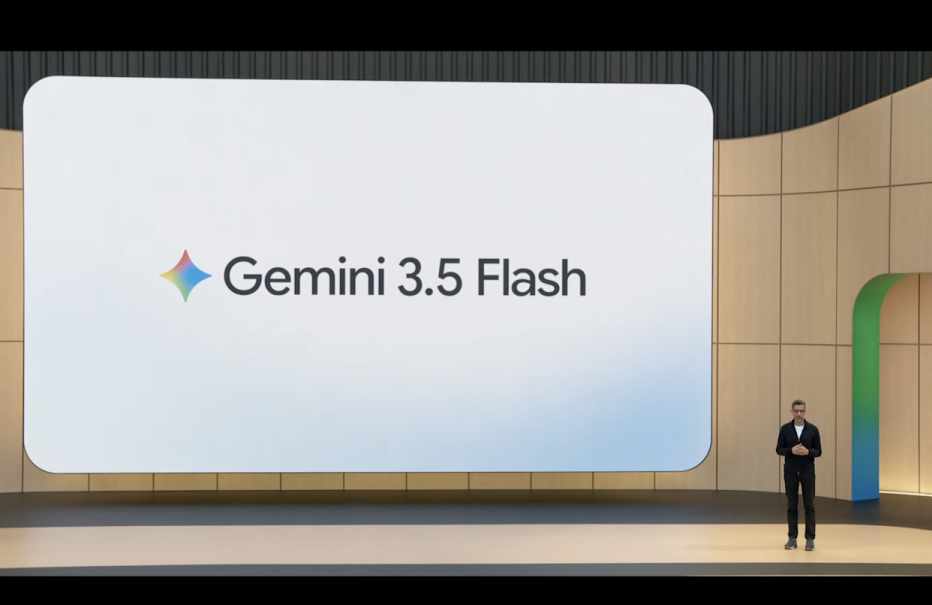
Google unveiled a wave of new Gemini-powered products and features at I/O 2026 on Tuesday, including AI models built to simulate the physical world, as the search giant pushes deeper into agentic AI across its ecosystem.
At its annual developer conference, the company introduced Gemini 3.5 Flash, a faster and lower-cost version of its flagship AI model family. Google also unveiled Omni, a new AI world model built to simulate physical environments and predict outcomes based on user actions, alongside Gemini Spark, a new agentic assistant aimed at helping users complete tasks across Search, Android, YouTube, and connected Google apps.
The announcements arrive at a critical moment for Google. OpenAI and Anthropic are gaining momentum with consumers, developers, and enterprise customers, pushing Google to prove it can move beyond search and turn Gemini into a full AI operating layer across its products.
Gemini 3.5 Flash: Frontier intelligence with action
Google says Gemini 3.5 Flash delivers frontier-level performance at a fraction of the cost of competing models. CEO Sundar Pichai described the model as “remarkably fast” during a briefing with reporters ahead of the event.
The company said Gemini 3.5 Flash beats Gemini 3.1 Pro across coding, agentic, and multimodal benchmarks, with output speeds up to four times faster than competing frontier models. Starting today, Flash is rolling out across the Gemini app, Google Search AI mode, Antigravity 2.0, and the Gemini API.
“You no longer have to trade quality for latency,” Google said in a blog post.
Google added that it strengthened cybersecurity protections in Gemini 3.5 Flash to reduce harmful outputs and lower the chances of the model refusing safe prompts by mistake.
Flash may be the model getting the immediate rollout, though Google signaled that Gemini 3.5 Pro remains its most capable system. The heavier-weight model is currently being tested internally and is expected to launch publicly next month.
Gemini Omni Flash
The company also introduced Gemini Omni, a new family of multimodal models built around reasoning and content generation. Omni accepts text, image, audio, and video inputs and can generate editable, real-world-knowledge-grounded video.
“Omni is our new model that can create anything from any input — starting with video. With Omni, you can combine images, audio, video and text as input and generate high-quality videos grounded in Gemini’s real-world knowledge. You can also easily edit your videos through conversation,” Google said in a blog post.
Google plans to bring Omni into the Gemini app, Google Flow, and YouTube Shorts. Users on AI Plus, Pro, and Ultra subscriptions will gain access first.
“Take a video you shot and just ask Omni to change what’s happening,” Google said in a separate post. The AI can “edit the action, add in new characters or objects.”
The company is leaning heavily into AI-generated media at a time when rivals are racing to dominate the next phase of creative tools. OpenAI’s Sora, Runway, Adobe, and several startups are all competing for the same market.
Gemini Omni (Image credit: Google)
Google’s latest push goes beyond media generation.
The company unveiled Gemini Spark, a general-purpose AI agent that can reason across connected apps and perform actions on behalf of users. Spark will launch in beta next week for trusted testers and Google AI Ultra subscribers.
Google says Spark is meant to help people manage their digital lives with less manual work. The broader goal is clear: turn Gemini from a chatbot into an active assistant capable of completing tasks across Google’s ecosystem.
That strategy carries high stakes for the company.
Google Search remains one of the company’s biggest businesses, though internet users are increasingly shifting simple queries and workflows to chatbots. Wall Street has been looking for signs that Google’s massive AI spending spree can produce deeper product integration and new revenue opportunities.
The company’s growing focus on AI agents comes as industry expectations continue to climb. Anthropic recently drew attention with Mythos, a model the company claimed discovered thousands of previously unknown software vulnerabilities.
Google is now trying to show that Gemini can compete on speed, reasoning, creativity, and automation all at once.
The Omni project may be one of the clearest signs of where the company thinks AI is headed next.
World models have long been studied inside DeepMind for robotics and simulation research. These systems attempt to predict how environments change over time based on actions and context, enabling AI systems to simulate physical behavior before acting.
Google says Omni can use those capabilities to generate more realistic video edits and imagery grounded in physical logic, rather than relying on simple prompt generation.
The company is betting that consumers will increasingly expect AI systems to do more than answer questions. Google wants Gemini to take action, create content, reason through tasks, and eventually operate across products with minimal user input.