After the SaaSpocalypse, SaaS companies stop charging per seat and start charging for outcomes
 Daniel Levi
Posted On May 12, 2026
Daniel Levi
Posted On May 12, 2026
Last week, we wrote about the emergence of software agent toll gates designed to counter the “SaaSpocalypse” triggered by the Claude Cowork AI agent. The disruption wiped out nearly $285 billion in market value of SaaS companies.
Now, a new report from The Information points to another strategy software companies are using to fight back: charging for AI based on outcomes rather than seats or token consumption.
From Subscriptions to Outcomes: SaaS Companies Race to Survive the AI Agent Era
According to the report, companies including HubSpot and Adobe have begun pricing AI tools based on the number of tasks successfully completed, rather than on flat subscription fees or raw AI usage.
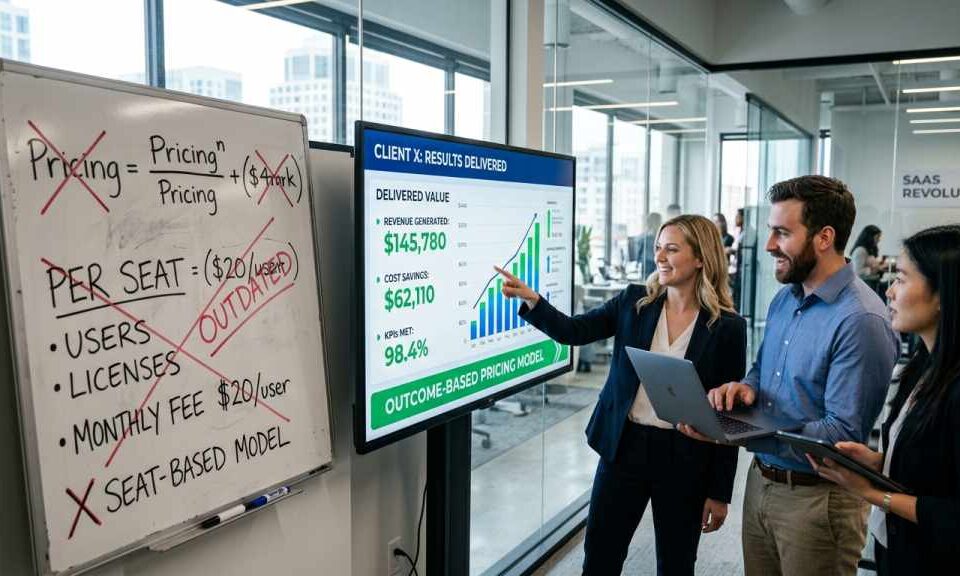
The shift marks a major break from the pricing model that helped build the SaaS industry over the past two decades. For years, software companies made money by charging businesses for each employee who used their platforms. One worker meant one seat. More employees meant more recurring revenue.
AI agents are starting to break that equation.
HubSpot, Adobe, and Salesforce shift to outcome-based AI pricing as SaaS faces disruption
The new generation of autonomous AI systems no longer acts like a chatbot sitting beside a worker. They are starting to perform entire workflows on their own. One agent can resolve customer support tickets, generate marketing campaigns, update enterprise records, analyze data, and trigger follow-up actions with little human involvement.
That creates a growing problem for software vendors. If AI agents reduce the number of employees actively using software, the traditional per-seat SaaS model begins to lose its grip.
Instead of resisting the shift, software companies are rebuilding pricing around AI labor itself.
Outcome-Based AI Pricing
Salesforce is already moving in that direction. The company recently introduced “Agentic Work Units,” or AWUs, a new way to measure the work completed by AI agents inside its platform. Rather than charging customers based on how many employees log in to the software, Salesforce is preparing for a future in which AI systems perform the work, and customers pay for the output.
“[We] introduced Agentic Work Units (“AWUs”) to measure tasks accomplished by an AI Agent, with 2.4 billion AWUs delivered to date across Agentforce and Slack, growing 57% quarter-over-quarter (“Q/Q”),” Salesforce said in its Q4 Fiscal 2026 Report.
Salesforce CEO Marc Benioff has also openly acknowledged the growing pressure AI agents are placing on SaaS economics. Earlier this year, he even embraced the “SaaSpocalypse” label as investors worried autonomous AI systems could shrink demand for traditional enterprise software subscriptions.
The idea spreading across the software industry is simple: stop selling access to tools and start selling completed work.
That transition is already gaining traction. According to survey data collected by former OpenView operating partner Kyle Poyar, 31% of 230 enterprise software firms expect outcome-based AI pricing to become their primary pricing model by mid-2029. Only 5% use that approach today.
The outcomes themselves vary widely. One company may charge when an AI agent successfully resolves a support ticket. Another may bill customers when an AI system generates an advertisement, closes a sales workflow, or completes a recruiting task.
No one fully agrees on what counts as a successful outcome yet.
That uncertainty sits at the center of the debate now unfolding inside enterprise software.
The rise of outcome-based pricing signals something larger than a billing change. Software companies are starting to build a new economic system around AI-generated work.
That system looks very different from the subscription model that dominated SaaS for years.
Traditional SaaS pricing provided companies with predictable, recurring revenue. Customers paid monthly or annual subscriptions tied to employee count. AI agents disrupt that structure, as a single autonomous system can replace multiple software seats and automate work previously handled by teams of employees.
That creates pressure from both sides.
Customers want pricing tied to measurable business value instead of flat subscriptions. Software companies need new ways to protect revenue as human interaction with software declines.
The Next SaaS Battleground: Charging AI Agents for Completed Tasks
AI itself adds another layer of pressure. Running advanced AI systems is expensive. Companies building large AI models continue spending billions on compute infrastructure and inference costs. Flat subscription pricing becomes risky when AI workloads spike unpredictably across enterprise customers.
Outcome-based pricing shifts some of that financial risk back to customers.
FedEx Chief Digital and Information Officer Vishal Talwar told The Information he welcomed the idea of pricing tied directly to business outcomes.
“It just keeps things simple,” he told The Information. CEOs of AI providers and their customers “can look each other in the eye and say, ‘I trust you, you trust me, I’ll make sure none of us really suffer a lot from this.’”
Still, many software companies remain cautious.
Nearly half of the firms surveyed by Poyar said they expect hybrid pricing models combining subscriptions, usage pricing, and outcome-based fees to dominate over the next several years.
That hesitation reflects how difficult outcome pricing may become in practice.
Amit Zavery, chief operating officer at ServiceNow, questioned whether outcomes can even be measured consistently in enterprise environments.
“If you go to the real world, there’s no way in a contract to figure out what [an] outcome would be, whether you can measure it,” Zavery told The Information.
The problem goes beyond billing disputes.
If an AI system completes a task poorly, who takes responsibility? Customers may refuse payment if the result falls short of expectations. Software vendors may end up absorbing those costs themselves.
That uncertainty is creating a strange new reality for enterprise software companies. SaaS firms that once sold predictable subscriptions are drifting closer to performance-based contracts tied to AI output.
Wall Street is watching the shift closely.
Investors increasingly view pricing flexibility as a sign that software companies are adapting to the AI era rather than being steamrolled by it. Consumption-based pricing, AI usage billing, and outcome-driven revenue models are becoming survival signals across the SaaS industry.
The larger fear hanging over the sector has little to do with chatbots or copilots.
The real threat is that autonomous AI agents may reduce the need for humans to interact with software at all.
For years, SaaS companies sold access.
Now they are preparing to sell the results.