Nvidia-backed Ayar Labs raises $500M to speed AI chips with light-based interconnects
 Nickie Louise
Posted On March 3, 2026
Nickie Louise
Posted On March 3, 2026

A quiet but critical battle is unfolding inside the data centers, fueling the AI boom. The latest signal came Tuesday, when Ayar Labs, a silicon photonics startup backed by Nvidia and AMD, announced it had raised $500 million in a Series E round, valuing the company at about $3.8 billion.
The new funding, which includes participation from Neuberger Berman, MediaTek, Qatar Investment Authority, and several major venture firms, lands at a moment when the industry is confronting a growing physical constraint: moving data between AI chips is becoming one of the hardest problems in computing.
The Wall Street Journal confirmed the funding, reporting, “Ayar Labs, a decade-old chip startup backed by Nvidia and Advanced Micro Devices, has raised $500 million from investors including Neuberger Berman, MediaTek, Qatar Investment Authority and others in a funding round that values it at $3.8 billion.”
Ayar Labs has spent years working on an alternative to the copper connections that currently link chips inside servers. Its approach replaces electrical signals with light beams, allowing data to move between processors and memory using photons rather than electrons. The pitch is simple. Light moves faster and wastes less energy.
The timing is no accident. As AI systems shift from training massive models to running them at scale through chatbots, agents, and enterprise tools, efficiency has become the new battleground. Data movement, not raw compute, is emerging as a major choke point.
“We’re solving one of the biggest hardware issues that’s causing bottlenecks in AI,” said Mark Wade, an electrical engineer and Ayar Labs’ chief executive. “We’ve been working on our core technologies for 15 years. We predicted that there would come a point in the 2020s or 2030s where copper connectivity would become a limiter on computing productivity.”
The company claims its optical interconnect chips can deliver between four and 20 times more computing throughput per watt than traditional copper-based systems. If those gains hold at scale, the implications for hyperscale data centers could be significant, especially as energy costs climb and AI workloads multiply.
NVIDIA’s presence in Ayar Labs’ cap table is telling. The GPU giant has spent more than a decade pushing high-speed chip-to-chip communication through its NVLink technology, which still relies on copper. As inference demand climbs and cluster sizes grow, the limits of copper are becoming harder to ignore.
“People stay on copper for as long as they can, but the more electrons you run through copper, it starts to lose its fidelity,” said Gabe Cahill, managing director at Neuberger Berman, which helped lead the round. “Using light is a step function forward.”
Nvidia-backed startup Ayar Labs raises $500M to eliminate AI chip bottlenecks with silicon photonics
Investor enthusiasm reflects a broader shift across the AI hardware stack. Citigroup analysts recently pointed to Nvidia’s multibillion-dollar investments in optical networking players Coherent and Lumentum as evidence that the company is actively seeking ways to push beyond copper-based architectures.
The idea of optical interconnects is far from new. Former Intel CEO Pat Gelsinger, now on Ayar Labs’ board, recalled launching silicon photonics research inside Intel more than two decades ago.
“I proudly declared that the death of copper was upon us, and everything would switch to optics, but I was just two decades too early,” he said. “The GPU is sitting there sucking on a straw for more compute. Everyone wants their clusters to be bigger, but the physics of copper is limiting how big they can get.”
For years, silicon photonics struggled with manufacturing precision, heat management, and packaging challenges. Ayar Labs says it has cleared those hurdles and is preparing for high-volume production, a claim investors appear willing to back with substantial capital.
The new funds will go toward scaling production and test capacity, expanding global operations, including a new office in Hsinchu, Taiwan, and accelerating deployment of its co-packaged optics technology inside AI systems.
Competition is heating up. Celestial AI raised $250 million last year for its own optical interconnect work. Meanwhile, Nvidia’s recent $2 billion investments in Coherent and Lumentum signal that large chipmakers are hedging their bets across multiple optical approaches.
What is clear is that investor appetite for AI infrastructure remains strong. As hyperscalers and governments pour hundreds of billions into compute capacity, attention is shifting from model size to the plumbing that keeps those models fed with data.
TechStartups previously covered Ayar Labs in 2020 after the company raised $35 million in Series B funding to advance optical connectivity aimed at extending Moore’s Law.
Founded in 2015 by Alex Wright Gladstein, Chen Sun, and Mark Wade, Ayar Labs has focused on replacing traditional electrical I/O with optical interconnect chiplets built using standard silicon manufacturing processes. The company says its approach targets major gains in bandwidth density and energy efficiency inside large-scale compute systems.
If Ayar Labs can deliver on its performance claims at scale, the company may find itself at the center of the next phase of the AI hardware race—one defined less by raw silicon and more by how quickly information can move between chips.
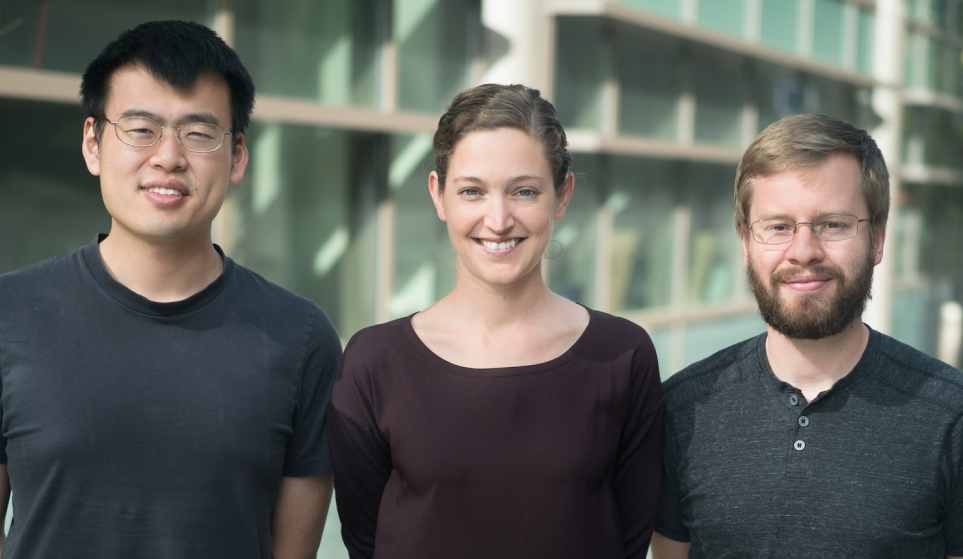
Ayar Labs Founders (Courtesy: Ayar Labs)