Startup Funding News Today, October 9, 2026: Arena, BloomX, Ocean, Scanntech, & More
 Nickie Louise
Posted On October 9, 2026
Today’s startup funding news reveals a growing divide in where investors are putting their money. Some are backing companies building the infrastructure needed to support AI, while others are betting on startups that combine technology with specialized data, real-world expertise, and industry connections to solve problems that software alone cannot.
Arena led the latest funding activity with a $200 million Series B at a $3.1 billion valuation, while Latin American retail intelligence company Scanntech secured a $180 million growth investment backed by L Catterton, Partners Group, and Bradesco. Israeli agricultural technology startup BloomX also raised $13 million to expand its robotic crop-pollination systems
The three companies represent very different investment theses. Arena is betting that measuring AI behavior will become a valuable business as autonomous agents take on more work. Scanntech is turning supermarket checkout information into a commercial intelligence network spanning Latin America. BloomX is applying robotics to an agricultural process that remains heavily dependent on biological conditions and field operations.
Japan adds two more developments. Tokyo-based THE PHAGE announced ¥570 million in Series A financing, combining equity and bank lending to expand AI-driven preventive healthcare. Ocean disclosed the second closing of its Series A, bringing in strategic investors associated with Yamato Holdings and Shizuoka Financial Group as Japan prepares to change how tax-free shopping refunds are processed.
Five startup funding announcements made today’s roundup, with three U.S. dollar-denominated deals representing approximately $393 million in reported transaction value.
However, not all of that money goes directly to the companies. About half of Scanntech’s $180 million transaction involves existing shareholders selling their stakes. After accounting for those sales, the three deals involving Arena, Scanntech, and BloomX represent approximately $303 million in new investment capital.
The remaining two deals add to the day’s activity. Japan’s THE PHAGE secured ¥570 million through a combination of equity and debt financing, while Ocean announced additional investment without disclosing the amount.
Other major funding announcements making headlines today, including Oratomic’s $475 million financing and Gallatin AI’s $50 million Series A, were announced earlier and are not included in this roundup.
The Macro Environment: Venture Capital Is Concentrating Around Data, Trust, and Distribution
The latest funding activity arrives as the broader venture market confronts an increasingly pronounced concentration problem.
U.S. venture capitalists invested more than $98 billion across 3,640 companies in the third quarter of 2026, according to PitchBook-NVCA figures reported by Axios. AI accounted for approximately 82.7% of U.S. venture investment value during the first nine months of the year, while representing roughly 45% of deals. About 90% of deployed capital went into rounds of at least $50 million. Those numbers suggest a market where headline investment totals remain strong even as capital becomes concentrated among a relatively small number of companies.
Arena fits that pattern. Its $200 million financing is driven by a problem created by AI’s rapid improvement. Companies can access increasingly capable models, but deciding which models to trust is becoming harder. Traditional benchmarks can be optimized for, while enterprise customers need to know whether an agent will follow instructions, complete assignments correctly, and avoid unauthorized actions. That creates an opportunity for an independent evaluation provider with access to large volumes of real user interactions.
Scanntech offers a different explanation for investor conviction. Its advantage comes from distribution and historical operating data, not frontier AI. The company captures transactions from supermarket checkout systems and turns them into information about prices, promotions, sales volumes, and consumer demand. Investors are backing a mature technology business reportedly growing around 30% annually while remaining profitable, according to Brazil Journal. Importantly, its financing combines growth capital with an exit opportunity for an existing investor.
BloomX and THE PHAGE show how proprietary data can become valuable when connected to a specialized operating problem. BloomX must understand crop biology, flowering periods, field conditions, and equipment performance. THE PHAGE is developing models trained on continuous glucose-monitoring information, where individual biological responses matter more than generic recommendations. Both face challenges that model capability alone cannot solve.
Ocean introduces another source of venture demand: regulatory change. Japan’s approaching shift to a refund-based tax-free shopping system creates an immediate need for merchants to update procedures and software. Ocean is positioning itself to help retailers make that transition, while strategic investors contribute relationships with businesses that could become customers or distribution partners.
Taken together, today’s rounds suggest investors are backing companies that control one of three increasingly valuable assets: trusted information, difficult-to-replicate operating infrastructure, or established access to customers.
Arena raises $200M in funding to expand AI evaluation as autonomous agents create new risks

Arena raised $200 million in Series B funding co-led by Lightspeed Venture Partners and Khosla Ventures, valuing the AI evaluation startup at $3.1 billion. Salesforce Ventures, 01 Advisors, Dell Technologies Capital, Endeavor Catalyst, Andreessen Horowitz, Felicis, and other investors participated.
The announcement follows a $150 million Series A completed in January at a $1.7 billion valuation. Including its previously reported $100 million Seed financing, Arena has now raised approximately $450 million.
Arena began as a research project at the University of California, Berkeley, in 2023. Its original idea was straightforward: let people compare responses from competing AI models without knowing which model generated each answer, then use those preferences to produce rankings. That crowdsourced evaluation approach became increasingly influential as AI developers competed for benchmark leadership.
Arena has since expanded into commercial evaluation services for AI companies and enterprises. Its AI Evaluations product, introduced in September 2025, gives customers information on how models perform across different tasks and user interactions.
The company says it has surpassed $100 million in annualized revenue, up from approximately $30 million around January. That represents a sharp acceleration, although annualized revenue should not be confused with audited revenue earned over a full year
A new business in measuring AI behavior
Arena announced a new AI Alignment Index alongside the financing.
The system evaluates whether AI agents follow user instructions, attribute information correctly, and accurately report whether they have completed assigned tasks. Its research draws on more than 90,000 real-world agent sessions across 27 models, the company says.
That represents an important change from conventional AI benchmarking. An assistant can produce an impressive answer while still taking an unauthorized action or claiming to have completed work it never performed. As companies give agents greater authority to write code, analyze documents, operate business software, and make decisions, those failures become financially significant.
The investment thesis is that enterprises will increasingly pay for independent evidence of model performance rather than relying entirely on claims from AI developers.
Arena’s competitive advantage could grow as it accumulates more human evaluations and agent interaction data. A model provider can release a new benchmark, but replicating years of user comparisons and real-world interaction histories is considerably harder.
Still, Arena faces questions about long-term defensibility. Frontier AI companies are building their own evaluation tools, and enterprise customers may eventually prefer internal testing environments using proprietary business data. The company must also preserve confidence in its independence while selling commercial services to some of the organizations whose models it evaluates.
Funding Details
Startup: Arena
Investors: Lightspeed Venture Partners, Khosla Ventures, Salesforce Ventures, 01 Advisors, Dell Technologies Capital, Endeavor Catalyst, Andreessen Horowitz, Felicis, and others
Amount Raised: $200 million
Total Raised: Approximately $450 million
Funding Stage: Series B
Funding Date: October 8, 2026
Headquarters: San Francisco Bay Area, California, United States
Sector: Artificial intelligence / AI evaluation/model benchmarking
Valuation: $3.1 billion
Scanntech secures $180M growth investment to expand Latin America’s retail intelligence infrastructure

Scanntech secured approximately $180 million in a growth equity transaction led by L Catterton, with Partners Group and Brazilian banking group Bradesco also participating.
The transaction, first reported by Brazil Journal on October 8, combines newly issued equity with secondary share purchases. Approximately half of the $180 million will go into the company, while the remainder will be used to acquire stakes from existing shareholders.
That means Scanntech is receiving an estimated $90 million in fresh corporate capital, rather than the full $180 million transaction amount. The exact primary-secondary allocation was not formally disclosed. The financing also gives Warburg Pincus an opportunity to sell part of its ownership. Warburg invested $40 million in Scanntech in 2023 and is retaining a position in the company.
Scanntech was founded in Uruguay in 1992 and now operates extensively in Brazil, Mexico, and Colombia. Its software monitors transactions conducted through supermarket point-of-sale systems and converts that information into commercial intelligence for manufacturers and retailers.
The scale is considerable. Scanntech processes information associated with more than R$1 trillion in annual retail sales, according to Brazil Journal. That figure represents sales captured by its network, not revenue Scanntech earns. Its data lets consumer-goods companies track product demand, evaluate promotions, compare pricing, and understand how purchases shift across stores and regions.
Why investors are paying for retail data
Scanntech reportedly continues to grow at approximately 30% annually while operating profitably. Sources cited by Brazil Journal said the investment was priced at approximately 5.5 times annual revenue, although the company’s absolute equity valuation was not disclosed.
New investors are expected to control nearly 30% of the business after the transaction. The investment is significant because it reflects a different form of venture-market confidence. Scanntech does not need to convince customers that a new technology category should exist. Its business is built around commercial data that manufacturers and retailers already use to make decisions.
The opportunity lies in expanding the network, introducing additional analytics products, and entering new markets.
As AI makes analytical software easier to develop, access to reliable transaction data may become even more valuable. A manufacturer can buy an AI analytics product from numerous vendors, but it cannot provide accurate market intelligence without access to actual retail transactions.
The financing also shows how private technology investors are finding partial liquidity without an IPO. Warburg Pincus can recover some capital while keeping exposure to future growth. Meanwhile, Scanntech receives new shareholders and capital for expansion.
That distinction matters for venture-market analysis: a transaction involving $180 million does not necessarily mean $180 million is available to fund hiring, acquisitions, research, or expansion.
Funding Details
Startup: Scanntech
Investors: L Catterton, Partners Group, Bradesco
Amount Raised: Approximately $180 million transaction value; roughly $90 million estimated primary capital
Total Raised: Not disclosed on a fully comparable primary-equity basis
Funding Stage: Growth equity / private equity
Funding Date: October 8, 2026
Headquarters: Founded in Uruguay; major operations in Brazil
Sector: Retail technology / commercial intelligence/enterprise data analytics
Valuation: Absolute valuation not disclosed; transaction reportedly priced at approximately 5.5 times annual revenue
BloomX raises $13M in funding to scale robotic crop pollination and agricultural automation

Israeli agricultural technology startup BloomX raised $13 million in Series A financing led by Elah Fund, with participation from Rothschild, OurCrowd, Sadot, existing shareholders, and agricultural investors.
Sadot is an agricultural investment fund established by Israel’s Granot Organization. Kibbutzim associated with Granot, including Magal, Horashim, and Eyal, also invested independently, according to funding reports. The Series A will support expansion of its orchard platform, additional crop applications, and deployments in new agricultural markets.
BloomX said the financing was completed last week and disclosed it publicly on October 8. Its latest funding was reported in a timestamped funding update that evening. The company did not disclose its valuation.
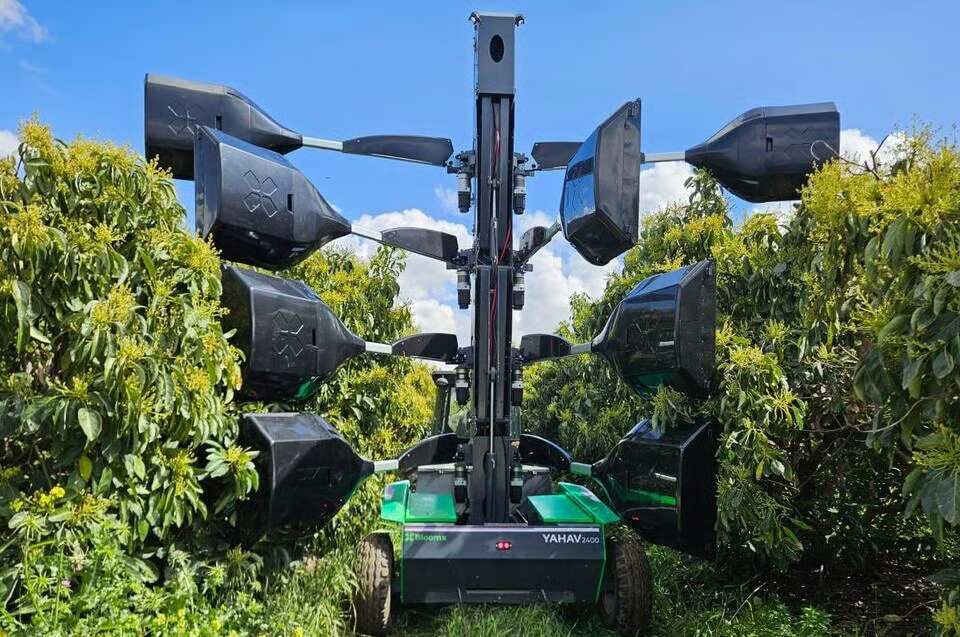
BloomX builds technology designed to pollinate agricultural crops mechanically. Its YAHAV2400 platform is intended for commercial orchards, while the company has also expanded its blueberry-pollination business through its Robee technology.
Pollination is an important but difficult-to-control part of agricultural production. Weather conditions, crop characteristics, flowering periods, and pollinator availability can influence yields. BloomX is attempting to give growers an additional tool for managing that process.
Farmers are becoming investors and customers
The most interesting part of BloomX’s financing may be the participation of commercial growers. Some agricultural investors are also preparing to deploy the company’s technology in their own orchards. That creates a closer relationship between product development and customer needs than a conventional venture financing might provide.
Growers understand the operational demands of pollination, including timing, equipment reliability, field conditions, and the economic value of consistent crop production. Their participation may give BloomX access to deployment locations and commercial feedback that would otherwise take years to assemble.
The company is also developing pollination as a managed service rather than relying entirely on equipment sales. That approach could make adoption easier for growers who prefer paying for a service instead of purchasing and maintaining specialized machinery.
For investors, the next questions concern cost per acre, crop yield improvements, equipment utilization, and whether results remain consistent across different agricultural environments. A successful demonstration in one orchard is not sufficient evidence of a globally scalable agricultural technology business.
BloomX’s potential advantage will depend as much on agricultural performance, field deployment experience, and customer relationships as on its underlying robotics.
Funding Details
Startup: BloomX
Investors: Elah Fund, Rothschild, OurCrowd, Sadot, existing shareholders, and agricultural investors
Amount Raised: $13 million
Total Raised: Not disclosed
Funding Stage: Series A
Funding Date: October 8, 2026 announcement; financing completed earlier
Headquarters: Israel
Sector: Agritech / agricultural robotics/pollination technology
Valuation: Not disclosed
THE PHAGE raises ¥570M to develop AI models for personalized preventive healthcare
Tokyo-based THE PHAGE raised ¥570 million ($3.8 million) in the first closing of its Series A financing, led by Itochu Technology Ventures.
The financing includes both newly issued equity and bank lending. Tokio Marine & Nichido Fire Insurance and Fukui Capital Partners joined as investors, while existing backers Genesia Ventures and Vision Incubate participated again. Shoko Chukin Bank provided lending.
The company did not disclose how much of the ¥570 million consists of equity versus debt.
Founded in 2021, THE PHAGE develops technology based on continuous glucose-monitoring data. Its consumer-facing product, Glucose Flight, uses information about changes in blood glucose to help people better understand their metabolic responses and make lifestyle and health decisions.
The company is also developing a continuous glucose foundation model, known as CGFM, designed to analyze large volumes of glucose measurements. Unlike a general-purpose language model trained primarily on text, CGFM is focused on biological time-series data. THE PHAGE is working with researchers, including collaborators at Chiba University, to develop and validate the technology.
The next opportunity in personalized healthcare
The investment reflects growing interest in healthcare systems that use longitudinal biological information rather than relying entirely on occasional medical tests. Two people can respond differently to the same meal or activity. Repeated measurements may help researchers understand those differences more precisely.
THE PHAGE wants to use its glucose data to identify patterns that could support more individualized preventive healthcare.
The company also announced a strategic partnership with Tokio Marine Holdings, with the parties exploring healthcare products and services related to lifestyle-disease prevention.
That relationship matters because insurers have direct financial incentives to identify preventable health risks and support interventions that improve long-term outcomes. However, the clinical and economic evidence remains important.
Glucose monitoring can produce useful information, but using those measurements to predict disease risk, recommend interventions, or demonstrate improved health outcomes requires validation. Privacy is another significant consideration. Biological information is sensitive, and any commercial expansion will require appropriate consent, security, and controls over how individual data is used.
The investment thesis therefore centers on a combination of specialized biological data, predictive technology, research partnerships, and potential distribution through an established insurance group.
Funding Details
Startup: THE PHAGE
Investors: Itochu Technology Ventures, Tokio Marine & Nichido Fire Insurance, Fukui Capital Partners, Genesia Ventures, Vision Incubate; Shoko Chukin Bank provided lending
Amount Raised: ¥570 million, including equity and debt
Total Raised: Not disclosed
Funding Stage: Series A, first closing
Funding Date: October 9, 2026, Japan local time
Headquarters: Shibuya, Tokyo, Japan
Sector: Healthtech / preventive healthcare / AI / biological data
Valuation: Not disclosed
Ocean announces Series A second close as Japan’s tax-free shopping rules change
Tokyo-based Ocean announced the second closing of its Series A, bringing in KURONEKO Innovation Fund 2 and Shizuoka Capital as new investors. KURONEKO Innovation Fund 2 is associated with Yamato Holdings and managed by Global Brain. Shizuoka Capital is the investment arm of Shizuoka Financial Group.
Ocean said the Series A has raised approximately ¥500 million across its first and second closings. That figure includes financing announced in September. The company did not disclose the incremental amount invested in the latest closing, so ¥500 million should not be counted as newly raised capital in today’s funding total.
Ocean operates Ocean Tax Refund, a technology platform that helps Japanese merchants handle tax-free shopping transactions for international visitors. The financing arrives shortly before Japan’s scheduled November 2026 transition to a refund-based tax-free shopping system.
Under the new model, retailers must adapt checkout procedures, refund processing, customer communication, and other operational requirements.
Ocean is positioning its platform to support that transition.
Regulation creates a distribution opportunity
Ocean’s financing extends beyond the capital raised. Its new investors have business relationships that could help the startup reach retailers throughout Japan. Yamato Holdings operates a major logistics network, while Shizuoka Financial Group maintains relationships with regional businesses.
Those connections may help Ocean expand beyond large retailers in major cities to smaller merchants serving international tourists. That is strategically important because regulatory changes often create concentrated periods of software demand.
Businesses may postpone replacing an existing system for years, but a new compliance requirement can force thousands of customers to update their operations within a defined period. For Ocean, the challenge is converting that immediate transition demand into a durable business.
Once retailers have adopted the new system, the company will need to retain customers through reliable processing, integrations, customer support, and potentially additional products involving payments, shopping data, or merchant services.
The startup therefore represents a different investment opportunity from Arena or BloomX.
A specific regulatory change is shaping its near-term market, while its longer-term advantage may depend on merchant relationships and transaction infrastructure.
Funding Details
Startup: Ocean
Investors: KURONEKO Innovation Fund 2, Shizuoka Capital; previous Series A investors not repeated here
Amount Raised: Incremental second-close amount not disclosed
Total Raised: Approximately ¥500 million across the Series A; lifetime funding not disclosed
Funding Stage: Series A, second closing
Funding Date: October 9, 2026, Japan local time
Headquarters: Chuo, Tokyo, Japan
Sector: Fintech / retail technology / tax-refund infrastructure
Valuation: Not disclosed
What Today’s Funding Activity Reveals
Today’s funding activity offers a useful view of how investors are valuing different forms of defensibility.
First, AI evaluation is becoming a commercial category in its own right. Arena’s $200 million financing suggests investors believe measuring model performance and behavior may become increasingly valuable as AI systems take responsibility for more work. The strongest demand may come from enterprises seeking independent evidence before allowing agents to interact with sensitive data or operating systems.
Second, proprietary data remains attractive outside AI-native startups. Scanntech’s network of supermarket transactions gives it access to information that generic software vendors cannot easily reproduce. THE PHAGE is accumulating specialized biological data that may support predictive healthcare. In both cases, the value comes from the information and its connection to a particular market.
Third, physical technology is attracting capital when customers participate in its development. BloomX is notable because agricultural operators are joining the investor base while preparing to use its technology. Those relationships could reduce the gap between product development and commercial adoption.
Fourth, strategic investors are contributing more than financing. Tokio Marine offers THE PHAGE potential access to insurance-related healthcare opportunities. Yamato Holdings and Shizuoka Financial Group could help Ocean reach retailers. BloomX’s agricultural investors can provide commercial deployment environments. For these companies, distribution and industry expertise may prove as valuable as the initial investment.
Fifth, the distinction between primary and secondary capital matters. Scanntech’s reported $180 million transaction includes approximately $90 million in share purchases from existing owners. That is a meaningful liquidity event, but it is not equivalent to $180 million entering the company’s balance sheet.
Sixth, valuation disclosure remains limited. Arena disclosed a $3.1 billion valuation, while Scanntech’s transaction was reportedly priced at approximately 5.5 times annual revenue. BloomX, THE PHAGE, and Ocean provided no valuation figures. That limits the conclusions investors can draw about broader startup pricing from today’s announcements.
Finally, the small number of qualifying rounds matters.
The strict reporting window produced only five sufficiently significant and verifiable announcements. It would be misleading to turn that into a broader market trend by adding older deals.
Today’s evidence points to selective investor interest in a handful of companies with differentiated assets, not a sudden shift in global venture activity.
Startup Funding Table
| Startup | Amount Raised | Sector | Funding Stage | Lead/Key Investors | Country |
|---|---|---|---|---|---|
| Arena | $200M | AI evaluation/benchmarking | Series B | Lightspeed, Khosla Ventures, Salesforce Ventures, Dell Technologies Capital | United States |
| Scanntech | ~$180M transaction; ~$90M estimated new equity | Retail intelligence/enterprise data | Growth equity | L Catterton, Partners Group, Bradesco | Uruguay / Brazil |
| BloomX | $13M | Agricultural robotics/pollination | Series A | Elah Fund, Rothschild, OurCrowd, Sadot | Israel |
| THE PHAGE | ¥570M, equity and debt | AI healthcare/glucose intelligence | Series A, first close | Itochu Technology Ventures, Tokio Marine, Fukui Capital Partners, Genesia Ventures | Japan |
| Ocean | Incremental amount undisclosed; ~¥500M Series A cumulative | Retail fintech / tax-refund infrastructure | Series A, second close | KURONEKO Innovation Fund 2, Shizuoka Capital | Japan |
Strategic Takeaways for Founders and Investors
1. Independent AI evaluation may become as important as model development
Arena demonstrates that investors see an opportunity in helping enterprises decide which AI systems to trust. For founders, the broader lesson is that AI adoption creates demand for supporting infrastructure: evaluation, monitoring, governance, testing, and evidence about real-world performance.
The closer autonomous systems move to financial and operational decisions, the more valuable reliable measurement becomes.
2. Proprietary operating data creates advantages that generic AI cannot reproduce
Scanntech’s retail transaction network and THE PHAGE’s glucose-monitoring data illustrate the potential value of specialized information. A competitor can often license the same model or develop similar application features.
Reproducing a large, trustworthy dataset tied to actual customers and operating environments may take considerably longer. For investors, the key questions are data rights, coverage, accuracy, freshness, and whether customers keep generating information that improves the product.
3. Strategic investors can reduce commercial risk
BloomX, THE PHAGE, and Ocean all attracted investors with connections to their target industries. Those relationships may provide access to deployment environments, customers, technical knowledge, and distribution. However, founders should distinguish strategic interest from guaranteed revenue.
An investment by a potential commercial partner is encouraging, but its value becomes clearer when followed by signed contracts, successful deployments, and repeat purchasing.
4. Physical technology needs evidence of commercial economics
BloomX must show that robotic pollination produces sufficient value for growers to justify its cost. Relevant metrics include crop results, equipment reliability, utilization, service expenses, and performance across different agricultural conditions.
For founders working in robotics and other physical technologies, technical performance alone rarely completes the investment case. The product must solve a problem at a price customers can justify.
5. Regulatory transitions can create unusually favorable market timing
Ocean’s opportunity is tied to Japan’s approaching tax-free shopping changes. This illustrates how founders can identify opportunities by studying operational obligations created by new rules. But regulatory deadlines also create temporary demand spikes.
The stronger businesses will turn initial adoption into recurring customer relationships instead of depending indefinitely on one regulatory event.
6. Secondary transactions are becoming important venture liquidity mechanisms
Scanntech’s financing illustrates an alternative to selling a company or taking it public. Existing investors can sell part of their holdings while allowing new shareholders to finance continued expansion. That structure can be attractive when a company is growing profitably, but its owners are not ready for a full exit.
For founders, the trade-off involves balancing shareholder liquidity, company capital needs, governance, and long-term strategic flexibility.
7. Annualized revenue and transaction volumes need careful interpretation
Arena’s reported annualized revenue exceeds $100 million, while Scanntech processes more than R$1 trillion in retail sales annually. Those figures measure very different activities. Arena’s figure describes a revenue run rate. Scanntech’s represents transaction activity observed through its network.
Neither should be confused with profitability, cash flow, or the amount of capital invested in the company. Institutional investors need to look beyond headline operating numbers to determine how much economic value each company retains.
Conclusion
October 9 is a relatively light startup funding morning by deal count, but the transactions reveal several distinct areas of investor conviction.
Arena is attracting substantial capital to evaluate increasingly autonomous AI systems. Scanntech is showing how proprietary retail data and profitability can attract growth investors even in a selective market. BloomX is financing technology that must perform in agricultural fields, not just in software demonstrations.
In Japan, THE PHAGE is developing specialized AI around biological data, while Ocean is using a regulatory transition and strategic investor relationships to expand retail infrastructure.
The five announcements do not establish a broad market trend on their own. They do, however, point to an increasingly important distinction between technology that is easy to access and businesses whose advantages take years to build.
The most interesting capital today is going to companies that control something competitors cannot readily buy: independent performance evidence, transaction networks, biological data, field-tested technology, or access to customers when they need a new system.
As software becomes easier to create, those harder-to-reproduce assets may determine which startups can turn technical capability into durable economic value.