OpenAI launches Prism AI workspace on Prism.app, a domain sold for $120K 10 days earlier
 Daniel Levi
Posted On February 17, 2026
Daniel Levi
Posted On February 17, 2026
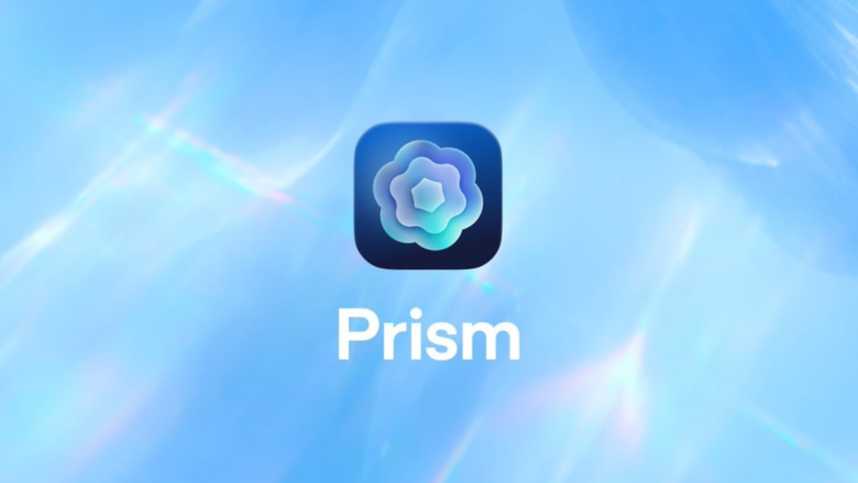
On January 17, NameBio reported that Prism.app had sold for $120,000. Ten days later, the domain began redirecting to prism.openai.com. Now, OpenAI has officially launched Prism, a free AI workspace built for scientific writing and collaboration, powered by GPT-5.2.
The timing raises eyebrows. The product, though, is the bigger story.
Prism: From Fragmented Tools to a Single Workspace
Scientific research still runs on a patchwork of tools. Researchers write in LaTeX editors, manage citations in separate software, exchange drafts over email, compile PDFs, and copy text back and forth into AI chat interfaces. Context gets lost. Versions conflict. Focus breaks.
OpenAI is betting that this friction is slowing science itself.
In its announcement, the company framed the problem directly:
“Science shapes nearly every part of daily life—from the medicines we rely on, to the energy that powers our homes, to the systems that keep us safe. But the pace of scientific progress is still constrained by how research is done day to day.”
Prism is OpenAI’s answer to that constraint.
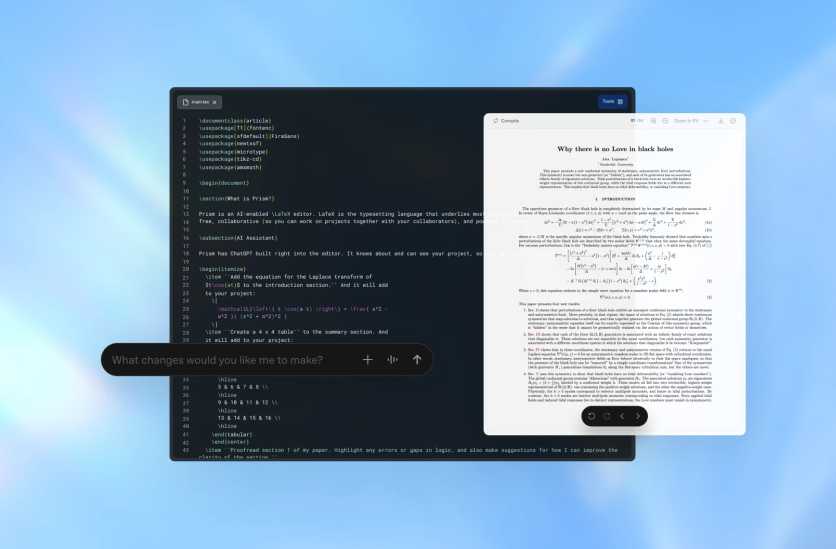
The platform integrates drafting, collaboration, and GPT-5.2 directly into a LaTeX-native cloud environment. Rather than pasting text into a chatbot and then copying responses back into a manuscript, the AI works directly within the document, with access to its structure, equations, references, and surrounding context.
That architectural shift matters. Scientific writing is not generic prose. Equations, figures, citations, and logical flow are tightly connected. Prism’s design reflects that reality.
OpenAI Prism: Built on Crixet, Now Rebuilt for AI
Prism did not start from scratch.
OpenAI acquired Crixet, a cloud-based LaTeX collaboration platform, and rebuilt it into what is now Prism. That acquisition provided the company with a solid foundation for collaborative scientific writing. The AI integration came next.
The result is a unified workspace where researchers can explore ideas with GPT-5.2 Thinking, draft and revise papers with full-document awareness, incorporate literature, such as arXiv research, directly into context, and convert whiteboard equations into LaTeX.
It supports unlimited projects and collaborators and is free for anyone with a personal ChatGPT account. Business, Enterprise, and Education plans will follow.
OpenAI describes this release as an early step in a broader shift. In its words:
“In 2025, AI changed software development forever. In 2026, we expect a comparable shift in science, as AI begins to meaningfully accelerate discovery in several ways, one of which is reducing friction in day-to-day research work. Prism is an early step toward that future.”
That framing signals ambition beyond writing assistance. OpenAI is positioning itself as an infrastructure for scientific production.
Why the Domain Move Matters
Then there’s the domain.
Prism.app sold publicly for $120,000. Ten days later, the name now routes to OpenAI’s new scientific workspace.
The company has not publicly commented on the acquisition. The redirect speaks for itself.
For domain investors and startup observers, the sequence underscores something familiar: when a product is strategic, branding tightens. OpenAI could have kept prism.openai.com as the primary access point. Securing the exact-match .app domain adds permanence and clarity.
It signals intent.
The Bigger Play
Over the past year, OpenAI’s models have been used in mathematical proofs, biological analysis, and experimental iteration. Prism moves that capability into researchers’ daily workflow rather than leaving it as an external tool.
Scientific publishing has long relied on systems that changed little over the decades. LaTeX remains dominant in many disciplines. Version control remains painful. Collaboration across institutions remains messy.
Prism does not claim to solve science itself. It aims to remove mechanical drag from the writing and reasoning process.
Whether researchers adopt it at scale remains to be seen. Academia is slow to shift habits. Trust builds over time.
Still, the combination of a GPT-5.2-native writing environment, unlimited collaboration, and frictionless LaTeX access puts OpenAI squarely inside the production layer of science.
And the $120,000 domain purchase ten days earlier suggests the company sees Prism as more than a feature release.
It looks like infrastructure.