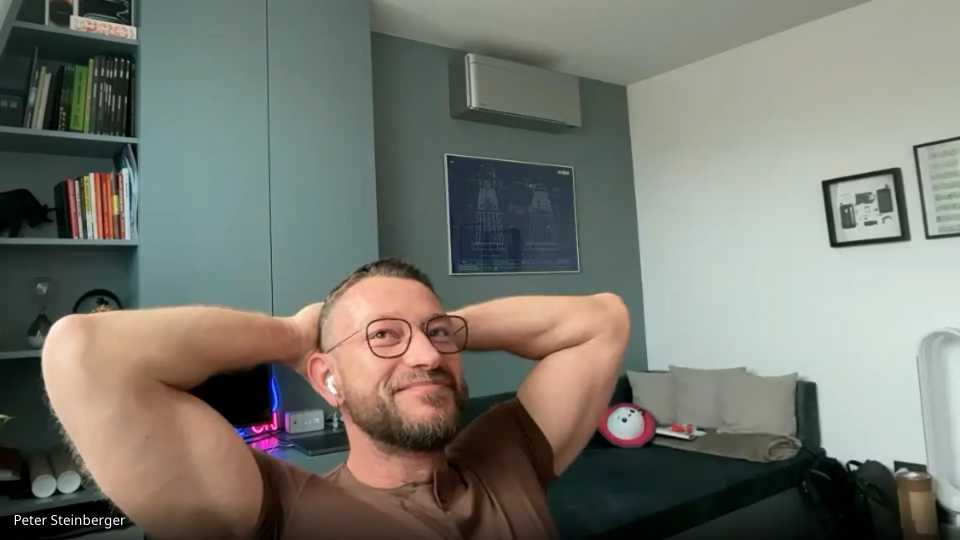
OpenClaw founder Peter Steinberger joins OpenAI to lead next-gen personal agents
 Daniel Levi
Posted On February 15, 2026
Daniel Levi
Posted On February 15, 2026
OpenClaw founder Peter Steinberger has joined OpenAI to lead next-generation personal agents, marking a major step in the company’s push toward autonomous AI systems.
Sam Altman announced Sunday that Steinberger is coming aboard OpenAI to drive what he described as “the next generation of personal agents,” adding that the work is expected to “quickly become core to our product offerings.”
“Peter Steinberger is joining OpenAI to drive the next generation of personal agents. He is a genius with a lot of amazing ideas about the future of very smart agents interacting with each other to do very useful things for people,” Altman wrote in a post on X.
That statement reframes this as more than a hiring announcement. It signals a product shift.
Peter Steinberger is joining OpenAI to drive the next generation of personal agents. He is a genius with a lot of amazing ideas about the future of very smart agents interacting with each other to do very useful things for people. We expect this will quickly become core to our…
— Sam Altman (@sama) February 15, 2026
From Viral Open-Source Breakthrough to OpenAI’s Core Strategy
Earlier this month, TechStartups covered OpenClaw as it went viral among developers, marking a turning point when autonomous agents moved from experimental demos to practical tools.
Unlike traditional chatbots that respond to prompts, OpenClaw demonstrated persistent memory, task execution, and coordinated agent behavior. It could browse, manage workflows, and execute actions rather than simply suggest next steps.
At the time, the surge of developer interest hinted at something larger: AI systems that collaborate and operate with greater autonomy.
Now, with Steinberger joining OpenAI and personal agents set to become “core” to its offerings, that early momentum looks less like hype and more like direction.
“The Future Is Extremely Multi-Agent”
Altman’s most consequential remark wasn’t about Steinberger’s background. It was about architecture.
“The future is going to be extremely multi-agent.”
In one sentence, he captured a broader shift unfolding across the AI industry. For years, progress centered on making a single large model more capable — better reasoning, stronger benchmarks, longer context windows. But the direction is changing.
The next phase is not about one model doing everything. It is about systems composed of multiple specialized agents working in coordination.
Instead of relying on a single assistant to handle every task, users may soon depend on a network of agents operating behind the scenes. One agent could focus on research, gathering, and synthesizing information. Another could analyze financial data. A third might write or debug code. Others could manage schedules, monitor systems, or execute workflows across apps and services.
Rather than acting in isolation, these agents would communicate, delegate, verify, and collaborate. The result is not just a smarter assistant, but a coordinated system designed to complete complex, multi-step objectives with minimal oversight.
If Altman’s framing is accurate, the shift to multi-agent architecture will define the next chapter of AI development.
If OpenAI makes this architecture central to its products, ChatGPT may evolve from a conversational interface into a coordination layer for multiple intelligent agents.
OpenClaw Will Live in a Foundation
Altman also announced that OpenClaw will move into a foundation as an open-source project, with OpenAI continuing to support it. This move carries strategic weight.
“OpenClaw will live in a foundation as an open source project that OpenAI will continue to support. The future is going to be extremely multi-agent and it’s important to us to support open source as part of that,” Altman stated.
As OpenAI has shifted much of its frontier model development into proprietary territory, placing OpenClaw on a foundation helps maintain alignment with open-source communities—particularly around agent infrastructure.
It also suggests that OpenAI sees value in cultivating an ecosystem where developers can experiment with agent frameworks while OpenAI integrates those concepts into commercial products.
Why This Hire Matters
Steinberger’s move to OpenAI does more than add a respected builder to its roster. It validates a broader shift already underway in the AI industry.
When OpenClaw went viral, it revealed something important: developers weren’t just experimenting with chat interfaces anymore. They were exploring autonomous systems capable of executing tasks, coordinating workflows, and operating with memory. The enthusiasm wasn’t theoretical. It reflected a growing appetite for AI that could do, not just respond.
By bringing Steinberger inside the company, OpenAI is signaling that this wave of agent-driven experimentation isn’t peripheral. It’s foundational.
Altman’s comment that personal agents will become “core” to OpenAI’s product offerings suggests a shift in emphasis. Instead of focusing solely on model benchmarks and incremental performance gains, future releases may place greater emphasis on automation, orchestration, and real-world task execution. The conversation moves from “How smart is the model?” to “What can the system accomplish?”
There’s also a structural implication. With OpenClaw moving into a foundation while OpenAI continues to support it, the company positions itself at the intersection of open and proprietary ecosystems. It can help shape agent infrastructure in the open-source community while advancing commercial systems internally. That dual influence could prove significant as multi-agent frameworks mature.
What Comes Next?
If Steinberger’s vision becomes embedded in OpenAI’s roadmap, the product direction may begin to reflect a more coordinated, agent-driven architecture.
ChatGPT could evolve into a stronger orchestration layer, where multiple agents collaborate behind the scenes rather than operating as a single conversational interface. APIs may expand to support agent-to-agent coordination. Developers could gain more robust tools for building autonomous workflows that persist beyond a single prompt session.
Over time, systems may begin to communicate with each other as naturally as users communicate with AI — delegating, verifying, executing, and reporting back without constant human supervision.
The multi-agent future described by Altman is no longer abstract. With this hire, it moves closer to implementation.
The hiring marks a transition point.
OpenClaw showed what autonomous agents could look like in developers’ hands. Now, the creator of that project is stepping inside the world’s most influential AI lab to help shape what those systems become at scale.
The multi-agent era is no longer theoretical. It is moving into product strategy.
OpenClaw Creator Peter Steinberger