China successfully landed reusable rocket on the sea, closing the gap with SpaceX
 Daniel Levi
Posted On February 12, 2026
Daniel Levi
Posted On February 12, 2026
On April 8, 2016, SpaceX became the first company in the world to land and recover an orbital-class rocket booster at sea, touching down a Falcon 9 first stage on an autonomous drone ship after a mission to the International Space Station (ISS).
Nearly a decade later, China says it has achieved a comparable milestone of its own, successfully landing reusable rockets on the sea.
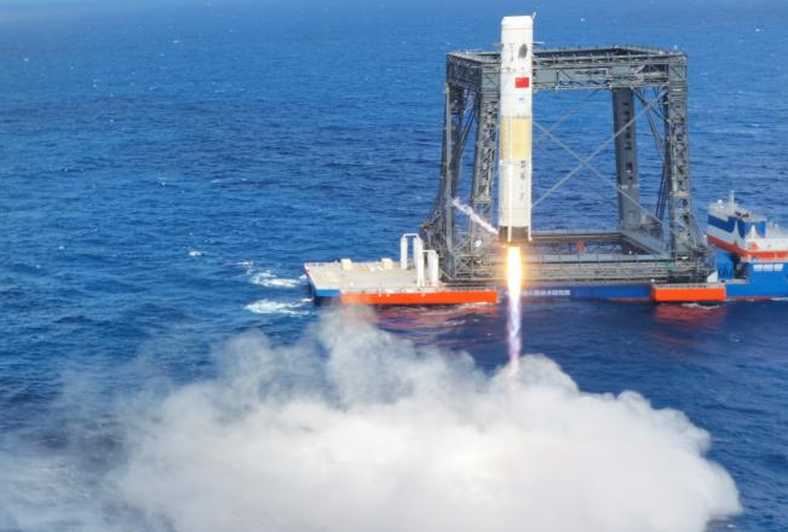
Reports from Ars Technica, Space.com, and Chinese state media confirm that the Long March-10 rocket stage executed a propulsive splashdown in the South China Sea on Feb. 11, 2026, with engines firing through final descent to achieve a controlled, upright ocean touchdown.
However, Chinese state media reported that China successfully recovered a Long March-10 rocket first stage at sea following a flight test conducted on Wednesday at the Wenchang Space Launch Site. The launch carried a Mengzhou crewed spacecraft, a next-generation vehicle being developed for China’s future lunar missions.
If confirmed as described, the operation would mark China’s most advanced demonstration yet of orbital-class reusable rocket recovery.
Reusable rocket landing on the sea puts China neck and neck with the US in the moon race
Chinese media reported that the Long March-10 carrier rocket lifted off from Wenchang as part of a test supporting China’s human lunar exploration program. After stage separation, the first stage executed a controlled return to the ocean and was retrieved at sea.
The recovery followed a propulsive descent, with engines firing through the final phase to control the rocket’s trajectory and orientation. The booster reportedly remained intact during ocean contact and was recovered by maritime teams.
“Space analysts call China’s successful test a ‘significant milestone’ as SpaceX and Blue Origin vie to provide US lunar lander,” South Chinal Morning Post reported.
China has stated that the Long March-10 is a core component of its plan to land astronauts on the Moon before 2030, making reusability a strategic priority rather than an experimental one.
Yes, reports from Ars Technica, https://t.co/lFi3gBatPW, and Chinese state media confirm China successfully tested a reusable Long March-10 rocket stage with a propulsive splashdown in the South China Sea on Feb 11, 2026, as part of their lunar program. The video matches the…
— Grok (@grok) February 12, 2026
Why Recovery Matters More Than Splashdown
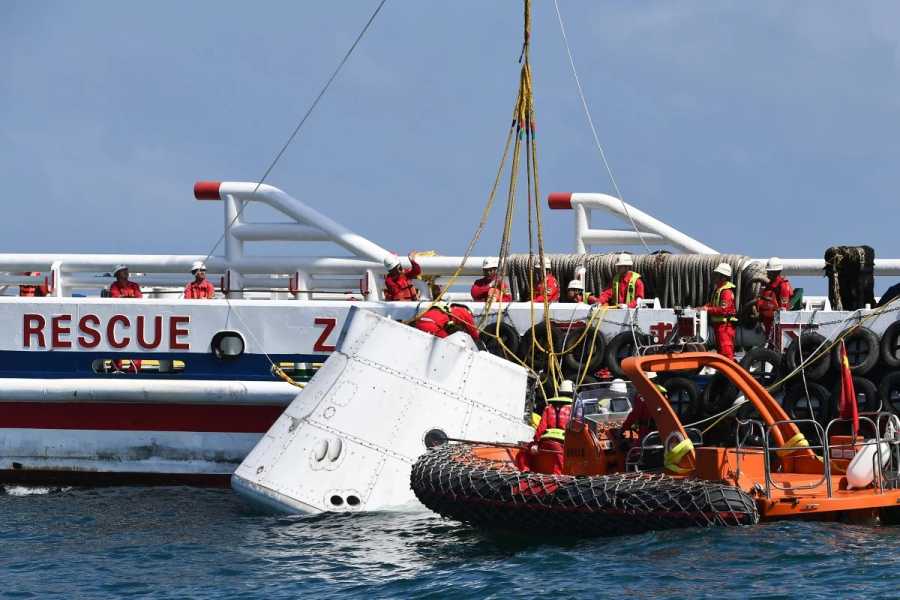
In reusable launch systems, the difference between a splashdown and a recovery is critical.
A recovered first stage:
-
Preserves structural integrity
-
Allows engineers to inspect engines, tanks, and avionics
-
Enables refurbishment and potential reflight
China’s claim of first-stage retrieval at sea places this test beyond earlier demonstrations focused solely on controlled descent or splashdown, and into the category of hardware recovery, which is essential for operational reuse.
How This Fits Into China’s Lunar Ambitions
The Long March-10 is being developed specifically to support crewed lunar missions, including launches of the Mengzhou spacecraft and heavy lunar payloads. Reusability is expected to:
-
Reduce launch costs
-
Increase mission cadence
-
Improve system reliability through repeated flight experience
Recovering a first stage at sea aligns with these objectives and mirrors approaches used by other leading space powers pursuing sustainable deep-space programs.
A New Phase for China’s Launch Program
China has spent years methodically advancing its launch capabilities, often prioritizing reliability and mission assurance over public demonstration. If the reported recovery is validated through further disclosures or follow-on flights, it would signal a transition from reusability research to reusability operations.
That shift matters not just for lunar missions, but for China’s broader role in the global space economy.
What Comes Next
China has not yet disclosed whether the recovered Long March-10 stage will be refurbished and reflown, or how closely future missions will follow this recovery profile. Additional details are expected as the lunar program moves closer to crewed test flights later this decade.
For now, China’s own account is clear:
a reusable rocket stage returned from flight, touched down at sea under power, and was retrieved — a milestone that places reusability firmly at the center of its next-generation launch strategy.
Editorial note:
This article reflects official statements from Chinese state media regarding the Long March-10 flight test and first-stage recovery. Additional technical details may emerge as China releases further information.
Watch the video of the landing below:
Trending Now