OpenAI launches standalone Codex app for Mac, expands AI coding agents to free ChatGPT users
 Nickie Louise
Posted On February 2, 2026
Nickie Louise
Posted On February 2, 2026
OpenAI rolled out a standalone app for its AI coding assistant, Codex, opening a new chapter in how developers work with autonomous software agents. The app is available on Apple computers, and for a limited time, Codex access is open to free ChatGPT users.
The release signals a clear shift in how OpenAI wants developers to build. Codex no longer lives only inside a chat window. The new Mac app serves as a command center where multiple AI agents can run simultaneously, each assigned to its own project thread. OpenAI says the goal is simple: let developers hand off real work and watch it move forward.
“Introducing the Codex app—a powerful command center for building with agents. Now available on macOS,” OpenAI said in a post on X.
OpenAI Rolls Out Codex App for Mac, Giving Developers a Command Center for AI Coding Agents
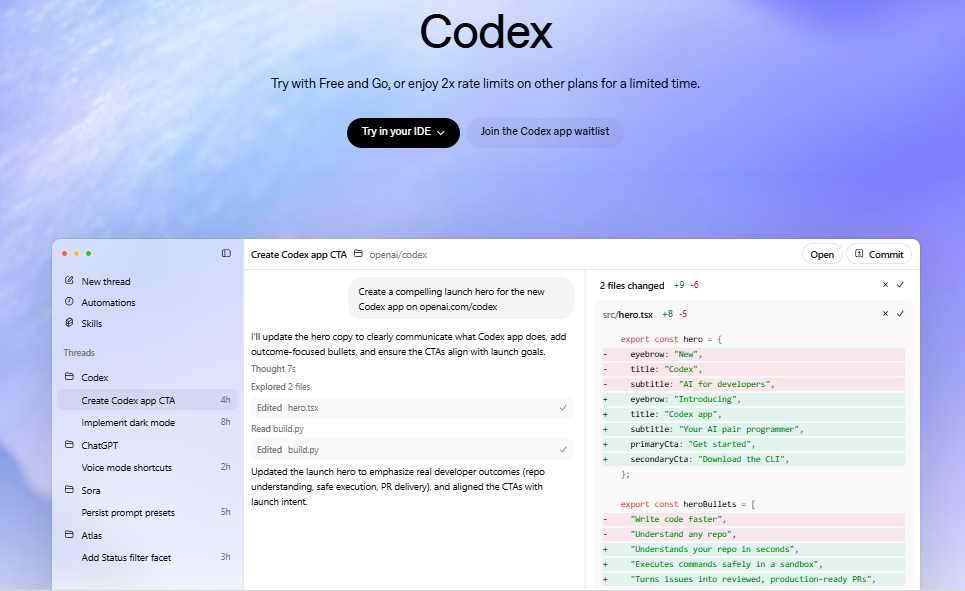
OpenAI Codex
Codex agents are designed to complete tasks independently, including writing and modifying code across files. Within the app, each agent runs in a separate thread, organized by project. Developers can review changes as they appear, comment inline, and collaborate with agents on longer-running background tasks.
AI coding assistants have surged in popularity over the past year, driven by demand for faster iteration and fewer manual steps. OpenAI says more than one million developers used Codex in the past month. The company introduced Codex earlier this year, then made it broadly available in October. The standalone app now gives the product a dedicated home that looks and feels closer to a developer workspace than a chatbot.
The timing is no accident. Competition in AI-assisted coding has intensified, with rivals like Anthropic and Cursor pushing their own tools for software builders. Codex takes a different path. Instead of focusing on autocomplete or inline suggestions, OpenAI is betting on agents that can take ownership of tasks.
OpenAI CEO Sam Altman described the Codex app as “the most loved internal product we’ve ever had” during a briefing with reporters on Friday.
“It’s been totally an amazing thing for us to be using recently at OpenAI,” Altman said. ”I’ve been staying up late at night with excitement, building all sorts of things myself.”
Inside the app, agents can run in parallel, a setup meant to mirror how small teams work rather than how a single developer types. OpenAI says this allows users to offload repetitive or time-consuming tasks, then return later to review progress. Agents stay scoped to their assigned projects, reducing the risk of unintended changes across unrelated codebases.
Codex extends beyond code generation. The app includes a library of skills agents can call into, such as image generation and other tools that support broader project needs. OpenAI frames this as a step toward agents that handle real workflows rather than isolated prompts.
Access to Codex typically comes through paid ChatGPT subscriptions, including Plus, Pro, Business, Enterprise, and Edu plans. With the app launch, OpenAI is temporarily opening Codex to free users and its low-cost Go tier. That move gives a wider audience a chance to test agent-driven coding without an upfront commitment.
Paid users are getting an incentive, too. OpenAI says it is doubling Codex rate limits across its subscription plans for a limited time, allowing more concurrent tasks and faster iteration.
Altman sees this shift as a change in how software gets built. “As fast as I can type in new ideas, that is the limit of what can get built,” he said. “It’s very cool to watch.”
The Codex app points to a future where developers spend less time issuing step-by-step instructions and more time directing outcomes. For OpenAI, it’s a bet that coding with agents, not prompts, will define the next phase of developer tools.
Trending Now