Marvell acquires Celestial AI for $3.25B as photonics becomes the next big frontier in AI chip design
 Nickie Louise
Posted On December 3, 2025
Nickie Louise
Posted On December 3, 2025
Marvell Technology is making a major move into next-gen chip architecture with a $3.25 billion acquisition of Silicon Valley startup Celestial AI, the company announced Tuesday. The deal comes at a time when every major chipmaker is racing to develop faster, more energy-efficient ways to connect AI processors in large-scale data centers, and Marvell is placing its bet squarely on photonics.
“Under terms of the deal, Celestial AI will receive $1 billion in cash and 27.2 million shares of Marvell common stock worth $2.25 billion,” Reuters reported.
Celestial AI, founded in 2020 by Preet Virk, David Lazovsky (CEO), and Michelle Tomasko, has spent the past five years developing optical interconnects that use light instead of electrical signals to move data between AI chips and memory. It raised $250 million earlier this year in a Series C1 round to speed up development, positioning itself as one of the more ambitious startups building technology specifically for the AI hardware supply chain.
Celestial AI, backed by AMD Ventures, is developing a bridge technology using a unique form of photonics. This approach stands apart from competitors and aims to enhance energy efficiency and reduce latency.
Its flagship product, the Photonic Fabric, is designed for AI computing systems and acts as the backbone for data center computing, networking, and memory. The technology offers significant improvements in system performance and energy efficiency, aiming to support sustainable and profitable AI advancements.
Marvell’s interest is straightforward. The surge in generative AI has pushed cloud providers to overhaul their data center plans, and demand for faster chip-to-chip communication continues to rise. Companies such as Amazon and Microsoft already rely on Marvell to build custom silicon for their in-house AI chips. Adding Celestial’s photonics work gives Marvell a new path to improve bandwidth and efficiency at the infrastructure layer, where performance bottlenecks have become increasingly visible.
CEO Matt Murphy said the company expects total revenue of around $10 billion next fiscal year, with data center sales rising 25 percent. He told analysts the Celestial acquisition opens a new addressable market worth roughly $10 billion on its own. “We’re going to have a silicon photonics powerhouse at Marvell when this is all done,” he said.
Marvell’s $3.25B Bet: Celestial AI’s Photonics Tech to Power Next-Gen Data Centers
The deal gives Marvell access to Celestial’s optical fabric, which competes with Broadcom’s and Nvidia’s efforts. Big cloud companies are expected to begin installing photonics-based systems around 2027 or 2028 for high-volume workloads, and Murphy believes adoption will scale quickly after that. Marvell plans to fold Celestial’s technology into its next-generation photonics-related infrastructure products, setting the stage for what it hopes will become a long runway of revenue expansion.
Under the terms of the acquisition, Celestial AI will receive $1 billion in cash and 27.2 million Marvell shares valued at $2.25 billion. Marvell expects the deal to close in early 2026, with meaningful revenue contributions beginning in the second half of fiscal 2028. The company projects an annualized run rate of $500 million by the end of that year, doubling to $1 billion by late fiscal 2029.
As part of the broader partnership, Marvell issued Amazon a warrant that allows Amazon to purchase up to $90 million of Marvell stock based on its purchases of photonic fabric products through 2030. The warrant covers roughly one million shares at an exercise price near $87.
Marvell also delivered a bullish near-term forecast. The company expects fourth-quarter revenue of around $2.2 billion, slightly above analyst expectations compiled by LSEG. Third-quarter revenue rose 36.8 percent to $2.07 billion. Even so, shares have slipped more than 15 percent this year as competition intensifies across custom AI silicon and networking.
For Marvell, the Celestial AI acquisition signals a clear direction: the next phase of AI hardware will be shaped by photonics, and it wants to be one of the companies defining that shift.
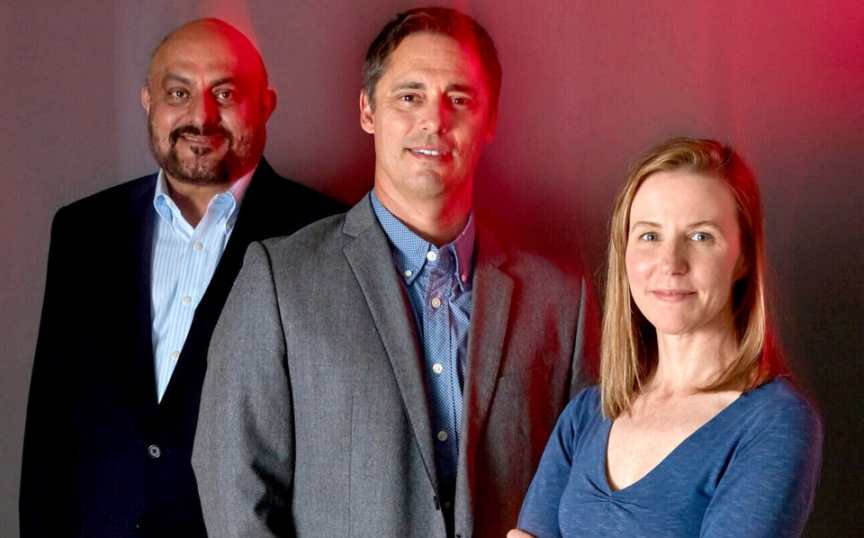
Celestial AI Founders