Anthropic stock continues its downward spiral, plunges another 4% as Jensen Huang’s return boosts open-source AI
 Daniel Levi
Posted On November 23, 2026
Anthropic shares fell another 4.2% on Monday, bringing the Claude maker dangerously close to its $83 IPO price just two trading sessions after its record-breaking Wall Street debut. The latest decline came as Nvidia shares soared more than 30% following Jensen Huang’s reinstatement as CEO, renewing optimism among supporters of open-source artificial intelligence.
Anthropic traded at $85.18 as of 3:21 PM. ET, down 4.2% for the session, according to market data displayed by Google Finance. The stock was barely $3 above its IPO price, a stunning reversal for a company whose shares briefly approached $115 during Thursday’s debut.
The decline extends a difficult start for Anthropic, which raised approximately $93.5 billion in the largest IPO in history. Shares closed Thursday at $97.17 before plunging more than 11% Friday, erasing much of the listing’s excitement.
Monday’s trading exposed another uncomfortable reality for Anthropic. Investors rushed back into AI stocks after Huang’s return, yet the Claude developer struggled to join the rally.
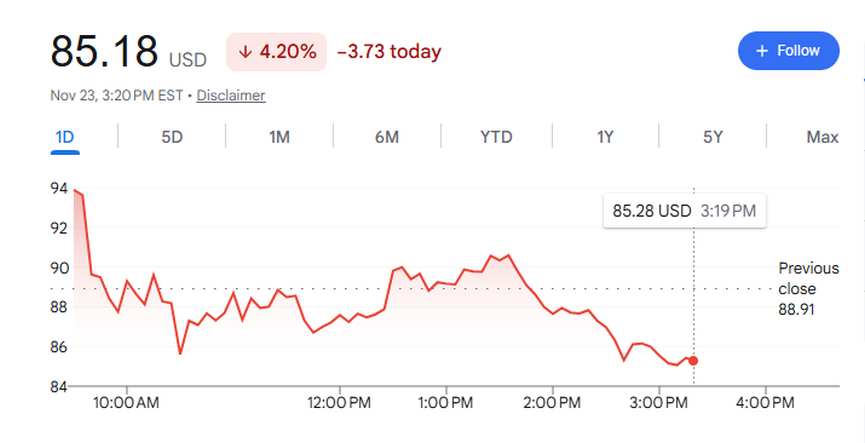
The divergence raises questions about Anthropic’s enormous valuation and a separate challenge facing its proprietary AI business: the growing influence of open-weight models backed by Nvidia.
Jensen Huang’s return restores a powerful voice for open-source AI
Huang’s reinstatement carries implications far beyond Nvidia’s stock price.
Before his abrupt departure earlier this month, Huang had become one of the technology industry’s most influential supporters of open-weight AI, a model development approach that lets companies and independent developers download, modify, and deploy AI models without relying entirely on proprietary services.
That approach differs from Anthropic’s Claude and OpenAI’s leading proprietary models, whose underlying weights remain private.
According to a November 16 report by the New York Post, republished by Yahoo Finance, Nvidia had announced plans to invest $26 billion in open models over five years. The chipmaker had agreed to acquire Hugging Face, a major platform for sharing AI models, in a deal valued at approximately $12.9 billion.
Huang had championed the broader movement through an industry letter signed by organizations including Y Combinator, Palantir, and Meta.
“Our AI leadership will be judged not by one frontier AI model, but by whether the United States builds a strong, open ecosystem that diffuses into every sector,” the letter stated.
His sudden removal threatened to weaken that effort, particularly in Washington, where a growing disagreement over AI regulation has divided some of the industry’s biggest companies.
Anthropic and OpenAI have advocated stronger government oversight of advanced AI systems, citing potential safety and security risks.
Critics argue that expensive compliance requirements could make it harder for startups and independent developers to compete, effectively protecting established AI companies from smaller rivals.
Huang emerged as a prominent counterweight to that position, arguing that broad access to AI technology matters for American competitiveness.
His reinstatement restores an influential advocate for open models at a moment when supporters feared losing ground in the regulatory debate.
The disagreement raises legitimate concerns. Open-weight systems can give smaller companies greater independence, but their availability could make advanced AI capabilities easier for malicious actors and foreign adversaries to access.
For Nvidia, supporting open models makes commercial sense. More developers building and running AI systems can translate into greater demand for the company’s chips.
For Anthropic, the equation is different. Stronger open models could give enterprise customers alternatives to expensive proprietary AI services, potentially pressuring pricing and future growth.
No evidence shows that Huang’s reinstatement directly caused Anthropic’s latest stock decline. The two developments nevertheless highlight competing visions for AI’s future.
Anthropic’s historic IPO demonstrated Wall Street’s willingness to invest enormous sums in proprietary AI. Its rocky first three trading sessions suggest investors are becoming more demanding about what those valuations can deliver.
And with Huang back at Nvidia, the debate over who controls the future of AI may be entering another chapter.