Anthropic paid Trump-connected lobbying firms $1.63 million as questions grow over Jensen Huang’s Nvidia exit
 Daniel Levi
Posted On November 17, 2026
Anthropic paid two lobbying firms closely tied to President Donald Trump’s political circle a combined $1.63 million as Washington intensified its scrutiny of Nvidia and its former CEO, Jensen Huang, according to federal lobbying disclosures. The payments, reported across six quarters, have drawn fresh attention following Huang’s sudden departure from the AI chip giant.
The firms, Continental Strategy and Ballard Partners, reported lobbying the National Security Council during the second quarter of 2026. Both have connections to senior Trump administration figures, including Secretary of State Marco Rubio and former White House chief of staff Susie Wiles.
The timing has raised questions about Anthropic’s political influence amid growing tensions over AI chip exports to China, national security, and competition between open and proprietary AI models.
According to a November 17 ZeroHedge investigation citing earlier Bloomberg reporting, Anthropic hired Ballard Partners on March 9, 2026, just four days after the Pentagon designated the AI company a supply-chain risk. ZeroHedge subsequently examined federal lobbying disclosures showing payments to Ballard Partners and Continental Strategy totaling $1.63 million since April 2025.
A November 17 ZeroHedge investigation, citing earlier Bloomberg reporting, examined Anthropic’s ties to Trump-connected lobbying firms and their reported government contacts. The investigation linked the timing of those lobbying activities to a March 30 memo from Secretary of State Marco Rubio concerning intelligence related to Alice Huang, a former executive at Singapore-based Megaspeed.
“Anthropic PBC hired the lobbying firm Ballard Partners as it draws out its fight with the Pentagon, a new public document shows. The artificial intelligence company hired Ballard Partners—the biggest shop in Washington, which also has strong ties to the Trump administration—just days after the Pentagon designated the company as a supply chain risk,” Bloomberg reported, citing a recent lobbying disclosure filing.
The records establish the lobbying activity and expenditures. They do not establish that Anthropic sought Huang’s removal or influenced Nvidia’s decision.
Following Anthropic’s $1.63 million lobbying trail
Federal lobbying records show that Anthropic retained Continental Strategy in April 2025 and Ballard Partners in March 2026.
| Lobbying firm | Reported payments | Political connections |
|---|---|---|
| Continental Strategy | $740,000 | Alberto Martinez, former chief of staff to Marco Rubio; Katie Wiles, daughter of Susie Wiles, is a partner |
| Ballard Partners | $890,000 | Former firm of Susie Wiles, Trump’s former White House chief of staff |
| Total | $1,630,000 |
Credit: ZeroHedge
The payments cover reporting periods through September 2026 and represent lobbying income disclosed by the firms, not a single transaction.
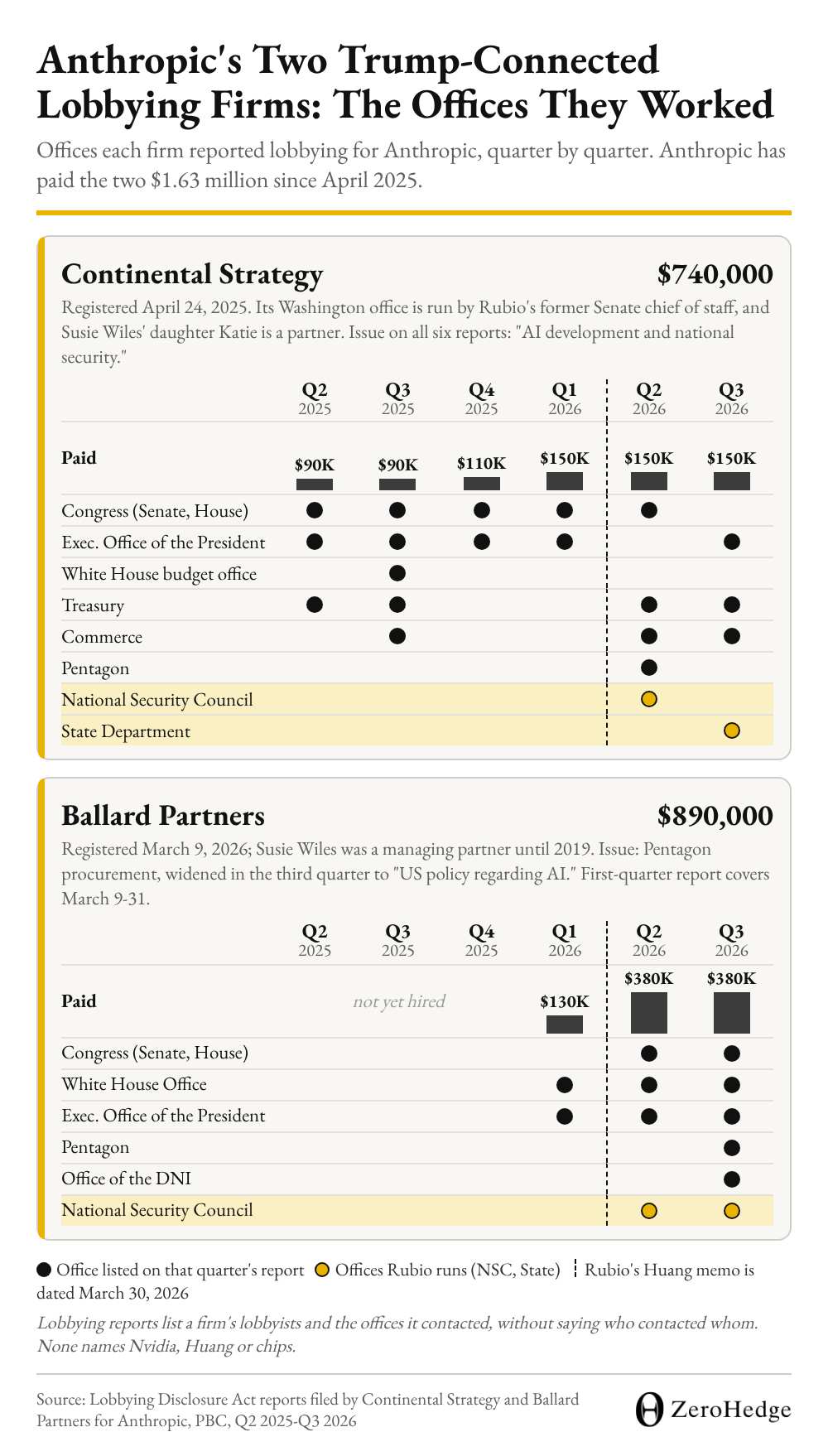
Continental’s Washington managing partner, Alberto Martinez, appears on all six quarterly reports covering its Anthropic account. Its second-quarter 2026 filing lists the National Security Council among the offices contacted. Its third-quarter report identifies the State Department.
Both offices fell under Rubio’s leadership during the period examined.
Ballard Partners registered to represent Anthropic on March 9, 2026, days after the Pentagon designated the AI company a supply-chain risk.
Its second-quarter federal disclosure reported $380,000 in lobbying income and listed the National Security Council, the White House Office, and the Executive Office of the President.
That filing identified Pentagon procurement advocacy as its lobbying issue.
The distinction matters. The disclosures identify government offices and policy areas, but they do not reveal the contents of individual conversations.
The former government officials on Anthropic’s lobbying accounts
The firms brought considerable Washington experience to their work for Anthropic.
| Lobbyist | Firm | Previous government position |
|---|---|---|
| Alberto Martinez | Continental | Chief of staff to Marco Rubio |
| Carlos Trujillo | Continental | U.S. ambassador to the Organization of American States |
| Caroline Farr | Continental | Senior adviser, Treasury Department |
| Amaryllis Fox Kennedy | Ballard | Deputy director of national intelligence; former CIA officer |
| Micah Ketchel | Ballard | White House and State Department adviser; former chief of staff to Mike Waltz |
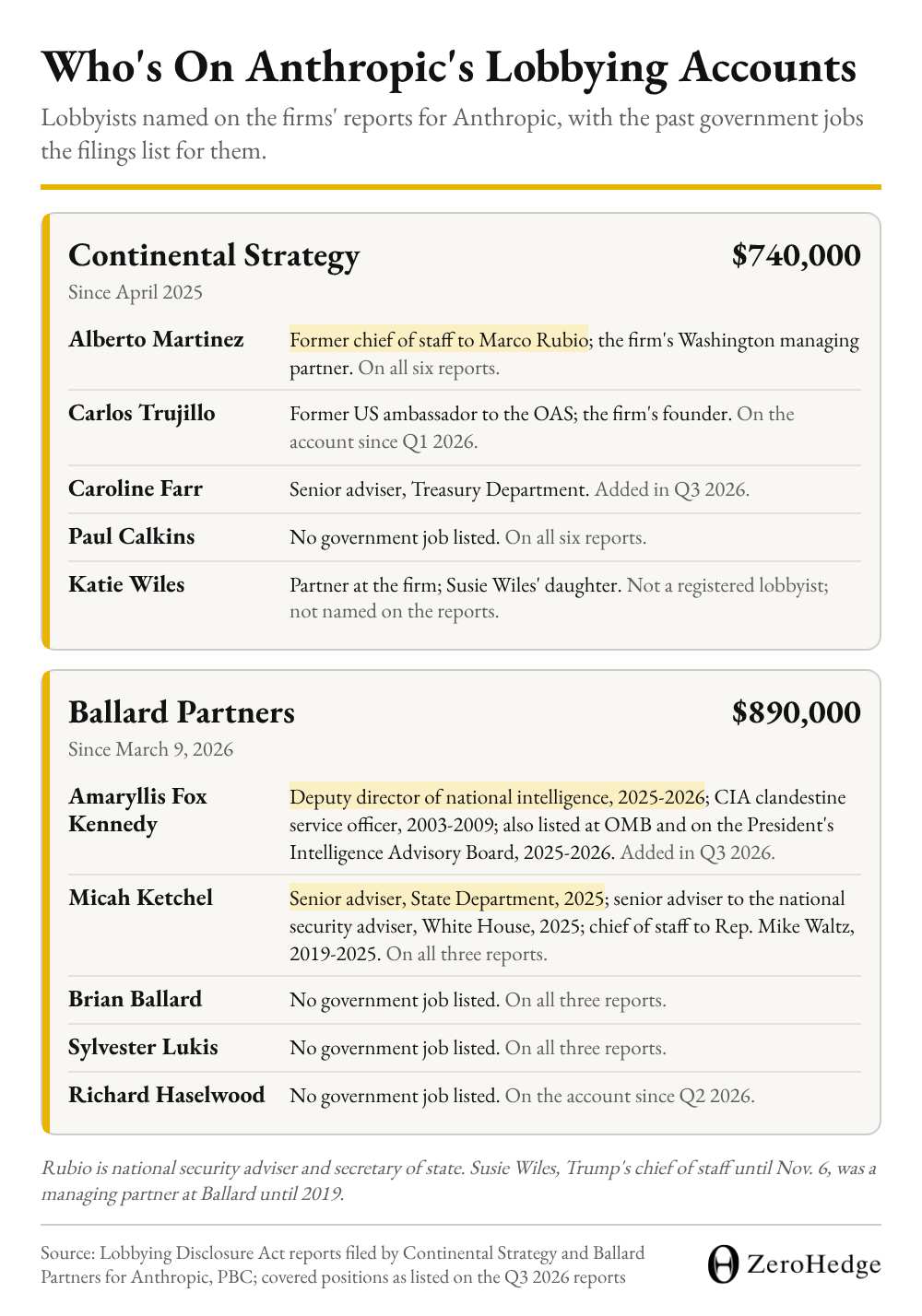
Anthropic’s lobbying accounts (Credit: ZeroHedge)
Ballard’s third-quarter filing added Fox Kennedy, whose reported government background includes senior intelligence work.
Continental’s connection to Susie Wiles extends through her daughter Katie, a partner at the firm. Katie Wiles is not listed as a registered lobbyist on Anthropic’s disclosures.
The network illustrates how major AI companies recruit former government officials to represent their interests in Washington. Such relationships are common in federal lobbying and do not, by themselves, establish misconduct.
Timeline: From the Megaspeed investigation to Huang’s resignation
The sequence of events helps explain why the lobbying disclosures have attracted attention.
| Date | Key development |
|---|---|
| 2024 | Commerce Department begins investigating Megaspeed for potential export-control violations |
| April 2025 | Continental Strategy begins representing Anthropic |
| May–June 2025 | Commerce requests Nvidia sales records; Nvidia places Megaspeed on its no-sell list |
| March 9, 2026 | Ballard Partners registers as an Anthropic lobbyist |
| March 30, 2026 | Rubio issues a memo concerning intelligence linked to Alice Huang, according to reports |
| April 17, 2026 | Anthropic CEO Dario Amodei meets Susie Wiles and Treasury Secretary Scott Bessent |
| April–June 2026 | Both lobbying firms report National Security Council contacts |
| July–September 2026 | Continental reports State Department lobbying; Ballard continues reporting NSC activity |
| November 12, 2026 | Nvidia publicly announces Jensen Huang’s resignation |
| November 16–17, 2026 | Commerce and Justice release details about the Megaspeed investigation |
The April 17 White House meeting offers another window into Anthropic’s relationship with the administration.
Axios reported that Amodei met Wiles and Bessent amid negotiations concerning Anthropic’s dispute with the Pentagon and its technology’s potential government applications.
That context provides an independently reported explanation for at least some of Anthropic’s engagement in Washington.
Why Huang’s departure matters in the AI rivalry
Huang had emerged as one of the industry’s most influential advocates for open-weight AI models and continued access to the Chinese market under export controls.
Nvidia’s Nemotron models and its investments in emerging AI companies placed the chipmaker in an increasingly influential position beyond semiconductor manufacturing.
Anthropic, the developer of Claude, operates primarily through proprietary AI models and has advocated tighter restrictions on exports of advanced AI chips to China.
The companies’ interests overlap, but their policy priorities have sometimes diverged.
Huang’s exit could alter the balance of influence in Washington as lawmakers debate chip restrictions, AI competition, and national security.
That potential shift has fueled speculation about who benefits from his departure. Yet a commercial or political advantage does not establish involvement in the events that led to his resignation.
The government investigation began before the lobbying controversy
A joint statement from the Commerce and Justice departments, dated November 16, confirms that federal investigators began examining Megaspeed in 2024.
Investigators sought Nvidia sales records in May 2025, inspected Megaspeed in June, and interviewed Alice Huang, according to the statement. Justice later assumed responsibility for the criminal investigation.
That chronology places the investigation’s origins before Anthropic’s reported arrangements with Continental Strategy and Ballard Partners.
The government has not established publicly that Alice Huang knowingly engaged in espionage. Allegations concerning her potential intelligence connections remain disputed.
Nvidia’s November 12 announcement confirmed Jensen Huang’s departure and named CFO Colette Kress as interim CEO. Its public announcement did not implicate Anthropic.
What remains unanswered
The lobbying records establish that Anthropic spent substantial sums engaging Washington firms with relationships across the administration’s national security establishment.
They do not identify Nvidia, Jensen Huang, or semiconductor exports as targets of the reported lobbying activity.
No evidence presented in the disclosures demonstrates that Anthropic requested, coordinated, or contributed to Huang’s removal.
The unanswered question is whether any conversations between Anthropic’s representatives and federal officials concerned Nvidia or Huang personally.
Until further documentation or firsthand testimony emerges, the $1.63 million lobbying trail establishes political access and advocacy, not responsibility for Nvidia’s leadership crisis.
The broader story reaches beyond one company’s departure. As AI becomes central to American economic and national security policy, the relationships between technology companies, their Washington representatives, and government decision-makers face growing scrutiny.