Aarden raises $8M to build smarter land markets for AI buildout and energy projects
 Daniel Levi
Posted On November 17, 2026

The AI boom is creating a new land rush, and Seattle-based startup Aarden wants to help determine where the next generation of infrastructure gets built. The company has raised $8 million to modernize how landowners, developers, and investors evaluate, value, and transact land for AI infrastructure, energy projects, and other large-scale developments.
Overture Ventures led the round, with participation from Madrona and Propeller Ventures. It brings Aarden’s total funding to $12 million in just 15 months, following a $4 million round led by Planeteer in June 2025.
The timing is no coincidence. As companies race to build data centers, solar farms, transmission networks, and other energy infrastructure, finding suitable land is becoming increasingly difficult. Developers need more than available acreage. They need access to electricity, clear ownership records, favorable development conditions, and landowners willing to make a deal.
Yet much of the land market still operates through fragmented information, lengthy due diligence, and relationships built over years.
Aarden believes artificial intelligence can change that.
“The new economy runs on land. Every development, whether a solar farm, data center, housing, or a novel geothermal project, starts with a site and a landowner,” said Danan Margason, founder and CEO of Aarden, in the company’s funding announcement.
Turning Land Data Into Investment Decisions
Founded in 2025, Aarden is building an AI-native platform that helps landowners and developers determine what a property can be used for, how much it could be worth, and which potential partners make sense.
Its technology analyzes hundreds of land attributes, historical market data, ownership records, development suitability, valuation trends, and community sentiment. The goal is to replace months of manual research with intelligence that supports faster investment decisions.
A property traditionally valued for timber production, for example, could have greater potential for solar installation, an energy storage facility, or industrial development. Aarden’s models help owners compare those possibilities before committing to a particular use.
The company’s website describes its approach as combining infrastructure and environmental data with market trends and community interests to evaluate potential returns across individual parcels.
Aarden says its commercial traction is already substantial.
Since launching commercially earlier this year, the startup has attracted clients that collectively manage about 14 million acres of land, an area nearly the size of West Virginia.
It has analyzed dozens of land transactions valued at $10 million or more, optimized portions of portfolios exceeding one million acres for five multinational landowners, and developed a strategy for a national-scale edge computing initiative.
For institutional landowners, the potential benefits extend beyond finding buyers.
Alex Hinson, president and CEO of Resource Management Service (RMS), said Aarden is helping the company assess whether individual properties should remain in timber production, support conservation, or be considered for solar and industrial development.
According to Hinson, work that previously required months can now produce investment-grade findings that inform portfolio decisions.
Why Investors Are Betting on Land Intelligence
Aarden’s funding reflects an overlooked part of the AI infrastructure boom: Every physical development needs a location, and the best sites are not necessarily the ones already being marketed.
For AI data centers, access to electricity can determine whether a project is economically viable. Energy developers face constraints around grid connections, permitting, land rights, and community acceptance.
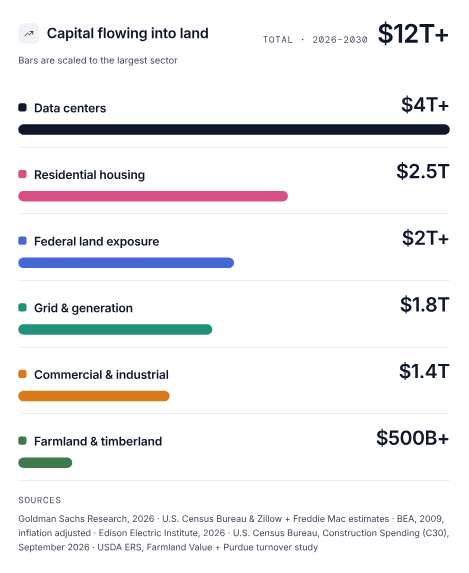
Capital flowing into land (Credit: Aarden)
These factors can turn site selection into a costly bottleneck long before construction begins.
Shomik Dutta, managing partner at Overture Ventures, sees an opportunity to modernize that process.
“The buildout of AI and energy infrastructure is the largest capital deployment in history, and every one of those projects runs through land,” Dutta said.
Aarden is positioning itself as more than a property analytics provider. Its broader ambition is to connect landowners, developers, and investors through a market infrastructure that supports projects from initial assessment through transactions.
That ambition comes with challenges. Land values depend on local regulations, infrastructure availability, environmental restrictions, and changing market conditions. AI can help analyze those factors, but its predictions still need to hold up against real-world development outcomes.
Aarden says it tests its models against sites developers previously selected and converted, though it has not disclosed detailed performance metrics.
The startup plans to use its latest funding to expand its landowner services, develop real-time market intelligence, improve its ability to prepare transaction-ready sites, and hire additional employees.
For Aarden, the opportunity is bigger than identifying land for the next data center or solar farm. It is about making an enormous, historically fragmented asset market more transparent.
As billions flow into AI and energy infrastructure, the companies that help developers identify the right land could become just as important as those building on it.

Aarden founder and CEO Danan Margason