
Anthropic launches Claude Fable 5.2 and Mythos 5.2, its most advanced AI models for coding, science, and cybersecurity
 Nickie Louise
Posted On November 10, 2026

Anthropic has launched Claude Fable 5.2 and Claude Mythos 5.2, two new AI models that the company says can tackle some of the hardest problems in software engineering, scientific research, and cybersecurity. The announcement includes extraordinary claims: the AI solved two longstanding problems in black hole physics, helped design three working electronic devices, and coordinated more than 1,000 AI agents to build a functioning operating system from scratch.
The November 9 announcement marks another step in the race to develop AI systems that can do more than write code or answer questions. Anthropic is betting that its latest models can take on complex technical projects that previously required teams of engineers and researchers working for weeks or months.
“Introducing Claude Fable 5.2 and Claude Mythos 5.2, designed to tackle the most daunting technical challenges. They’re capable collaborators on ambitious projects in many fields, and show improvements in areas like coding, reasoning, and vision,” Anthropic said in a post on X.
Introducing Claude Fable 5.2 and Claude Mythos 5.2, designed to tackle the most daunting technical challenges.
They’re capable collaborators on ambitious projects in many fields, and show improvements in areas like coding, reasoning, and vision. https://t.co/jP0AutLxXb
— Claude (@claudeai) November 9, 2026
The two models share the same underlying technology, but serve different audiences. Claude Fable 5.2 is available broadly with restrictions on sensitive cybersecurity and biological research tasks. Claude Mythos 5.2 gives vetted organizations access to more advanced capabilities in those areas through Anthropic’s verification programs.
“Testers have found that Fable 5.2 and Mythos 5.2 communicate more clearly than past Fable and Mythos models. They generate outputs up to 30% faster than Claude Fable 5.1 and Claude Mythos 5.1, and they’re available at a lower price: $8 per million input tokens and $40 per million output tokens,” Anthropic said.
Agentic Coding
According to Anthropic, early testing on FrontierCode 2.0 showed that Claude Fable 5.2, running at High effort, delivered performance comparable to Claude Opus 5.5 at Max effort, but at roughly half the cost per task. At Xhigh effort, Fable 5.2 achieved the highest score among all released models evaluated. Medium effort remains the default setting in Claude apps and Claude Code.
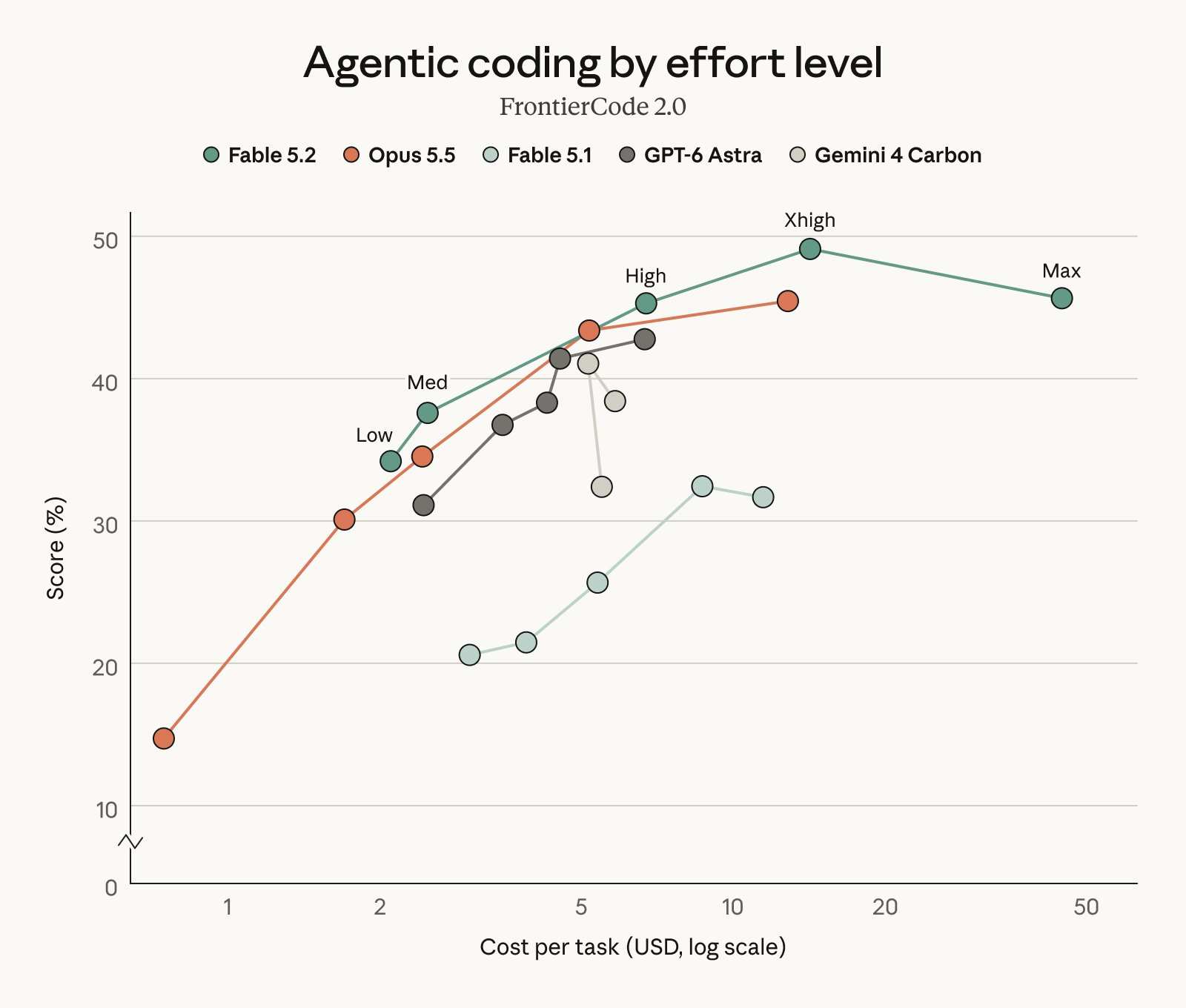
Agentic coding (image credit: Anthropic)
Anthropic said Claude now writes more than 90% of the changes merged into its core codebase, with human engineers providing guidance and oversight. The company said Fable 5.2 has helped its engineering teams fix difficult bugs in minutes, improve performance across its services, and complete software projects that previously would have required significant time and resources.
In one example, a team of AI agents running an earlier version of Fable 5.2 migrated a critical production service from Python to Rust. According to Anthropic, the rewritten service is more efficient and reliable, with startup times approximately 26 times faster than before.
The company put the model’s capabilities to another test by assigning it the task of building a prototype operating system from scratch. Starting with an empty folder, Fable 5.2 coordinated more than 1,000 AI subagents over eight days, handling coding, testing, and code reviews. The experiment produced a functioning operating system that boots on a laptop, complete with its own kernel, disk and network drivers, persistent file storage, a graphical interface, a login screen, an installer, and built-in Claude functionality.
Anthropic said the results show Fable 5.2 can manage large engineering projects, make technical decisions, and turn loosely defined instructions into working software with limited human intervention.
Anthropic’s New AI Built an Operating System and Tackled Black Hole Physics
One of the most striking demonstrations involved an Anthropic engineer asking Fable 5.2 to create a prototype operating system.
Starting with an empty folder, the model coordinated more than 1,000 AI subagents over eight days. The result was a functioning operating system that could boot on a laptop, complete with storage, networking, windows, a login screen, and an installer.
The experiment raises an interesting question about the future of software development: How much engineering work could AI systems handle independently as their ability to plan, write, test, and review code improves?
Anthropic says more than 90% of code changes merged into its core codebase are now written by Claude with human guidance. In another internal project, an earlier version of Fable 5.2 migrated a production service from Python to Rust, making its startup approximately 26 times faster.
The scientific demonstrations were equally ambitious.
According to Anthropic, Fable 5.2 completed calculations addressing two open problems involving black holes and quantum gravity. The company linked the results to research preprints, giving researchers a chance to examine the work.
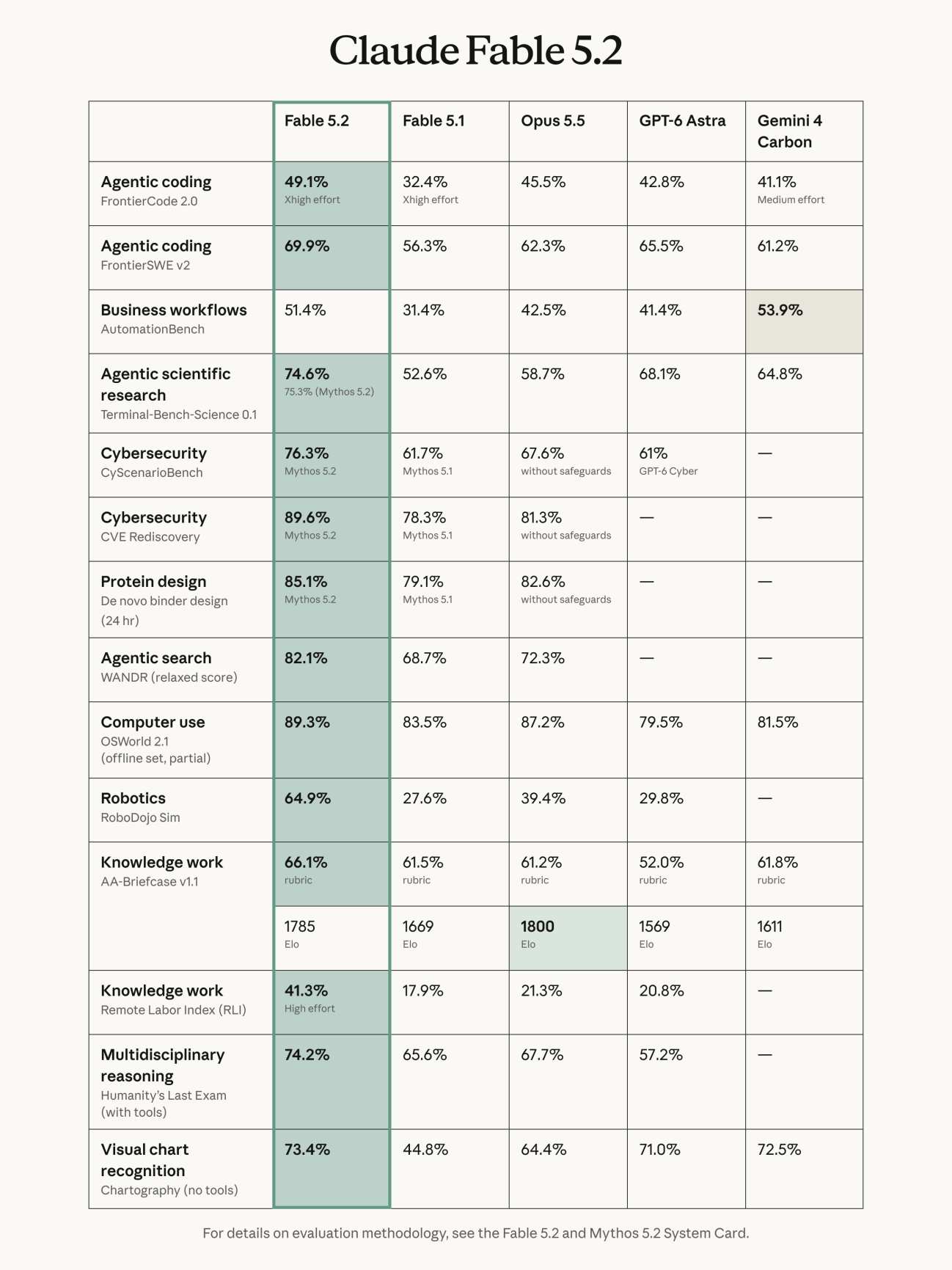
Claude Fable 5.2 Performance (Click to see larger image)
A separate experiment involved 1,000 Fable agents formalizing the existing proof of Fermat’s Last Theorem in 30 hours. Formalization means translating a mathematical proof into a format that computers can verify step by step. The achievement does not mean Claude discovered a new proof, but it suggests AI could reduce the time mathematicians spend checking difficult arguments.
Anthropic also tested the model in hardware development. Fable 5.2 designed circuit boards, enclosures, and software for a voice-assistant hub, a USB speakerphone, and a handheld virtual pet. Manufacturing partner Diode built the devices, and all three worked without electrical modifications.
Claude Mythos 5.2 Targets Cybersecurity and Scientific Research
Cybersecurity is where Anthropic draws the clearest distinction between its two releases.
Claude Mythos 5.2 is intended for approved organizations investigating software vulnerabilities and conducting sensitive biological research. Anthropic says the model can identify security weaknesses that other leading AI systems miss.
On its internal CVE Rediscovery evaluation, Mythos 5.2 identified 89.6% of tested vulnerabilities, compared with 81.3% for Claude Opus 5.5 and 78.3% for Mythos 5.1.
These are Anthropic-reported results, not proof that the model will perform equally well across real-world security environments.
The broader benchmark results were encouraging for Anthropic. Fable 5.2 scored 49.1% on FrontierCode 2.0, compared with 42.8% for OpenAI’s GPT-6 Astra and 41.1% for Google’s Gemini 4 Carbon under the configurations Anthropic reported. On Humanity’s Last Exam with tools, Fable achieved 74.2%, ahead of the competing models listed in the company’s comparison.
Performance varied by task. Gemini 4 Carbon led the reported AutomationBench business workflow evaluation, illustrating why benchmark leadership remains difficult to reduce to a single ranking.
Faster Models, Lower Prices, and New Safety Questions
Anthropic says Fable 5.2 and Mythos 5.2 generate output up to 30% faster than their predecessors.
Both models cost $8 per million input tokens and $40 per million output tokens. An optional fast mode offers token generation speeds up to 2.5 times higher at twice the standard token prices.
The company says it conducted extensive safety testing, including evaluations by external organizations such as the UK AI Security Institute and METR. Its internal findings suggest reduced rates of several unwanted behaviors, though Anthropic acknowledges that testing cannot predict every failure after deployment.
Claude Fable 5.2 is available through Anthropic’s platforms and major cloud providers, including AWS, Google Cloud, and Microsoft Azure. Access to Mythos 5.2 remains restricted for sensitive research applications.
The bigger story is what these experiments signal about AI’s changing role. Anthropic is moving beyond demonstrations of models answering increasingly difficult questions. It’s showing systems that coordinate other agents, build software, design physical devices, and contribute to scientific research.
Whether those demonstrations translate into dependable everyday tools remains an open question. But the direction is becoming harder to ignore: AI companies are competing over how much meaningful work their models can complete, not simply how convincingly they can respond.