Big Tech’s AI spending boom hides $3.6 trillion in off-balance-sheet commitments
 Daniel Levi
Posted On October 23, 2026
The artificial intelligence boom is creating financial obligations far larger than the billions Big Tech reports spending on data centers, chips, and computing infrastructure. Eight major technology companies, including Google, Meta, Microsoft, Amazon, Nvidia, Oracle, Broadcom, and SpaceX, face an estimated $3.6 trillion in off-balance-sheet commitments, raising questions about the financial risks accumulating behind the AI infrastructure race.
The staggering figure, highlighted in an October 21 chart credited to ZeroHedge and based on a Morgan Stanley Research framework, includes future chip purchases, data center leases, financial guarantees, investment agreements, and other contractual arrangements. Many of these obligations stretch years into the future and have not yet appeared as liabilities on corporate balance sheets.
An independent analysis published October 22 by FourWeekMBA, based on recent SEC filings, estimated the combined commitments at approximately $3.56 trillion. Of that amount, roughly $2.03 trillion involves purchase commitments and $1.25 trillion relates to leases that have not yet commenced. The remaining $287 billion covers guarantees, investments, contingent purchases, and other financial arrangements.
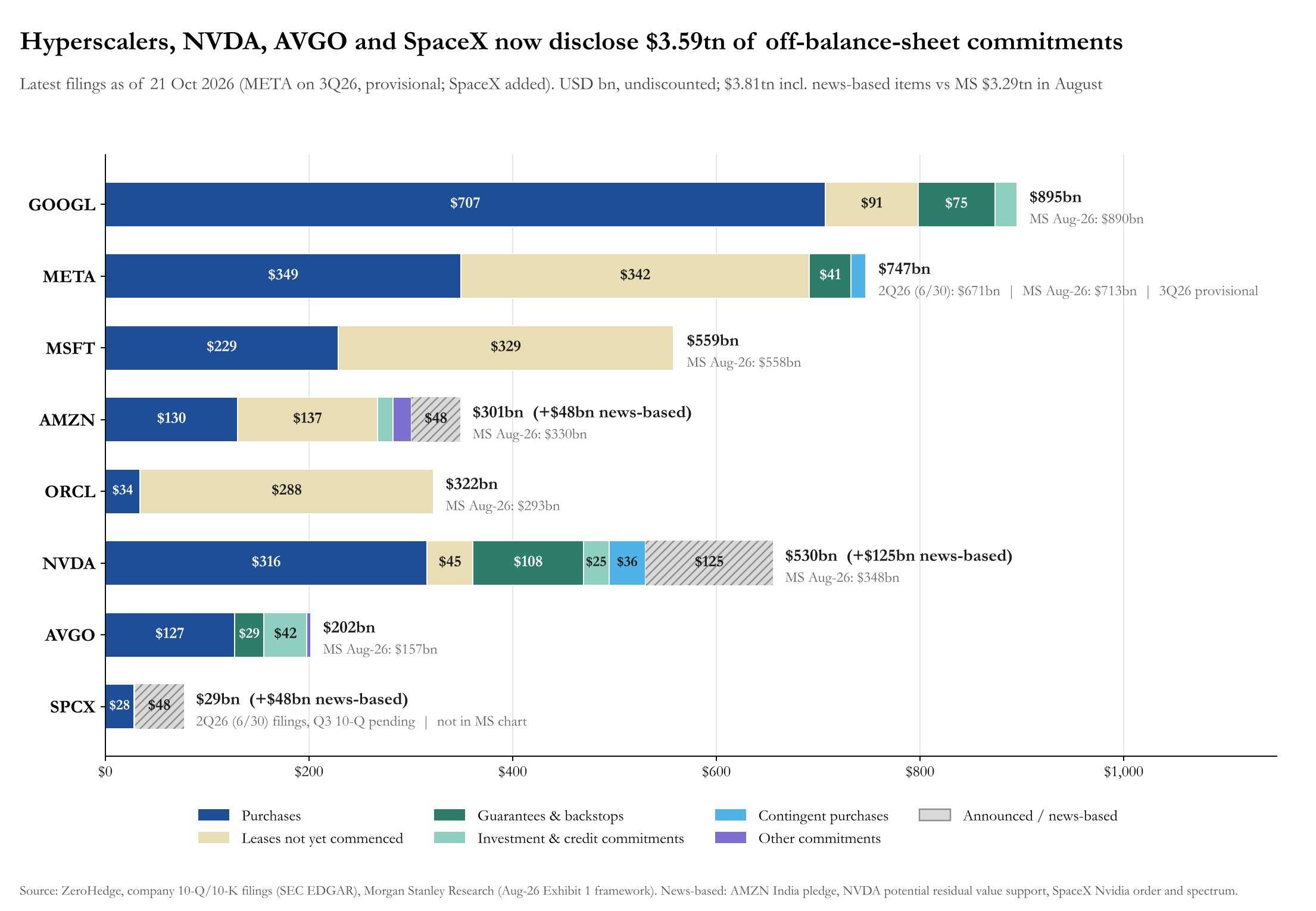
Credit/Source: ZeroHedge, company 10-Q/10-K filings (SEC EDGAR), Morgan Stanley Research (Aug-26 Exhibit 1 framework). News-based: AMZN India pledge, NVDA potential residual value support, SpaceX Nvidia order and spectrum. (Click to enlarge the image)
The findings expose a less visible side of the AI boom. The enormous sums companies report in quarterly capital expenditures represent only part of the financial commitments being made to secure the infrastructure needed to support artificial intelligence.
In August, Bloomberg reported that Morgan Stanley had identified more than $3.1 trillion in commitments across five major cloud providers and chipmakers Nvidia and Broadcom. The investment bank estimated that the five cloud companies alone had obligations exceeding $2.7 trillion, equivalent to approximately three years of their operating cash flow at the time.
Big Tech off-balance-sheet commitments disclosed in SEC filings
| Company | Significant commitments disclosed | Source |
|---|---|---|
| Alphabet (Google) | $811B in purchase and other contractual obligations, plus $85.2B in leases not yet commenced | June 2026 10-Q |
| Meta | $454.52B in noncancelable contracts, $355.73B in uncommenced leases, and up to $14.72B in contingent purchases | September 2026 10-Q |
| Microsoft | $194.06B in purchase commitments and $443.51B in disclosed operating and finance lease payments, including commenced leases | 2026 Annual Report |
| Amazon | $130.07B in unconditional purchase obligations and $137.21B in leases not yet commenced | June 2026 10-Q |
| Oracle | $288B in additional leases not yet commenced and $34.15B in unconditional purchase obligations | August 2026 10-Q |
| Nvidia | $366B in scheduled future commitments, plus $56B in additional commitments and $108.5B in maximum guarantee exposure | July 2026 10-Q |
Figures are undiscounted where reported and are not directly additive without reconciling accounting categories and overlapping obligations. In particular, Microsoft’s lease total includes obligations already reflected on its balance sheet.
Meta’s commitments reveal how quickly the numbers are growing
Meta offers one of the clearest examples of how quickly these financial obligations are accumulating.
In its latest SEC filing for the quarter ended September 30, 2026, the Facebook parent disclosed $454.52 billion in noncancelable contractual commitments, primarily for cloud capacity, servers, networking infrastructure, energy services, and hardware.
The company reported another $355.73 billion in leases that have not yet commenced, covering data centers, energy infrastructure, colocation facilities, and networking equipment. The leases are expected to begin between late 2026 and 2036, with terms extending up to 30 years.
Together, those two categories reached $810.25 billion, up nearly $182 billion from the previous quarter. Adding $14.72 billion in contingent cloud purchase obligations brings the three categories to approximately $825 billion.
The financial exposure extends far beyond Meta.
Alphabet’s commitments reached approximately $871 billion under FourWeekMBA’s filing-based analysis, followed by Microsoft at $558 billion and Nvidia at $426 billion. Oracle accounted for approximately $322 billion, Amazon $286 billion, Broadcom $202 billion, and SpaceX nearly $28 billion.
The estimates differ from some company totals in the ZeroHedge chart because of differences in reporting dates, classifications, and how conditional or news-based arrangements are treated.
What makes up Big Tech’s $3.6 trillion in commitments?
The $3.6 trillion figure is not a single pool of debt. It represents seven categories of financial commitments with different contractual terms and risk levels.
The chart classifies these obligations as follows:
| Commitment type | What it means |
|---|---|
| Purchases | Future contractual purchases of chips, equipment, cloud capacity, services, and other resources. |
| Leases not yet commenced | Future lease payments for data centers and other infrastructure not yet placed into service. |
| Guarantees and backstops | Financial support agreements that may require payment if certain conditions arise. |
| Investment and credit commitments | Agreements to invest capital, provide financing, or extend credit. |
| Contingent purchases | Purchase obligations dependent on future events or contractual conditions. |
| Other commitments | Obligations outside the preceding categories. |
| Announced and news-based | Estimates from announcements or reporting that may not represent finalized contractual obligations. |
Nvidia illustrates how different financial arrangements can accumulate within a single company.
The ZeroHedge chart lists $316 billion in purchases, $45 billion in leases, $108 billion in guarantees and backstops, $25 billion in investment and credit commitments, and $36 billion in contingent purchases. It separately depicts $125 billion in news-based commitments.
Those figures require caution. The five disclosed-category amounts already sum to $530 billion, matching the chart’s displayed total before the additional news-based component. FourWeekMBA’s filing-based analysis calculated a lower Nvidia total of approximately $426 billion.
The discrepancy highlights why these estimates should not be treated as standardized debt calculations.
A contractual chip purchase creates a different financial obligation from a guarantee that may never be exercised. An announced infrastructure investment may change before the underlying agreements become binding.
The financial risks behind AI’s trillion-dollar infrastructure race
Reuters reported in August that Microsoft, Meta, Oracle, Amazon, and Alphabet had committed approximately $1.09 trillion in future lease payments for facilities that had not yet entered service. That compared with roughly $285 billion in lease liabilities already recognized on their balance sheets.
The distinction matters. Future lease payments are often undiscounted and spread across many years, meaning they cannot simply be added to conventional corporate debt.
For Big Tech, long-term agreements can secure scarce computing resources, electricity supplies, and infrastructure capacity before competitors gain access. Strong AI demand could make those commitments profitable.
The risk emerges if revenue growth falls short of expectations.
Companies could find themselves committed to expensive infrastructure that customers cannot fully use, pressuring margins, cash flow, and future investment decisions.
These commitments do not automatically signal an impending financial crisis. Major technology companies generate substantial cash flow, and many obligations extend across decades.
Still, the figures reveal how much of the AI industry’s financial future is being committed today.
The biggest question facing the AI industry may no longer be how much Big Tech is willing to spend, but whether AI can generate enough revenue to justify the trillions of dollars companies are committing.
Sources and methodology: This report draws on company 10-Q and 10-K filings with the U.S. Securities and Exchange Commission (SEC), Meta’s September 2026 quarterly filing, Morgan Stanley research reported by Bloomberg, Reuters’ investigation into Big Tech’s future lease obligations, and FourWeekMBA’s October 22 analysis. Figures include contractual obligations, uncommenced leases, financial guarantees, contingent commitments, and certain news-based estimates. These amounts do not represent conventional debt and may differ depending on the reporting methodology.