Meta launches Muse Spark Open, an 816B-parameter AI model optimized for Apple’s M5 Ultra Macs
 Daniel Levi
Posted On October 15, 2026

Meta’s new open-weight AI model features a 1-million-token context window and can run locally across two Apple M5 Ultra Mac Studios.
Meta has released Muse Spark Open, a massive 816-billion-parameter AI model optimized to run locally on Apple’s M5 Ultra Mac Studios, bringing advanced AI capabilities out of the cloud and onto developers’ desktops. The release marks a significant step in the race to make increasingly capable AI models accessible beyond the data centers operated by major technology companies.
Meta describes the new model as the most capable U.S. open-weight AI model to date, developed for complex coding, software engineering, and autonomous AI agents. It has 816 billion total parameters, 42 billion active parameters, and a 1-million-token context window that can process large amounts of information in a single session.
The headline-grabbing feature is its ability to run locally on two Apple M5 Ultra Mac Studios, using Apple’s MLX machine learning framework. That means developers with sufficiently capable hardware can operate a frontier-scale AI model without sending every request to an external cloud service.
“Today we’re releasing Muse Spark Open, the most capable US open-weight model to date. Built for coding and agentic work, it excels at long-horizon tasks, complex software engineering, and multi-step reasoning,” Meta said in a post on X.
Today we’re releasing Muse Spark Open, the most capable US open-weight model to date.
Built for coding and agentic work, it excels at long-horizon tasks, complex software engineering, and multi-step reasoning.
Key Model Specs:
→ 816B total / 42B active parameters
→ 1M token context window
→ Natively multimodal across text, image, video, audio— AI at Meta (@AIatMeta) October 15, 2026
The release arrives as competition intensifies among Meta, OpenAI, Google, Anthropic, and other AI developers over who can build the most capable models and how those models should be distributed.
Meta and Apple bring massive AI models to the desktop
Running an 816-billion-parameter model on desktop hardware would have been difficult to contemplate just a few years ago. Meta’s approach relies on a mixture-of-experts architecture that activates only 42 billion parameters during inference, reducing the amount of computation needed for each token.
Apple’s hardware plays a central role in enabling local deployment.
Each M5 Ultra Mac Studio supports up to 512GB of unified memory, allowing two machines to provide a combined 1TB memory pool. The chip’s 1.2TB/s memory bandwidth helps move model data quickly enough to support inference.
Meta worked with Apple’s MLX framework to optimize the model for this setup, effectively turning two desktop computers into a system that can host an AI model that would ordinarily require specialized server infrastructure.
The company demonstrated the model performing real software development tasks through Muse Code, including modifying Ice Cubes, an open-source Mastodon client. The demonstrations covered bug fixes, new features, and complete application builds.
Another demonstration involved DaVinci Resolve, where the model analyzed video footage frame by frame, identified promising clips, and prepared footage for vertical video formats.
These examples highlight Meta’s focus on agentic AI, where models go beyond answering questions to carrying out sequences of actions across software applications.
Muse Spark Open is natively multimodal, supporting text, images, video, and audio. Its 1-million-token context window gives developers room to work with extensive codebases, long documents, and other large inputs.
Meta expands its open-weight AI strategy as competition heats up
Muse Spark Open is available through inference providers including Baseten, Fireworks AI, Groq, Modal, Nebius, OpenRouter, and Together AI.
Developers can download Muse Spark Open weights through Hugging Face, Amazon SageMaker AI, Google Cloud Model Garden, and Microsoft Foundry Models.
The model supports popular inference frameworks including vLLM, SGLang, TensorRT-LLM, llama.cpp, and Apple MLX, with optimizations for hardware from AMD, Apple, Intel, and Nvidia.
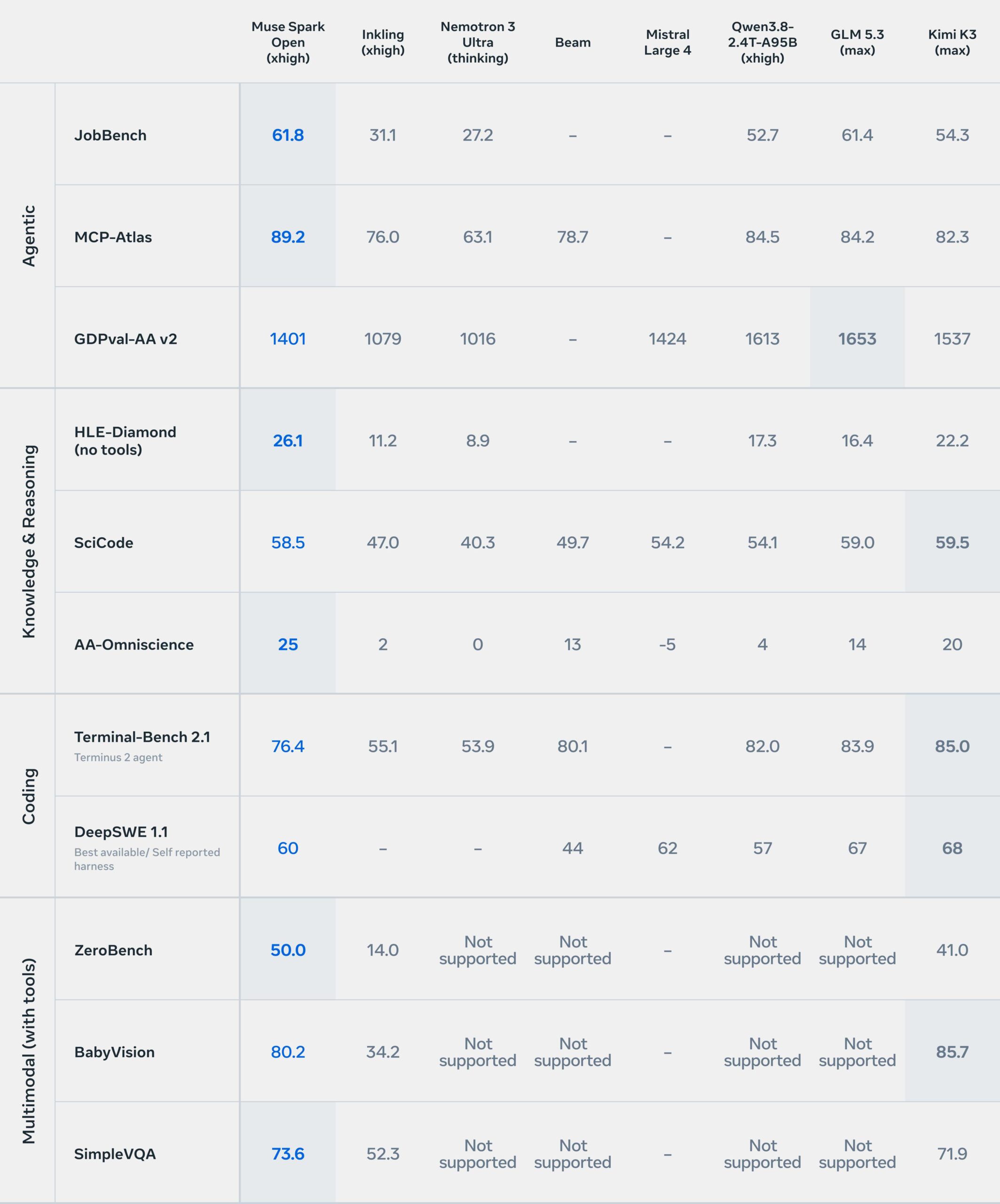
Muse Spark Open Benchmark (Source: Meta AI)
Meta says its custom Helion GPU kernels deliver speed improvements ranging from 1.03 to 3.95 times in individual kernel benchmarks. Those gains should not be confused with overall model performance. The company reported a more modest 3% end-to-end improvement on AMD’s MI350 hardware.
The release comes with an important limitation. Muse Spark Open is distributed under Meta’s Muse Model License, which includes restrictions on commercial use. Developers can inspect and customize the weights, but the licensing terms differ from those of permissively licensed open-source software.
Meta says it conducted safety evaluations under its Superintelligence Scaling Framework and applied additional safety training before releasing the weights. A detailed evaluation report is expected to follow.
For developers, the biggest question may be whether running a model this large locally makes financial sense. Two high-end Mac Studios represent a substantial hardware investment, and local deployment does not automatically guarantee faster or cheaper inference than cloud alternatives.
Still, the announcement points to a broader shift in AI computing. The industry has spent years building larger centralized data centers to serve increasingly sophisticated models. Meta’s latest release suggests another path is emerging, one where developers can run advanced AI systems on hardware they control.
The significance goes beyond Meta and Apple. If frontier-scale models become practical on local machines, developers could gain greater control over privacy, customization, and operating costs without depending entirely on cloud AI providers.
Muse Spark Open is an early test of how far that approach can go.