The biggest AI startup exits of 2026: How Nvidia, SpaceX, Google, and OpenAI are buying the future of AI
 Daniel Levi
Posted On October 14, 2026
From 2025’s landmark acquisitions to 2026’s multibillion-dollar deals, technology giants are spending heavily to secure AI talent, models, developer platforms, and the infrastructure behind them.
The past 18 months have seen an extraordinary wave of AI startup dealmaking, with nearly $200 billion in reported acquisitions, investments, licensing agreements, and proposed transactions. Big Tech’s AI buying spree has reached staggering proportions.
In June, Elon Musk’s SpaceX agreed to acquire Cursor maker Anysphere for $60 billion, one of the largest AI startup deals ever announced. Nvidia followed with a $12.9 billion agreement to acquire Hugging Face, and AMD struck an $8.2 billion deal for Fei-Fei Li’s World Labs. These transactions are changing who owns the technology, talent, and platforms shaping artificial intelligence.
Many of the startups involved are remarkably young, with a reported median age of just four years. For venture capital investors, the potential rewards are enormous. A successful multibillion-dollar exit can generate exceptional returns and, under the right circumstances, return an entire venture fund. The scale of these transactions highlights how valuable a small group of AI startups has become in a relatively short period.
The buying frenzy extends far beyond traditional acquisitions. Meta has invested billions in AI startups, Google has paid heavily to license technology and recruit researchers, and OpenAI has spent billions acquiring companies that could help it move beyond chatbots.
For startups, the message is clear: building something the technology giants need can lead to an extraordinary payday, sometimes just a few years after launch.
The biggest AI startup deals of 2025–2026
The following table highlights major announced acquisitions and strategic transactions through October 14, 2026. Figures represent announced or reported transaction values, not necessarily cash paid to founders or investors.
| AI startup | Buyer | Deal value | Year | Structure |
|---|---|---|---|---|
| Cursor (Anysphere) | SpaceX | $60B | 2026 | Acquisition agreed |
| Groq | Nvidia | ~$20B | 2025 | Licensing and hiring |
| Scale AI | Meta | $14.3B | 2025 | Minority investment |
| Hugging Face | Nvidia | $12.9B | 2026 | Acquisition agreed |
| World Labs | AMD | $8.2B | 2026 | Acquisition agreed |
| OpenRouter | Stripe | Reported $8B+ | 2026 | Acquisition agreed |
| io | OpenAI | $6.5B | 2025 | Acquisition |
| Windsurf | $2.4B | 2025 | Licensing and hiring | |
| Statsig | OpenAI | $1.1B | 2025 | Acquisition |
Sources include Reuters, Nvidia’s SEC filing, AMD, Stripe, and other published transaction reports. Several acquisitions remain subject to closing conditions.
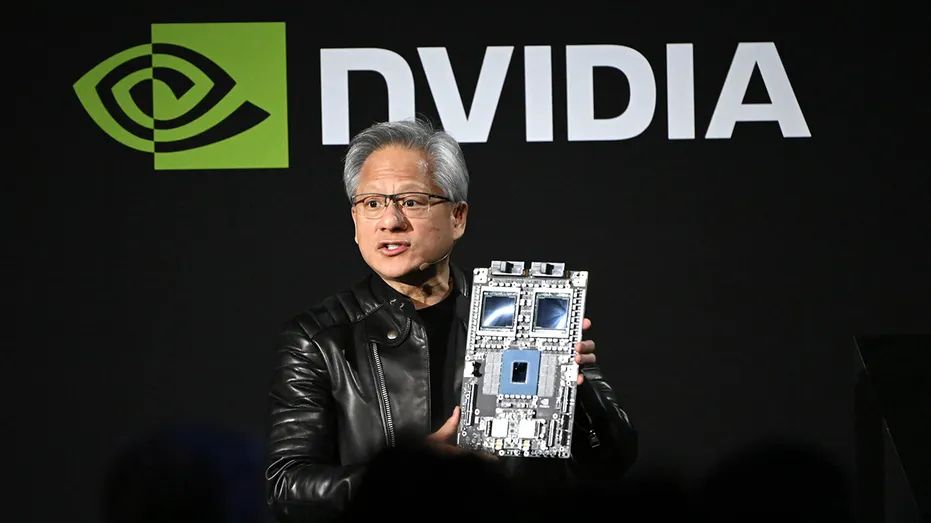
Nvidia’s acquisition strategy shows how the AI race is moving beyond semiconductor hardware.
Its acquisition of Hugging Face gives the chipmaker ownership of a platform used by more than 18 million developers. Nvidia’s regulatory filing values the transaction at approximately $11.9 billion in purchase consideration, plus an employee retention program worth up to $1 billion. The acquisition is expected to close in 2027.
Hugging Face has become a major destination for sharing AI models, datasets, and applications. Owning that distribution channel could give Nvidia a closer relationship with developers deciding which AI technologies to use.
The company says Hugging Face will remain open to competing hardware and cloud platforms. Whether that independence survives under Nvidia’s ownership will be closely watched.
Meta and Google are rewriting the acquisition playbook
Some of the industry’s most consequential AI transactions do not involve buying an entire company.
Meta’s $14.3 billion investment in Scale AI gave it a major ownership stake and brought Scale CEO Alexandr Wang into its AI operation.
Google took a different route. Its $2.4 billion Windsurf arrangement secured technology licensing rights and brought key researchers into Google without acquiring the whole startup.
These arrangements offer technology companies another way to secure scarce engineering talent and intellectual property. They raise questions about competition, particularly when large companies gain access to a startup’s most valuable assets without purchasing the business outright.
OpenAI is expanding beyond ChatGPT
OpenAI’s $6.5 billion acquisition of Jony Ive’s AI hardware startup io in 2025 signaled an ambition to develop consumer devices built around artificial intelligence.
Its $1.1 billion acquisition of product experimentation company Statsig extended that strategy into software development and testing.
Both deals reflect a broader shift: AI companies are looking for more ways to turn their models into products people and businesses will pay to use.
What the AI acquisition boom means for startups
The deals reveal three increasingly valuable assets: specialized talent, access to developers, and technology that can shorten the time needed to launch competitive AI products.
The headline figures require caution. Licensing agreements, minority investments, and pending acquisitions are not equivalent to completed startup exits. Adding their reported values together can exaggerate the amount buyers have spent acquiring companies.
The bigger story is about control. As AI becomes central to software, hardware, and business operations, the largest technology companies are buying pieces of the ecosystem they once depended on outside startups to provide.
For founders, the opportunity is enormous. The unanswered question is how many independent AI companies will remain once the biggest buyers finish shopping.
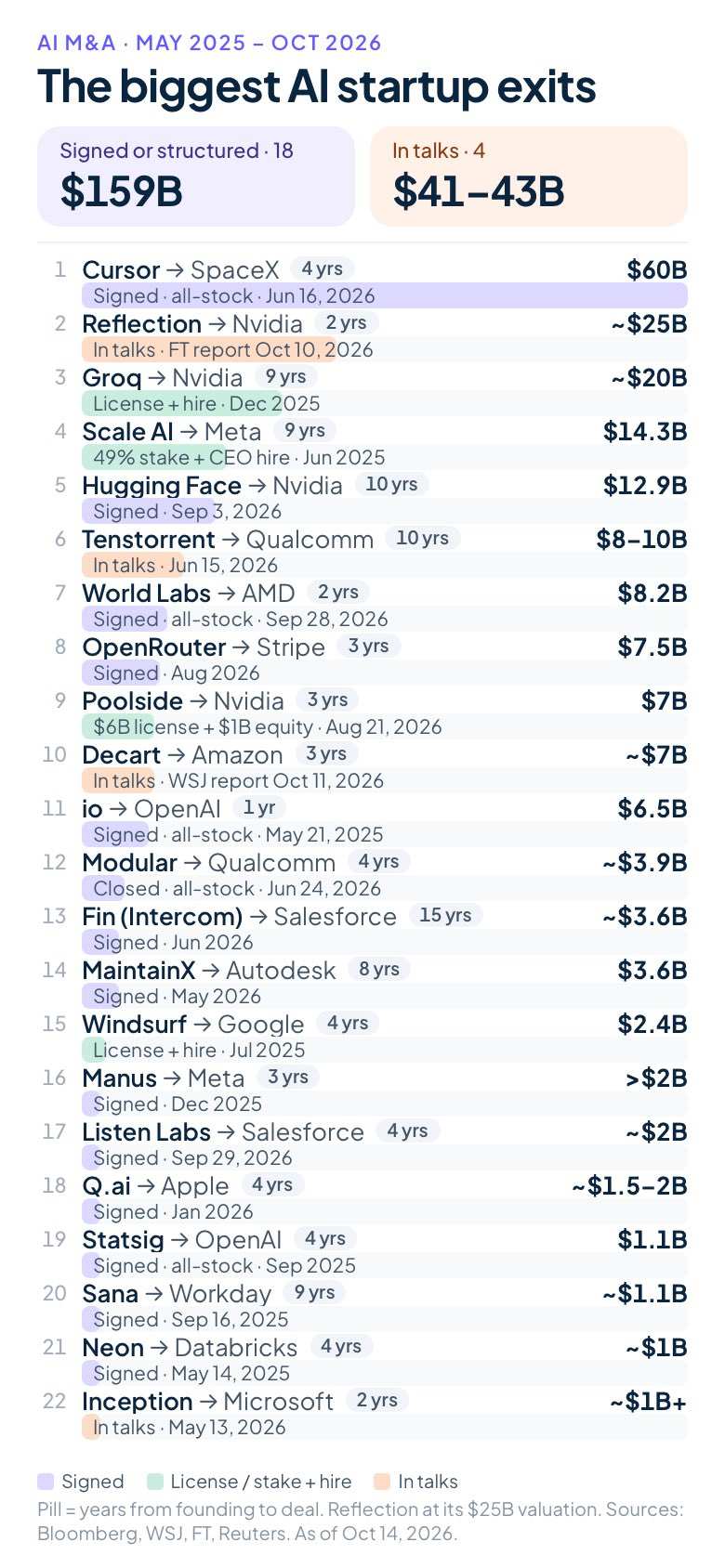
The Biggest AI Startup Exits: May 2025 – October 2026
| # | Startup → Buyer | Reported value | Status/structure |
|---|---|---|---|
| 1 | Cursor → SpaceX | $60B | Signed, all-stock; Jun 16, 2026 |
| 2 | Reflection → Nvidia | ~$25B | In talks; FT report Oct 10, 2026 |
| 3 | Groq → Nvidia | ~$20B | License + hire; Dec 2025 |
| 4 | Scale AI → Meta | $14.3B | 49% stake + CEO hire; Jun 2025 |
| 5 | Hugging Face → Nvidia | $12.9B | Signed; Sep 3, 2026 |
| 6 | Tenstorrent → Qualcomm | $8–10B | In talks; Jun 15, 2026 |
| 7 | World Labs → AMD | $8.2B | Signed, all-stock; Sep 28, 2026 |
| 8 | OpenRouter → Stripe | $7.5B | Signed; Aug 2026 |
| 9 | Poolside → Nvidia | $7B | $6B license + $1B equity; Aug 21, 2026 |
| 10 | Decart → Amazon | ~$7B | In talks; WSJ report Oct 11, 2026 |
| 11 | io → OpenAI | $6.5B | Signed, all-stock; May 21, 2025 |
| 12 | Modular → Qualcomm | ~$3.9B | Closed, all-stock; Jun 24, 2026 |
| 13 | Fin (Intercom) → Salesforce | ~$3.6B | Signed; Jun 2026 |
| 14 | MaintainX → Autodesk | $3.6B | Signed; May 2026 |
| 15 | Windsurf → Google | $2.4B | License + hire; Jul 2025 |
| 16 | Manus → Meta | >$2B | Signed; Dec 2025 |
| 17 | Listen Labs → Salesforce | ~$2B | Signed; Sep 29, 2026 |
| 18 | Q.ai → Apple | ~$1.5–2B | Signed; Jan 2026 |
| 19 | Statsig → OpenAI | $1.1B | Signed, all-stock; Sep 2025 |
| 20 | Sana → Workday | ~$1.1B | Signed; Sep 16, 2025 |
| 21 | Neon → Databricks | ~$1B | Signed; May 14, 2025 |
| 22 | Inception → Microsoft | ~$1B+ | In talks; May 13, 2026 |
The infographic below highlights just how young many of these AI startups were at the time of their deals, ranging from just one year for io to 15 years for Intercom. Credit goes to Deedy, a partner at Menlo Ventures, for sharing the infographic on X.