Wall Street’s hottest AI skill surges 1,721% as banks race to deploy AI agents
 Daniel Levi
Posted On October 2, 2026

Quick Highlights
- Demand for “agent orchestration” surged 1,721% this year as Wall Street banks push deeper into AI agents.
- AI-related job postings at JPMorgan, Citi and Capital One jumped 49% from 2025, reaching 139,819 listings.
- Banks are hiring forward-deployed engineers who can bring AI agents into trading, compliance and back-office workflows.
- Generative AI managers in finance command a median base salary of about $190,000, according to Draup.
Artificial intelligence may eventually eliminate some Wall Street jobs. For now, it is creating a new class of highly paid ones.
Demand for “agent orchestration,” the skill of coordinating multiple AI agents to complete tasks, has surged 1,721% this year, according to an analysis conducted by CNBC, citing enterprise hiring data firm Draup. The jump makes it one of the fastest-growing AI skills in finance as banks move from experimenting with generative AI to putting agents inside real business operations.
AI-related job postings at JPMorgan Chase, Citigroup and Capital One rose 49% from 2025 to 139,819 listings this year, according to Draup. The hiring push points to a shift taking place inside large financial institutions. Banks still need engineers who can build and adapt AI models, but they increasingly need people who can connect those models to the messy workflows where financial work actually happens.
“This is arguably the hottest skill on Wall Street,” Draup CEO Vijay Swaminathan told CNBC. “It’s a massive opportunity; they need people who understand data and people who understand AI and where to put it.”
That last part may be the harder problem.
Wall Street needs people who can make AI agents work together
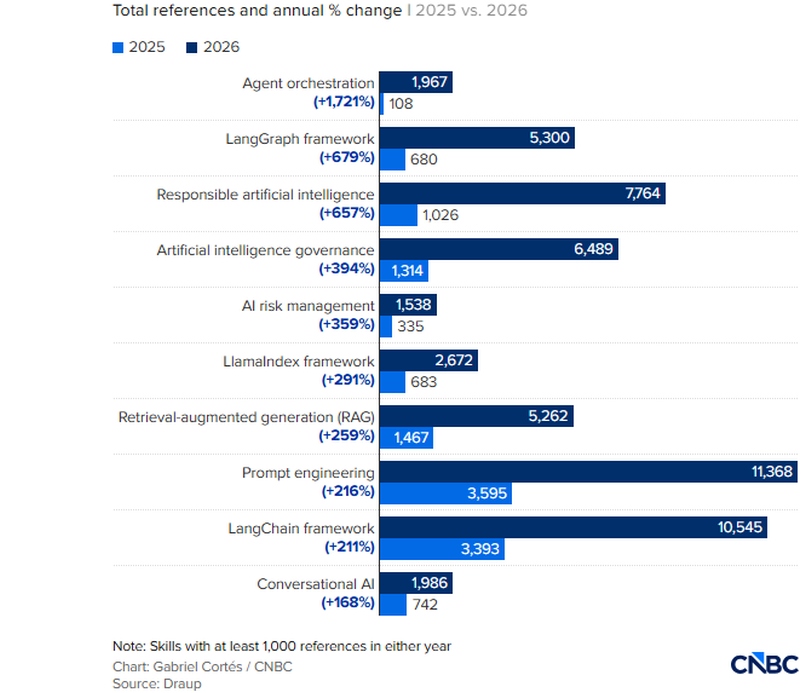
Agent orchestration is growing faster than every other major AI and data skill tracked by Draup, but the broader numbers show how dramatically banks’ AI needs are changing. Prompt engineering remains the most referenced skill, with 11,368 mentions in 2026, yet agent orchestration is growing much faster, soaring 1,721% from just 108 references in 2025 to 1,967 this year.
Most Referenced AI and Data Skills in Banking Jobs
| AI/Data Skill | 2025 | 2026 | Annual Increase |
|---|---|---|---|
| Agent orchestration | 108 | 1,967 | +1,721% |
| LangGraph framework | 680 | 5,300 | +679% |
| Responsible artificial intelligence | 1,026 | 7,764 | +657% |
| Artificial intelligence governance | 1,314 | 6,489 | +394% |
| AI risk management | 335 | 1,538 | +359% |
| LlamaIndex framework | 683 | 2,672 | +291% |
| Retrieval-augmented generation (RAG) | 1,467 | 5,262 | +259% |
| Prompt engineering | 3,595 | 11,368 | +216% |
| LangChain framework | 3,393 | 10,545 | +211% |
| Conversational AI | 742 | 1,986 | +168% |
Source: Draup analysis via CNBC. Includes skills with at least 1,000 references in either year.
An AI agent built to summarize a document is one thing. Giving agents responsibility for a real banking process is another.
A single workflow could require one agent to retrieve internal data, another to analyze documents, another to check the output against compliance rules, and a human to step in when the system encounters an exception. Someone has to decide how those pieces interact, what data each agent can access, and where human approval remains necessary.
That is where agent orchestration comes in.
The hiring boom is creating demand for so-called forward-deployed engineers, technical workers who sit closer to the business and integrate AI into trading desks, compliance teams, human resources and back-office operations.
“There is a lot of complexity in an enterprise,” Swaminathan said. “Sometimes these complexities are visible, but many times they are hidden. It takes a long time even to automate a simple process.”
Draup’s data shows demand spreading across the technology stack surrounding agents. Mentions of LangGraph, a framework for building multi-step AI workflows, climbed 679%. LlamaIndex references rose 291%, and demand for retrieval-augmented generation, better known as RAG, increased 259%.
“Our analysis shows that there is a renewed focus on soft skills like problem solving, creativity, ability to ask tough questions, being assertive [when it comes to] deeper understanding of the processes,” Swaminathan said.
The trend fits a broader enterprise shift from standalone AI tools to coordinated agent systems. Draup itself describes modern AI capabilities as increasingly layered across models, orchestration logic, automated workers, company systems, and human oversight.
The surprise is that coding alone may not be enough.
Banks need workers who understand financial processes, can spot hidden exceptions, and can ask the right questions before handing a task to software. Draup found growing demand for problem-solving, creativity, assertiveness, and other human skills alongside technical expertise.
The AI jobs boom comes with $190,000 salaries and a governance problem
Banks aren’t hiring solely to put more AI agents to work. They’re building teams to keep those agents under control.
References to “responsible AI” in job postings jumped 657%, according to Draup. AI governance rose 394%, and risk-management references increased 359%. Governance-related skills now appear more than 16,000 times in Draup’s data, nearly double the roughly 8,400 references associated with training, deploying, and operating models.
That split says something about where enterprise AI is heading. Getting a model to produce an answer is no longer the whole job. Financial institutions need systems that determine what an agent can do, what information it can see, when humans take over, and how to prevent outside models or third-party tools from creating security problems.
Draup’s own agent architecture reflects that enterprise focus, including centralized management, monitoring, and governed access for multi-agent workflows. The company says its data covers more than 1 billion job descriptions across 33 industries.
The scarcity of people with the right mix of skills is showing up in salaries. Generative AI managers in finance earn a median base salary of about $190,000, according to Draup, and AI- and agent-related roles command higher pay than many other technology positions in the industry.
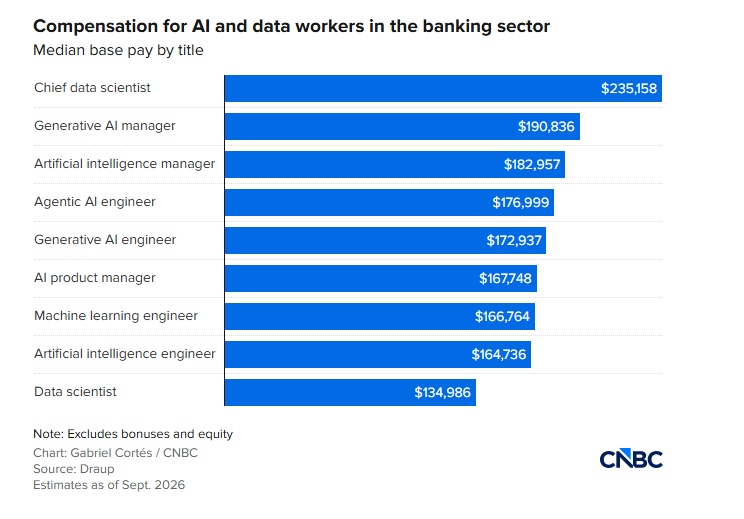
The pay gap is revealing. An agentic AI engineer commands a median base salary of $176,999, about $42,000 more than a data scientist at $134,986. Generative AI managers earn $190,836, second only to chief data scientists among the roles Draup tracks. Those figures exclude bonuses and equity, meaning total compensation can be considerably higher.
AI and Data Salaries in Banking
| Role | Median Base Salary |
|---|---|
| Chief data scientist | $235,158 |
| Generative AI manager | $190,836 |
| Artificial intelligence manager | $182,957 |
| Agentic AI engineer | $176,999 |
| Generative AI engineer | $172,937 |
| AI product manager | $167,748 |
| Machine learning engineer | $166,764 |
| Artificial intelligence engineer | $164,736 |
| Data scientist | $134,986 |
Source: Draup analysis via CNBC. Estimates as of September 2026. Compensation excludes bonuses and equity.
Banks are responding by retraining existing employees instead of relying solely on outside hiring. JPMorgan CEO Jamie Dimon has already discussed large-scale worker redeployment as AI assumes more tasks across the bank.
That creates an unusual moment for Wall Street. Banks are spending heavily on technology meant to automate human work, yet deploying it is exposing just how much institutional knowledge is buried in the work itself.
The hottest AI job may not belong to the person who builds the smartest model. It may belong to the person who knows how to make a group of agents function inside a bank without breaking everything around them.