AI coding startup Factory raises $200 million, more than triples valuation to $5 billion
 Daniel Levi
Posted On September 15, 2026

Factory has raised $200 million at a $5 billion valuation, more than tripling the $1.5 billion valuation investors assigned it just five months ago.
Blackstone, Khosla Ventures, Sequoia Capital, Insight Partners, Evantic Capital and Sound Ventures backed the new round, with Salesforce CEO Marc Benioff and hedge-fund manager Brad Gerstner participating as angel investors. The funding arrives as investors pour billions into companies trying to change how software gets written, tested, and maintained inside large organizations.
“Factory, which makes autonomous AI agents that code, has raised $200 million at a $5 billion valuation, the company said—more than three times its valuation from five months ago, when it last raised funding,” the Wall Street Journal reported.
San Francisco-based Factory was founded in 2023 by Matan Grinberg and Eno Reyes. Its platform gives engineering teams AI agents that can work across software development tasks, from writing code and fixing bugs to testing and maintaining existing systems. Factory competes with Anthropic, OpenAI and SpaceX, which have each launched AI-assisted coding tools of their own.
That puts Factory in an increasingly expensive race with AI coding companies including Cursor and Cognition. Earlier this month, Cognition raised $2 billion at a $48 billion valuation, underscoring just how much investor money is chasing the coding market, Reuters reported.
Factory’s own valuation climb has been striking. The company raised $150 million at a $1.5 billion valuation in April. Five months later, investors are valuing it at $5 billion, a roughly 233% increase.
AI coding is moving from assistant to workforce
The bigger story behind Factory’s funding is a shift happening inside corporate engineering departments. Early AI coding tools largely acted as copilots, suggesting code snippets to individual developers. The next battle is over agents that can handle larger pieces of engineering work with less human intervention.
Factory sees that shift moving beyond individual developers and into the operating structure of entire engineering organizations.
“Across the world’s largest enterprises, we are seeing a move from individual coding agents to software factories that serve as the core foundation from which an entire software company operates,” said Matan Grinberg, co-founder and CEO of Factory.
That pitch lands at a sensitive moment for the technology industry. Companies are under pressure to prove that enormous AI spending produces measurable economic returns. Software development has become one of the clearest places to test that proposition since coding tasks can often be measured through completion time, output, and engineering costs.
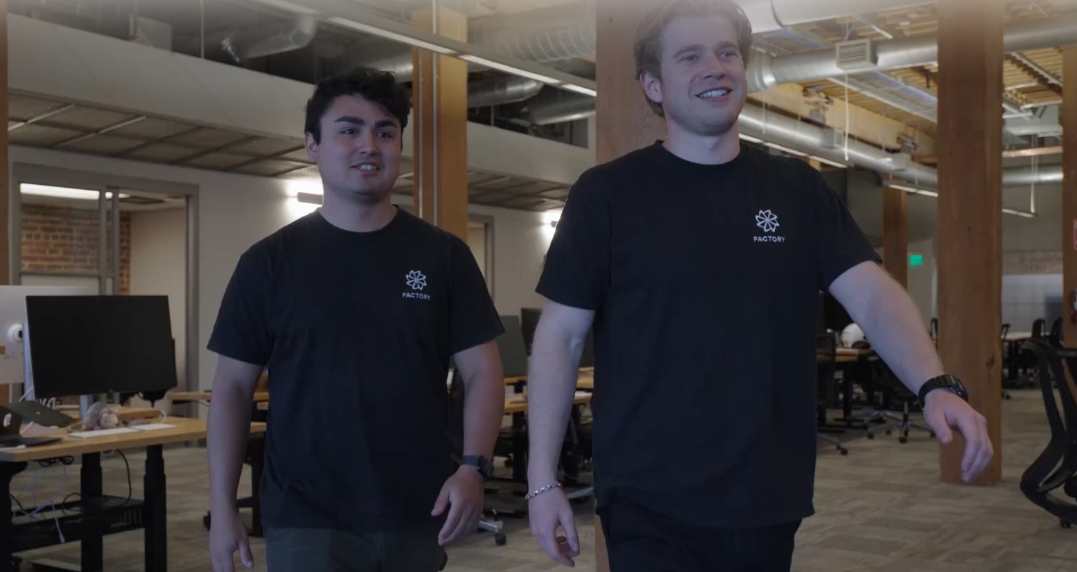
Factory Co-Founders Matan Grinberg and Eno Reyes
Companies such as Coinbase and Block have already tied workforce changes to gains they say they are seeing from AI. That raises a harder question hanging over the coding-agent boom: whether these systems will mostly make engineers more productive or allow companies to operate with fewer engineers.
The answer could shape far more than Factory’s valuation.
AI-assisted coding has become one of generative AI’s most commercially successful applications, turning software engineering into a proving ground for autonomous agents. The competition is shifting from which AI can autocomplete code fastest to which system can reliably take responsibility for meaningful chunks of software work inside companies.
At $5 billion, Factory’s investors are betting that enterprise software development is headed in that direction.
The industry is racing there as some leading AI executives call for greater caution around increasingly capable systems and the risks they could pose. That tension is becoming hard to miss: concerns about where advanced AI may lead are rising even as investors put billions behind companies built to give AI more work to do.
For Factory, the next test is no longer whether investors believe that story. It’s whether enterprise engineering teams do.