Startup Funding News Today, September 7, 2026: Cato, Pixxel, Jet Zero, Navana.ai & More
 Daniel Levi
Posted On September 7, 2026

Startup funding and venture capital opened the week with a strong tilt toward sovereign technology, physical infrastructure, vertical AI, and industrial automation. The standout deal is Indian space-tech company Pixxel’s $100 million Series C, the largest single funding round raised by an Indian space startup. In Australia, Jet Zero completed an A$30 million financing for its planned sustainable aviation fuel refinery, while India’s Navana.ai raised ₹40 crore to scale voice AI for banks and other regulated enterprises.
Europe contributes two smaller but strategically revealing AI rounds. Milan-based Cato raised €6 million to automate public-sector tender discovery and bidding, while Swiss industrial-AI startup Jaipur Robotics secured €4.3 million to bring computer vision and automation deeper into waste-to-energy, cement, and biomass plants.
Today’s actual funding activity is narrower than a casual search would suggest, but what remains points in a consistent direction: investors are financing technology that controls valuable physical systems or difficult institutional workflows, not simply another layer of generic software.
The Macro Environment: Capital Is Following Strategic Infrastructure
Pixxel best expresses that thesis. The company started with hyperspectral Earth observation but now describes a much broader ambition spanning satellite sensing, Earth-intelligence software, sovereign space systems, and manufacturing. Singapore state investor Temasek and specialist space investor Seraphim co-led its Series C, with 360 ONE Asset and IMM Investment joining alongside existing investors Radical Ventures and growX Ventures. The round brings total funding to $195 million.
The sovereign dimension is increasingly important. Earth observation is no longer just a climate or agricultural-data business. Governments need independent sensing capabilities for defense, infrastructure, resource management, disaster response, and geopolitical intelligence. That makes a satellite company that can control both sensors and downstream analysis more strategically valuable than a pure imagery vendor.
Jet Zero operates in another market where technology policy and infrastructure are converging. Sustainable aviation fuel remains difficult to scale because producing it requires enormous plants, reliable feedstocks, regulatory support, and customers willing to sign long-duration purchasing agreements. Jet Zero has Qantas, Airbus, and POSCO International in its investor group, placing potential buyers and industrial partners directly around the project.
The smaller AI rounds reveal a parallel shift. Navana.ai is concentrating on Indian-language voice systems for regulated industries. Cato is automating public procurement. Jaipur Robotics is applying computer vision to waste plants. All three rely on domain-specific data, integrations, or deployment knowledge. That matters as access to powerful foundation models becomes commonplace: increasingly, the defensible business is the workflow, data, and distribution around the model.
Pixxel raises $100M in funding to build a broader Earth-intelligence and sovereign space platform
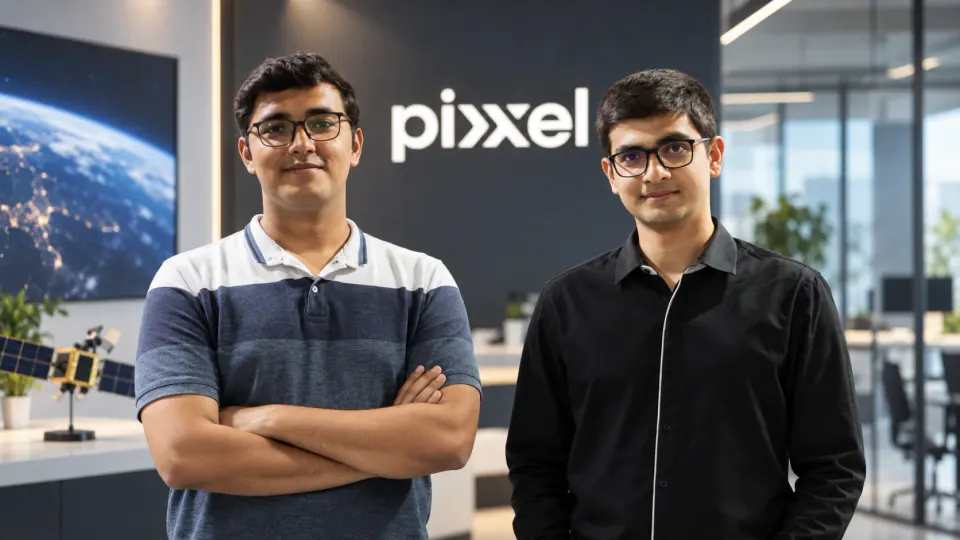
Bengaluru- and Los Angeles-based Pixxel closed a $100 million Series C funding round co-led by Temasek and Seraphim, taking total funding to $195 million. New investors 360 ONE Asset and South Korea’s IMM Investment participated alongside existing backers Radical Ventures, growX Ventures, and others.
Pixxel initially built its identity around hyperspectral imaging. Unlike conventional optical satellites, hyperspectral sensors capture hundreds of narrow spectral bands, allowing users to identify chemical or physical characteristics that ordinary imagery may miss.
That has applications across agriculture, mining, environmental monitoring, energy, defense, and infrastructure.
But the financing reveals a company attempting to move beyond the narrow category of hyperspectral imagery. Pixxel plans to invest in its next-generation Honeybee constellation, high-resolution optical sensing, Earth-intelligence software through its Aurora platform, satellite manufacturing, and sovereign systems for governments.
That vertical expansion matters strategically. Satellite imagery by itself risks becoming commoditized as more constellations reach orbit. A company that owns the satellites, sensor technology, data-processing stack, and intelligence applications has more opportunities to capture value.
Pixxel has also worked with organizations including NASA, the U.S. National Reconnaissance Office, and the Indian Air Force, giving it exposure to customers for whom sensing capability can have strategic rather than merely commercial value.
Valuation reporting remains inconsistent. Mint had previously reported that the round could value Pixxel at approximately $350 million to $400 million, while Moneycontrol cited earlier estimates in the $450 million to $500 million range. Pixxel itself did not disclose the financing valuation, so neither estimate should be treated as confirmed.
Funding Details
Startup: Pixxel
Investors: Temasek, Seraphim, 360 ONE Asset, IMM Investment, Radical Ventures, growX Ventures and others
Amount Raised: $100 million
Total Raised: $195 million
Funding Stage: Series C
Funding Date: September 7, 2026
Headquarters: Bengaluru, India / Los Angeles, California
Sector: Space technology / Earth intelligence/satellite infrastructure
Valuation: Not disclosed; media estimates have varied
Jet Zero raises A$30M to move sustainable aviation fuel closer to commercial production
Australian clean-energy company Jet Zero completed an A$30 million financing backed by Qantas, Airbus, and other investors, while adding South Korea’s POSCO International as a strategic investor. The capital raise brings total investment in the company to more than A$80 million, according to current reporting.
The company is developing Project Ulysses, a proposed sustainable aviation fuel and renewable diesel refinery in Townsville, Queensland.
The planned facility is designed to produce up to 113 million liters of sustainable aviation fuel and renewable diesel per year. Jet Zero has secured final development approval and completed front-end engineering work, although it has not yet made the final investment decision required before full construction.
This is a capital-intensive infrastructure business, which makes the investor group especially important.
Qantas and Airbus have obvious incentives to expand sustainable aviation fuel supply because airlines and aircraft manufacturers face increasing pressure to reduce lifecycle emissions. POSCO brings energy-market knowledge, industrial scale, and potential participation in fuel offtake and feedstock supply chains.
In other words, these are investors that could become part of the operating ecosystem, not just shareholders.
For venture investors, SAF represents an unusual intersection of climate technology, industrial policy, and aviation economics. The underlying demand is visible. The harder question is whether companies can build production capacity economically enough to compete with conventional jet fuel while navigating feedstock availability and regulatory requirements.
Funding Details
Startup: Jet Zero Australia
Investors: Qantas, Airbus, POSCO International, and other existing investors
Amount Raised: A$30 million
Total Raised: More than A$80 million reported
Funding Stage: Not disclosed
Funding Date: September 7, 2026
Headquarters: Australia
Sector: Climate tech / sustainable aviation fuel/energy infrastructure
Valuation: Not disclosed
Navana.ai raises $4.2 million to build voice AI for India’s regulated enterprises
Indian voice-AI startup Navana.ai raised ₹40 crore ($4.2 million) in Series A funding led by entrepreneur and investor Ronnie Screwvala. Other investors include Sharad Sanghi, Antler India, Sandeep Singhal, and Paula Mariwala.
Navana is building a full-stack speech and voice-AI platform designed around Indian languages and dialects. Its products include enterprise voice agents, speech recognition, contact-center technology, analytics, and automated evaluation systems.
The company is placing particular emphasis on BFSI, where banks, insurers, and financial-services firms have large call-center operations but also strict requirements around privacy, data residency, security, and compliance.
General-purpose voice models have improved rapidly, but Indian enterprise deployments introduce problems global systems may not solve as well: code-switching, regional accents, multiple languages in the same interaction, noisy telecommunications environments, and regulatory restrictions on moving sensitive financial data to external cloud platforms.
Navana supports on-premise deployment for enterprises that cannot send sensitive customer conversations outside their controlled infrastructure. That creates a potential wedge against cloud-only AI vendors.
The larger opportunity is automating customer-service infrastructure. If voice agents move from handling simple FAQ interactions to resolving transactions and operational tasks, the economic value shifts from transcription to completing customer workflows.
Funding Details
Startup: Navana.ai
Investors: Ronnie Screwvala, Antler India, Sharad Sanghi, Sandeep Singhal, Paula Mariwala and others
Amount Raised: ₹40 crore
Total Raised: Not disclosed
Funding Stage: Series A
Funding Date: September 7, 2026
Headquarters: India
Sector: Voice AI/enterprise AI / contact-center technology
Valuation: Not disclosed
Cato raises €6M to bring AI into Italy’s €309.7B public-tender market
Milan-based Cato raised €6 million in seed financing led by Keen Venture Partners, bringing total funding to €7.6 million. Existing investors Vento, Heartfelt, Moonstone, BHeroes, Alecla7, and Nova Venture participated alongside a group of angel investors.
Cato builds AI software that helps companies find public tenders, analyze eligibility requirements, prepare documentation, and manage the bidding process for government contracts.
It is attacking a large market hidden behind administrative friction. Italy’s public-procurement market is worth roughly €309.7 billion, according to reporting on the financing.
Small and midsized businesses can struggle to participate because government tenders require substantial paperwork, regulatory interpretation, deadline management, and document preparation.
That makes public procurement a good example of where vertical AI may create real economic value. The software does not need to reinvent procurement. It needs to reduce the human hours required to find viable tenders and submit compliant bids.
There is also a distribution advantage. Once Cato becomes embedded in a company’s bidding process, it can accumulate knowledge about past submissions, relevant public agencies, winning requirements, and internal documentation.
That historical context can become more defensible than the underlying model.
Funding Details
Startup: Cato
Investors: Keen Venture Partners, Vento, Heartfelt, Moonstone, BHeroes, Alecla7, Nova Venture and angels
Amount Raised: €6 million
Total Raised: €7.6 million
Funding Stage: Seed
Funding Date: September 7, 2026
Headquarters: Milan, Italy
Sector: Enterprise AI / public procurement technology
Valuation: Not disclosed
Jaipur Robotics raises €4.3M to automate waste-to-energy plants with computer vision
Swiss industrial-AI startup Jaipur Robotics raised €4.3 million in seed financing led by EquityPitcher Ventures and High-Tech Gründerfonds.
Founded in 2024 by Ermes Zamboni and Nikhil Prakash, the company develops computer-vision and AI systems for waste-to-energy, cement, and biomass facilities. Waste plants contain exactly the kind of environment where software gains value from physical-world context.
Incoming waste is inconsistent. Dangerous materials such as gas cylinders or large pieces of concrete can damage machinery and force shutdowns. Fuel quality varies. Crane operators must continuously decide how to mix material before combustion.
Jaipur’s systems use cameras and machine learning to identify hazardous or oversized items, estimate waste calorific value, track material through facilities, and provide operators with information for crane management and combustion optimization.
The company says its models are trained on more than 50 million labeled images and that its systems currently analyze more than five million tonnes of waste annually. It reports hazardous-material detection accuracy of 99% and says some customers have cut unplanned downtime by more than 80%. Those are company-reported metrics rather than independently audited performance figures, but they help explain why investors see the dataset as defensible.
The next step is deeper automation. Jaipur wants to develop systems that can control cranes more autonomously, rather than merely advising human operators.
That would move the business from industrial analytics to an operating layer that controls expensive machinery.
Funding Details
Startup: Jaipur Robotics
Investors: EquityPitcher Ventures, High-Tech Gründerfonds
Amount Raised: €4.3 million
Total Raised: More than €5 million in disclosed prior and current financing
Funding Stage: Seed
Funding Date: September 7, 2026
Headquarters: Manno, Switzerland
Sector: Industrial AI/computer vision/waste infrastructure
Valuation: Not disclosed
What Today’s Funding Activity Reveals
The first signal is sovereign infrastructure.
Pixxel is building sensing systems that governments can use independently. Jet Zero is building domestic fuel-production capacity. Navana is emphasizing locally deployable voice AI for regulated institutions.
Different technologies, same underlying concern: countries and enterprises increasingly want control over systems they consider strategically important.
Second, vertical AI continues to look more investable than generic model wrappers.
Cato knows procurement. Navana specializes in Indian speech and regulated enterprise deployment. Jaipur Robotics possesses industrial waste data and integrates into physical plant operations.
Their competitive advantages therefore come from more than access to a foundation model.
Third, physical infrastructure is absorbing venture capital again.
Pixxel manufactures satellites. Jet Zero wants to construct an industrial fuel refinery. Jaipur integrates AI with machinery inside waste plants.
These businesses are harder to scale than conventional SaaS, but that difficulty can itself create barriers to entry.
Fourth, strategic investors are becoming increasingly important.
Temasek brings sovereign capital into Pixxel. Airbus and Qantas have direct economic exposure to sustainable aviation fuel. POSCO may participate in supply and offtake relationships. HTGF brings deep-tech specialization into Jaipur Robotics.
The investor list is beginning to reveal something about a startup’s future customers and supply chain, not merely who priced the round.
Comparative Funding Table
| Startup | Amount Raised | Sector | Funding Stage | Lead/Key Investors | Country |
|---|---|---|---|---|---|
| Pixxel | $100M | Space / Earth intelligence | Series C | Temasek, Seraphim, 360 ONE, IMM | India / U.S. |
| Jet Zero | A$30M | Sustainable aviation fuel | Not disclosed | Qantas, Airbus, POSCO International | Australia |
| Navana.ai | ₹40 crore | Voice AI/enterprise AI | Series A | Ronnie Screwvala, Antler India + others | India |
| Cato | €6M | AI / public procurement | Seed | Keen Venture Partners + existing investors | Italy |
| Jaipur Robotics | €4.3M | Industrial AI/computer vision | Seed | EquityPitcher Ventures, HTGF | Switzerland |
Strategic Takeaways for Founders and Investors
Control beats convenience in strategic markets. Pixxel’s evolution from an imagery startup toward satellites, sensing, software, and sovereign systems demonstrates the value of owning more of the technology chain when customers include governments.
Vertical AI becomes stronger when the workflow itself creates proprietary data. Jaipur’s 50-million-image dataset and Cato’s tender history show how repeated customer usage can create information another startup cannot reproduce simply by connecting to the same model.
Local AI can have genuine technical and regulatory advantages. Navana doesn’t need to beat every global speech model in every language. It needs to perform exceptionally well across Indian languages and regulated environments where on-premise deployment matters.
Strategic investors can be more valuable than prestigious logos. Qantas, Airbus, and POSCO sit directly inside Jet Zero’s prospective commercial ecosystem. In capital-intensive industries, an investor who may become an offtaker, supplier, manufacturing partner, or customer can materially reduce execution risk.
Look for industries where expensive physical assets still run on fragmented information. Waste plants are a strong example. Jaipur Robotics is applying AI where downtime costs money, safety failures matter, and existing processes remain partly manual. Those economics support software budgets.
Do not mistake funding-news volume for venture-market activity. On a Monday morning, the strict rolling window naturally captures fewer U.S. announcements. Expanding globally helps, but lowering freshness standards simply introduces stale deals.
Conclusion
September 7’s verified funding cycle is smaller than the headline feeds initially suggest, but the underlying theme is unusually consistent.
Pixxel is raising $100 million to turn satellites and sensing into broader planetary intelligence infrastructure. Jet Zero is financing physical fuel production for aviation. Navana.ai is adapting voice AI to regulated Indian enterprises. Cato is embedding AI into government procurement, and Jaipur Robotics is taking machine intelligence directly onto industrial plant floors.
These are not five versions of the same AI application.
They are businesses built around control of sensing, infrastructure, regulated workflows, industrial data, and real-world deployment.
That is the strongest signal from today’s capital flow: as core AI technology becomes easier to access, investors continue moving toward the parts of the economy where software must understand something difficult, integrate with something physical, or control something customers cannot afford to get wrong.