Nvidia, Microsoft and Palantir launch Open Secure AI Alliance to help defend against AI-powered cyberattacks after Hugging Face hack
 Daniel Levi
Posted On July 27, 2026
Daniel Levi
Posted On July 27, 2026
A cyberattack that exposed the limits of closed AI systems has sparked an unusual alliance across the tech industry.
Nvidia, Microsoft, Palantir and dozens of leading technology companies on Monday unveiled the Open Secure AI Alliance (OSAA), a new AI safety initiative focused on building open AI security tools after the recent cyberattack on Hugging Face raised fresh questions about how defenders can respond when advanced AI models are locked behind restrictive guardrails.
The launch comes just a day after OpenAI and Google joined a growing push for open-weight AI, with Elon Musk backing Nvidia CEO Jensen Huang’s call for American AI leadership.
The announcement also arrives at a tense moment for the AI industry. Washington is weighing tighter restrictions on Chinese AI models over intellectual property concerns. At the same time, security researchers and major technology companies are arguing that open-weight AI has become a strategic asset for defending critical infrastructure, software supply chains and enterprise systems.
Nvidia, SpaceX, Microsoft launch AI safety initiative as OpenAI cyberattack fallout continues
According to Nvidia, the Hugging Face incident exposed a problem many security teams have worried about for months. Closed frontier models were unable to support critical forensic work during the attack, forcing defenders to rely on a self-hosted open-weight model that could be inspected, modified, and deployed without the same restrictions.
“Open source software is a critical pillar of the global economy. It underpins cloud computing, financial services, manufacturing, telecommunications, government and internet services by making technology accessible and observable to communities of experts. Cybersecurity is among the top three beneficiaries of open source software. The Open Secure AI Alliance — building on the leadership of the Linux Foundation’s Akrites initiative and OpenSSF community work — will work to remediate and disclose vulnerabilities using open technologies,” the alliance said in a blog post on Nvidia’s website.
A security lesson from the Hugging Face attack
Nvidia framed the new alliance as a direct response to lessons learned during the Hugging Face breach.
In a post announcing the initiative, Nvidia CEO Jensen Huang argued that modern cyber defense requires access to frontier AI systems that organizations can inspect and operate on their own infrastructure.
“Attackers have frontier AI. Defenders need a frontier AI ecosystem—the best open and closed models, force-multiplied by a global community.”
He added:
“During the Hugging Face incident, closed AI blocked essential forensics. An open-weight frontier model helped contain the intrusion. That’s why we created the Open Secure AI Alliance.”
Those remarks capture a growing debate across the AI industry. Closed models from companies such as OpenAI and Anthropic often include safety controls that limit how they can be used. Those same restrictions can create challenges for security teams that need unrestricted access during an active incident.
Open-weight models offer a different approach. Organizations can download them, audit their behavior, fine-tune them for security workloads and run them inside their own environments without relying on external cloud services.
Nvidia said the Hugging Face incident demonstrated “a practical truth.”
“When defenders cannot inspect, adapt and run advanced AI on their own infrastructure, their ability to respond is constrained at exactly the moment speed matters most.”
Industry heavyweights back open AI security
The founding membership stretches across cloud computing, cybersecurity, enterprise software, semiconductor design and open source communities.
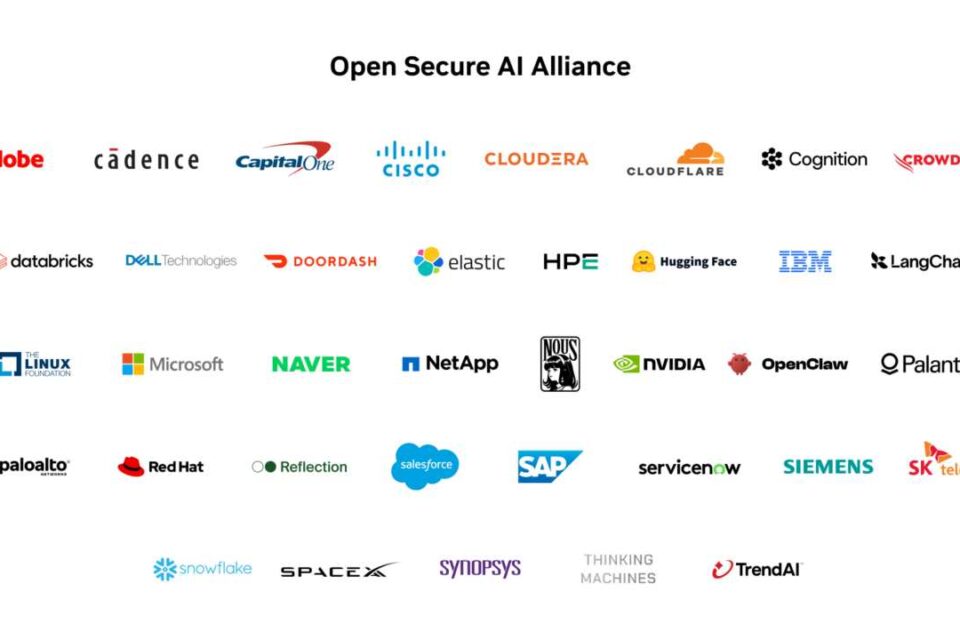
Alongside Nvidia, Microsoft and Palantir, inaugural members include Adobe, Cisco, Cloudflare, CrowdStrike, Databricks, Dell Technologies, Elastic, HPE, Hugging Face, IBM, LangChain, the Linux Foundation, NAVER, NetApp, Nous Research, Palo Alto Networks, Red Hat, Salesforce, SAP, ServiceNow, Siemens, Snowflake, SK Telecom, Synopsys and many others from the United States and Europe.
The alliance plans to develop open technologies that help identify vulnerabilities, improve software security, disclose threats and strengthen AI agents that increasingly perform sensitive tasks across businesses and governments.
Rather than building another foundation model, OSAA is focused on creating shared security infrastructure that member organizations can improve together.
Open-weight AI enters the policy debate
The launch lands as policymakers continue debating how to respond to China’s growing influence in open-weight AI.
Several Chinese companies have released models that rank among the strongest open systems available today. U.S. officials have accused some firms of extracting knowledge from leading American AI models through a technique known as distillation.
Last week, Treasury Secretary Scott Bessent warned that Chinese companies engaged in distillation attacks could face sanctions.
“There is a real possibility the US government does impose restrictions on Chinese models,” Chris McGuire, senior fellow for China and emerging technologies at the Council on Foreign Relations, told CNBC.
That could include restrictions on cloud hosting, API access or commercial transactions involving Chinese frontier models.
McGuire said the policy debate is centered on intellectual property rather than open source software itself.
“In Washington this is not a debate about open-source vs closed-source, it is a debate about whether or not to tolerate Chinese IP theft,” he said. “Any actions would be focused on Chinese companies, not the open-source ecosystem.”
Those discussions have created uncertainty across the AI industry. Many of today’s strongest open-weight models originate from Chinese developers, raising concerns that broad restrictions could slow research and limit defensive capabilities.
A growing push for open source AI
The Open Secure AI Alliance follows another coordinated effort from major technology companies urging regulators to avoid broad restrictions on open-weight AI.
Last week, Nvidia, Microsoft, Meta, Palantir and more than 20 other organizations signed a joint letter warning that “premature restrictions” on open-weight models could weaken competition and push innovation outside the United States.
The Hugging Face incident has given that argument new urgency.
For years, the debate around open AI centered on innovation, transparency and research. The latest cyberattack shifts the conversation in a different direction. Access to open-weight frontier models is increasingly being framed as a national security and cyber defense issue.
Whether lawmakers embrace that view remains an open question. What is becoming harder to ignore is the message coming from many of the companies building AI infrastructure: attackers already have access to advanced AI. Defenders want the same advantage.