Ropedia raises $30M to build the data infrastructure powering physical AI and robotics
 Daniel Levi
Posted On July 23, 2026
Daniel Levi
Posted On July 23, 2026

The race to build smarter robots has exposed a problem that money alone cannot solve. Large language models are learned from the internet. Physical AI cannot. Robots need millions of examples of real human movement, interaction, and decision-making in the physical world. Singapore startup Ropedia believes it has built the missing layer, and investors are betting that demand for that data will surge.
Today, Ropedia announced that it has raised $30 million in pre-A funding to expand its platform for collecting and delivering real-world multimodal data used to train robots and embodied AI systems. The investment came from venture firms with experience in AI, enterprise software, and infrastructure across Southeast Asia, alongside long-term financial backers and strategic partners in robotics, mobility, and enterprise technology.
The funding arrives as robotics companies race to build AI systems that can move beyond research labs and perform useful work in warehouses, factories, hospitals, and homes. That shift has placed new attention on one of the industry’s biggest bottlenecks: collecting enough high-quality data that teaches machines how people interact with the physical world.
“A robot can’t play baseball by watching a video any more than you could learn to ride a bike by reading about it. The robot must understand what it’s like to grip a bat and know the timing it takes to hit a ball. That’s the information Ropedia’s technology provides, and it’s why this investment matters. Text scraped from the internet was used to train the last generation of AI. Real-world human experience, captured at the same scale, will train physical AI. Physical AI will let us leave the lab and go to work, first in factories, then at home, helping our families,” said Zhaoxi Chen, chief executive and co-founder of Ropedia.
That distinction sits at the center of Ropedia’s business.
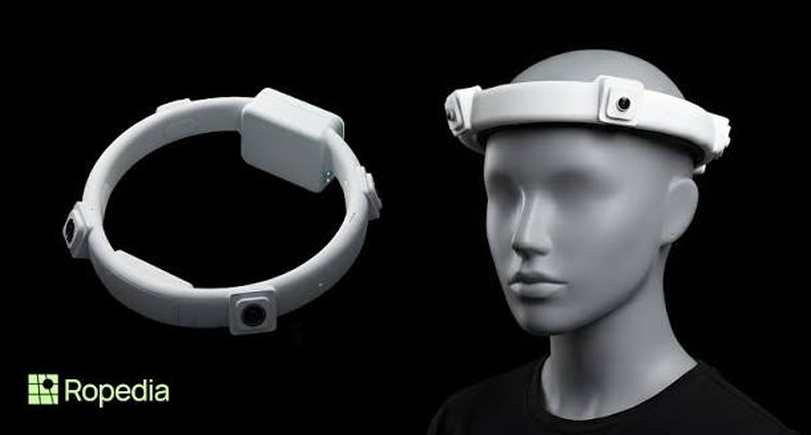
Image credit: Ropedia
With $30 million in funding, physical AI startup Ropedia aims to collect the real-world data robots need to learn
Instead of labeling datasets collected elsewhere, the physical AI startup captures human experiences directly through its wearable device, HOMIE. The head-mounted system records synchronized streams of first-person video, audio, depth information, gaze direction, hand tracking, body movement, and camera position. Every signal is timestamped so AI models can learn how perception and action occur together in real time.
The synchronized recordings flow through Ropedia’s processing and annotation platform before becoming training datasets for robotics and embodied AI developers.
The company argues that this approach solves a limitation found in many existing data collection systems. Teleoperation platforms depend on expensive robot hardware and often generate data tied to specific robot designs. HOMIE collects information from people instead, allowing data collection across many environments without deploying fleets of robots.
That difference has helped Ropedia build what it calls Xperience-10M, a dataset containing more than 10 million interaction episodes and over 10,000 hours of multimodal recordings. The collection spans billions of synchronized video frames, motion capture records, depth data, and inertial sensor measurements. Each additional deployment expands the variety of tasks, environments, and human behaviors represented in the dataset.
The startup says its platform reduces data collection costs by up to 50 times compared with conventional approaches. HOMIE has already entered mass production, and Ropedia says it serves more than a dozen customers in North America working in embodied AI and spatial intelligence.
Building the data layer for physical AI
Ropedia describes itself as a data infrastructure company rather than a data labeling business.
The comparison reflects a broader shift taking place across AI. The first wave of generative AI depended on enormous collections of internet text and images. Physical AI needs something different. Robots must learn how humans manipulate objects, move through spaces, respond to changing environments, and coordinate vision with motion. Those experiences cannot be scraped from websites in the same way language models collected text.
That has created growing demand for companies building large-scale pipelines for collecting multimodal interaction data.
Ropedia sells access through dataset licensing, research partnerships, and selective availability of its HOMIE hardware platform. The company operates what it describes as a closed-loop pipeline that combines synchronized data capture, quality assurance, annotation, and model-ready dataset preparation.
The latest financing follows an earlier $8 million pre-A round announced on social media in March. Combined with the newly disclosed $22 million investment, the company has raised $30 million in pre-A funding.
Ropedia plans to use the capital to expand data collection across Southeast Asia and North America, deploy larger fleets of HOMIE devices, strengthen its AI research platform, and grow its engineering team in the United States.
One early investor believes the company has positioned itself at the foundation of a new AI stack.
“I backed the Ropedia team early because they had a rare combination of deep technical expertise, speed of execution and a clear vision for where physical AI was heading. Since then, they have built a compelling data infrastructure platform serving leading robotics and foundation-model companies globally. I believe Ropedia is well positioned to become a foundational company in the physical AI ecosystem,” said one angel investor, a research scientist from Amazon.
Founded in Singapore during the second half of 2025 by Zhaoxi Chen, Fangzhou Hong, and Ziwei Liu, Ropedia operates from its headquarters in Singapore with an additional office in Mountain View, California. Chen previously worked on 3D computer vision and multimodal AI, Hong contributed to Meta’s egocentric multimodal intelligence research before moving into 3D spatial intelligence, and Liu serves as chief scientist alongside his role as an associate professor at Nanyang Technological University.
The company is entering a market where AI’s next leap may depend less on bigger language models and more on capturing the messy, unpredictable experiences of the physical world. If that proves true, data pipelines like Ropedia’s could become as valuable to robotics as internet-scale text was to the rise of generative AI.