OpenAI’s GPT-5.6 is 54% more token efficient on agentic coding than rival AI models, Sam Altman says
 Daniel Levi
Posted On July 9, 2026
Daniel Levi
Posted On July 9, 2026
OpenAI says its newest flagship AI model, GPT 5.6, can deliver the same coding results using far fewer tokens, a claim that could translate into lower costs for businesses running AI applications at scale. Speaking to CNBC on Thursday, CEO Sam Altman said GPT-5.6 is 54% more token-efficient on agentic coding than rival AI models, placing cost and performance at the center of OpenAI’s latest push to stay ahead in an increasingly crowded AI race.
“Every enterprise now is thinking about spend and the value they’re getting in exchange for AI, and this is what we really want to do,” Altman said.
How GPT-5.6 Could Cut AI Costs for Enterprise Customers
The comments came as OpenAI rolled out GPT-5.6 Sol, Terra, and Luna, the company’s newest family of AI models. OpenAI first introduced the lineup last month but limited early access to a small group of trusted partners after completing a government review process.
The launch also marks the debut of OpenAI’s new naming system. The number identifies the model generation, while Sol, Terra, and Luna represent capability tiers that can evolve independently. OpenAI said the new structure is intended to help developers and enterprise customers choose models based on the right balance of intelligence, speed, and cost.
Why Token Efficiency Is Becoming AI’s Next Competitive Battleground
Token efficiency sits at the center of that strategy. AI models consume tokens as they process prompts and generate responses, making token usage one of the biggest drivers of inference costs. A model that produces the same quality output with fewer tokens can lower operating expenses, reduce latency, and improve scalability for companies deploying AI across customer support, software development, and autonomous agents.
OpenAI said GPT-5.6 Sol achieved performance comparable to Anthropic’s Mythos Preview on ExploitBench while generating only about one-third as many output tokens. The company pointed to that result as evidence that enterprises can complete demanding coding and cybersecurity workloads with less compute and lower inference costs.
Pricing reflects OpenAI’s tiered approach. GPT-5.6 Sol costs $5 per million input tokens and $30 per million output tokens. Terra is priced at $2.50 per input token and $15 per output token, while Luna costs $1 per million input tokens and $6 per million output tokens.
Altman Addresses OpenAI IPO and U.S. Government Stake Talks
Altman said OpenAI collaborated with Commerce Secretary Howard Lutnick, Treasury Secretary Scott Bessent, and U.S. National Cyber Director Sean Cairncross before the launch. According to Altman, government officials tested the models and raised issues for OpenAI to address before broader deployment.
“If you want broad access, which we do, and you have powerful models, you really want to be able to be confident in your safety claims, because otherwise the world is going to get uncomfortable very fast,” Altman said.
The review highlights how frontier AI models are drawing closer scrutiny from policymakers as governments weigh national security, cybersecurity, and public safety concerns alongside commercial deployment.
OpenAI balances AI innovation with government oversight
OpenAI remains in early discussions with the Trump administration over a potential government investment, though Altman pushed back on reports describing the talks.
CNBC previously reported that OpenAI has explored giving the U.S. government a stake in the company. A separate Financial Times report said the proposal involved a 5% ownership position. Altman dismissed parts of those reports, saying there are “a lot of inaccuracies there.”
Altman said he hopes AI regulation evolves into a global framework that allows people to use advanced AI systems without constantly worrying about safety.
“Everybody will get access,” he said. “It’s not like the U.S. is going to disproportionately benefit here.”
Founded in 2015 as a nonprofit AI research lab, OpenAI became one of Silicon Valley’s fastest-growing companies after the launch of ChatGPT in late 2022 ignited the generative AI boom. Private investors now value the company at about $852 billion, placing it among the world’s most valuable private technology firms.
The competitive pressure has only intensified. On Thursday, Meta introduced Muse Spark 1.1, describing it as its strongest model yet for agentic and coding workloads. A day earlier, SpaceX, which acquired Elon Musk’s AI startup xAI earlier this year, released Grok 4.5 as the race to build more capable AI systems continues.
The rivalry extends beyond model performance. SpaceX completed the largest IPO in history last month, and both OpenAI and Anthropic have confidentially filed paperwork that could pave the way for blockbuster public offerings.
Altman offered little insight into OpenAI’s own timeline for entering the public markets.
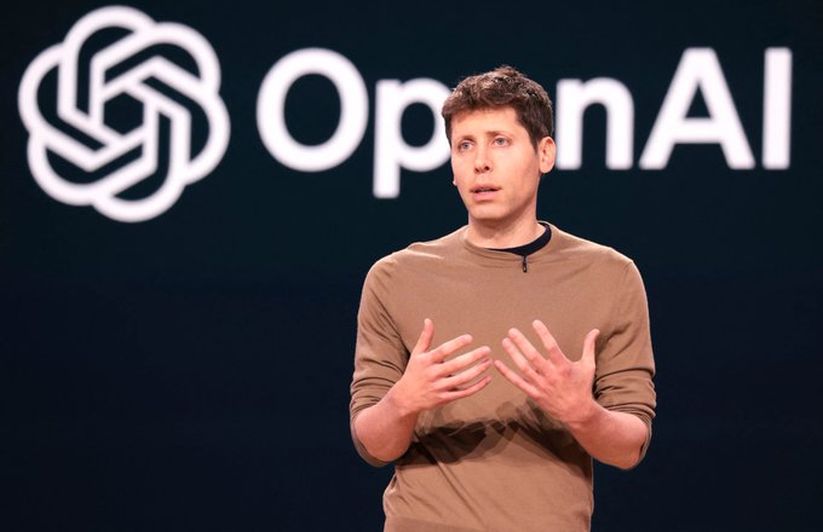
OpenAI CEO Sam Altman