It’s Tuesday, June 16, 2026, and today’s global tech agenda shows just how quickly the next phase of the industry is taking shape — from DeepSeek’s massive China AI funding round and Qualcomm’s chip ambitions to AI security, streaming consolidation, space intelligence, and new rules for social media. Here are the top tech stories making waves today.
SpaceX just made two moves in a single day that would have seemed impossible a year ago: it acquired the leading AI coding startup Cursor for $60 billion and watched its post-IPO shares surge toward overtaking Amazon in market value. At the same time, AI’s explosive energy demands are triggering a wave of fast-tracked power plants with minimal public oversight. Qualcomm is declaring that AI agents will replace traditional apps, and regulators from London to Rome are cracking down on Big Tech.
From Beijing’s record-breaking AI funding round to Meta’s internal reckoning and new global rules on everything from social media to porn sites, here are the top technology news stories shaping technology, infrastructure, and power on a global scale
Technology News Today
SpaceX to acquire AI coding startup Cursor for $60 billion in major enterprise push
SpaceX announced plans to acquire Anysphere, the parent company of the popular AI coding tool Cursor, in an all-stock deal valued at $60 billion. The transaction, structured through a SpaceX subsidiary, is expected to close in the third quarter of 2026 and includes significant termination fees. Cursor has seen rapid growth, generating $2.6 billion in annualized B2B revenue with strong enterprise adoption. SpaceX previously held an option on the deal following its June 11 IPO.
The acquisition strengthens SpaceX’s (and its affiliated xAI) position in enterprise AI, particularly in coding and developer tools, where it has trailed rivals such as OpenAI and Anthropic. It provides Cursor with access to substantial computing resources and aligns with SpaceX’s recent large cloud computing agreements. The move comes as SpaceX stock continues its post-IPO momentum.
Why It Matters: This landmark deal accelerates the convergence of Big Tech and the space sector around AI infrastructure and tools, reshaping competition in developer productivity and enterprise AI adoption.
Source: TechStartups via SEC Filings.
DeepSeek becomes China’s most valuable AI startup after a $7.4B raise
DeepSeek has become China’s most valuable AI startup after raising more than $7.4 billion in its first outside funding round, pushing its valuation above $50 billion. The round drew backing from Tencent, CATL, JD.com, NetEase, IDG Capital, Monolith Management, and China’s National AI Fund, with founder Liang Wenfeng also contributing roughly $3 billion.
The financing gives DeepSeek fresh capital for research, compute infrastructure, open-source AI tools, and agentic AI systems. It also strengthens Beijing’s broader push to build domestic AI capabilities as U.S. chip restrictions continue to limit access to advanced hardware. For the global AI race, this is another sign that China’s leading AI labs are moving from model launches to deep-pocketed infrastructure buildouts.
Why It Matters: DeepSeek’s raise shows China is still building serious AI challengers despite export controls and hardware limits.
Source: TechStartups via Reuters, The Information, Wall Street Journal.
Qualcomm reportedly in talks to buy AI chip startup Tenstorrent
Qualcomm is reportedly in talks to acquire Tenstorrent, the AI chip startup led by veteran chip designer Jim Keller, in a deal that could value the company between $8 billion and $10 billion. The discussions remain uncertain, but the talks point to Qualcomm’s growing ambition beyond smartphones and mobile processors.
Tenstorrent builds AI accelerators for training and inference, a market dominated by Nvidia but increasingly crowded with startups and strategic buyers looking for alternatives. For Qualcomm, a Tenstorrent deal would deepen its AI hardware strategy across data centers, autos, and edge computing. It would also give the company a stronger position as enterprises search for more affordable and diversified AI compute supply.
Why It Matters: A Qualcomm-Tenstorrent deal would add more pressure on the AI chip market as major incumbents race to reduce their dependence on Nvidia.
Source: Reuters.
Sarvam becomes India’s newest AI unicorn after $234M funding round
Sarvam AI has raised $234 million in the first close of a $300 million Series B round, valuing the Bengaluru-based startup at $1.5 billion. HCLTech led the round with a $150 million investment, joined by Bessemer Venture Partners, Khosla Ventures, and Peak XV Partners.
Sarvam is building a full-stack sovereign AI platform for India, spanning model development, inference infrastructure, voice AI, document AI, and enterprise applications. The startup says its tools already serve government and enterprise use cases across agriculture, insurance, fintech, banking, and defense. The deal also marks one of the clearest signs yet that India’s major IT companies are moving from AI partnerships to direct bets on homegrown foundation-model infrastructure.
Why It Matters: Sarvam’s round gives India a stronger local AI contender as countries push for more control over critical AI systems.
Source: TechCrunch.
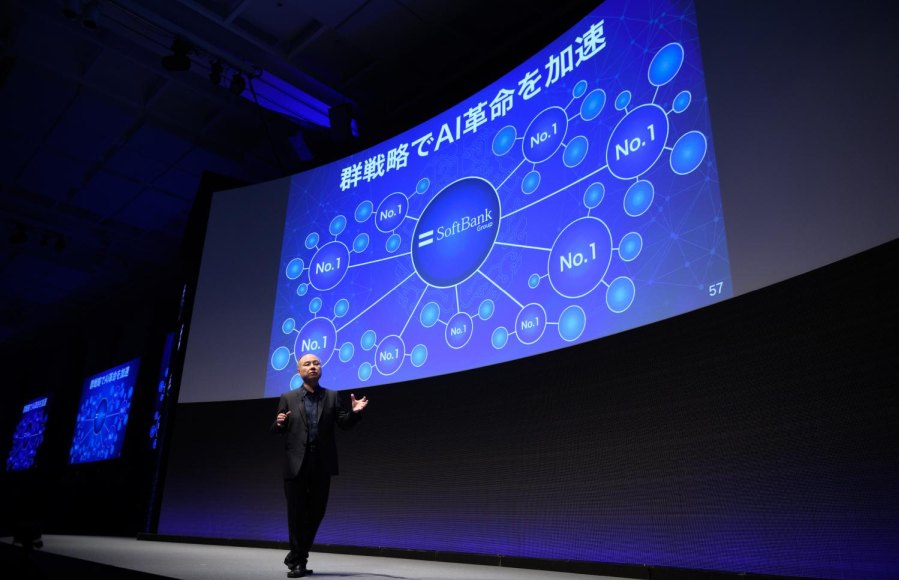
SoftBank launches an OpenAI-powered cybersecurity tool in Japan
SoftBank has launched a cybersecurity product in Japan called “Patching as a Service,” built on OpenAI models and designed to defend against AI-enabled cyberattacks. The product is part of SoftBank’s joint venture with OpenAI and is designed to help Japanese businesses and critical infrastructure respond faster to software vulnerabilities.
The launch comes as companies worry that attackers are using AI to find, exploit, and scale breaches faster than traditional security teams can respond. SoftBank plans to expand the team behind the rollout from about 50 people to roughly 1,000. For Japan, the product is also a strategic AI deployment: cybersecurity, infrastructure protection, and enterprise AI integration are converging into one market.
Why It Matters: SoftBank is turning its relationship with OpenAI into a national-scale cybersecurity business.
Source: Reuters.
Cyber startup Ent raises $100M seed round for real-time endpoint protection
Cybersecurity startup Ent has raised $100 million in seed funding to build a real-time behavioral monitoring platform for endpoint devices. The round was led by Decibel Venture Capital, with backing from Sequoia Capital, Crosspoint Capital, Craft Ventures, Shield Capital, Felicis, and In-Q-Tel.
Ent’s pitch is preventive security. Instead of waiting for malware signatures or post-breach alerts, its agent monitors unusual human and AI activity on laptops and desktops and intervenes in real time. That approach is becoming more relevant as companies deploy workplace AI agents and face a growing risk of data leaks, credential abuse, and automated insider-style behavior. The funding size also shows how much investor attention is shifting toward security products built for the AI era.
Why It Matters: Ent’s large seed round reflects rising demand for security tools that can police both humans and AI agents at work.
Source: Wall Street Journal.
SpaceX shares surge over 8% in premarket trading, on track to surpass Amazon in market value
Shares of SpaceX extended their post-IPO rally, rising more than 8% in premarket trading on Tuesday following a strong Monday performance. The gains position the company to overtake Amazon and become the world’s fifth-largest by market capitalization. SpaceX went public on June 11 in one of the largest IPOs in history.
The surge reflects robust investor confidence in SpaceX’s diversified businesses, including Starlink, launch services, and growing AI ambitions. Executives have highlighted continued momentum from the IPO, with additional capital raised through underwriters. The performance underscores the market’s appetite for high-growth tech and space companies amid the broader AI-driven rally.
Why It Matters: SpaceX’s rapid ascent highlights how frontier tech companies blending space, AI, and infrastructure are redefining market leadership and attracting massive capital flows.
Source: Reuters.
U.S. lets key federal data center oversight law expire as AI demand surges
The U.S. government is allowing the Federal Data Center Enhancement Act to expire without a clear replacement. The law has been used to guide federal standards for data center efficiency, sustainability, cybersecurity, and transparency.
The timing matters because AI is driving a historic wave of data center construction, with growing public concern over electricity demand, water usage, grid strain, and local permitting fights. Without the law, federal agencies may lose a common framework for measuring and reporting energy and security performance across government data centers. The move also fits a broader deregulatory posture toward AI infrastructure, even as the sector becomes more important to national competitiveness.
Why It Matters: As demand for AI compute grows, the U.S. is loosening federal data center oversight at a critical moment.
Source: WIRED.
NewCore raises $66M to secure identities for AI agents
NewCore has emerged from stealth with $66 million in funding to build identity infrastructure for the agentic enterprise. The company is backed by Cyberstarts, Index Ventures, and Evolution Equity Partners, and is led by cybersecurity veterans with prior exits including Dome9’s acquisition by Check Point.
The company’s thesis is simple: AI agents are becoming part of the workforce, and enterprises need to authenticate, govern, and control them like human and machine identities. That means discovery, permissions, audit trails, phishing-resistant authentication, and controls for agents that act across internal systems. As companies move from AI demos to production agents, identity may become one of the biggest bottlenecks in enterprise adoption.
Why It Matters: AI agents need access to systems, and NewCore is betting that access control becomes a major cybersecurity category.
Source: NewCore.
Respond.io raises $62.5M as AI agents reshape business messaging
Malaysia-based Respond.io has raised $62.5 million in a Series B round led by Camber Partners, with participation from Endeavor Catalyst and existing investors. The company provides customer conversation management software across WhatsApp, Instagram, TikTok, Messenger, Line, Telegram, WeChat, voice, and web chat.
Respond.io says it has reached $35 million in annual recurring revenue, growing 169% year over year, while processing about 2 billion messages per quarter. Its AI agents help businesses qualify leads, respond to customer inquiries, and close sales without relying entirely on human support teams. The funding will support hiring, organic growth, and possible acquisitions in North America and Europe.
Why It Matters: Respond.io shows how AI agents are turning messaging platforms into revenue engines for global businesses.
Source: TechCrunch.
AI satellite milestone shows future of autonomous space intelligence
An Earth observation satellite has reportedly used an onboard vision-language model to autonomously identify areas of interest, without waiting for human analysts on the ground. The system ran aboard Loft Orbital’s YAM-9 satellite using NASA Jet Propulsion Laboratory software.
The milestone points to a new phase for space-based sensing. Satellites typically collect huge amounts of imagery and send it to Earth for processing, creating bandwidth and latency constraints. If satellites can interpret data in orbit, they can prioritize what to transmit, respond faster to disasters or security events, and support new commercial services. The development also fits the broader trend of pushing AI from cloud data centers to edge environments where real-time decisions matter.
Why It Matters: AI in orbit could make satellites more autonomous, useful, and valuable.
Source: TechCrunch.
SpaceX shares climb as AI acquisition expands post-IPO ambitions
SpaceX shares continued to rise after its public market debut, helped by investor enthusiasm around its $60 billion all-stock acquisition of Anysphere, the maker of Cursor. The move pushes SpaceX deeper into AI software at a time when the company is already expanding across rockets, satellites, defense, connectivity, and AI infrastructure.
The deal matters because Cursor is one of the fastest-growing AI coding platforms, giving SpaceX a direct asset in developer productivity and software automation. For investors, it also reinforces the idea that SpaceX is no longer being valued only as a space company. Its public-market story now touches AI, software, data centers, satellite communications, and national-security infrastructure.
Why It Matters: SpaceX’s Anysphere deal blurs the line between space infrastructure and AI software platforms.
Source: Reuters.
Salesforce buys Fin for $3.6B to strengthen Agentforce
Salesforce has signed a definitive agreement to acquire Fin, formerly Intercom, for about $3.6 billion. Fin builds AI customer service agents that resolve support queries across live chat, email, WhatsApp, SMS, phone, and Slack.
The deal gives Salesforce a stronger agentic AI asset as it tries to defend its enterprise software base from AI-native challengers. Fin’s technology will be folded into Salesforce’s Agentforce platform, which helps companies build autonomous agents for service, sales, and internal workflows. The acquisition also shows how fast the enterprise software market is shifting from dashboards and seats to outcomes handled by AI agents.
Why It Matters: Salesforce is buying AI-native customer support technology to keep Agentforce competitive.
Source: Salesforce.
Fox agrees to buy Roku in a $22B streaming tech deal
Fox has agreed to acquire Roku in a cash-and-stock transaction valued at about $22 billion. The deal combines Fox’s sports, news, and entertainment businesses with Tubi’s streaming business, Roku’s connected TV platform, The Roku Channel, first-party data, and more than 100 million streaming households.
The acquisition would give Fox a much bigger position in connected TV advertising and streaming distribution. It also reflects the broader consolidation of media and technology as legacy TV companies try to regain leverage over audiences, ad targeting, and platform control. For Roku, the deal provides scale and a major content partner after years of competing in a market dominated by Big Tech platforms and streaming giants.
Why It Matters: Fox’s Roku deal is a major bet that streaming distribution and ad data are now strategic media infrastructure.
Source: Fox Corporation.
UK unveils sweeping social media ban for users under 16
The UK government has announced plans to ban children under 16 from accessing major social media platforms, including TikTok, Instagram, Snapchat, YouTube, Facebook, and X. Messaging services such as WhatsApp and Signal are expected to be excluded, while AI companion chatbots would face stricter age limits.
The policy could take effect by spring 2027 and would put the UK among the most aggressive countries in regulating youth access to social platforms. Supporters argue the ban could reduce exposure to harmful content, addictive design, and algorithmic pressure. Critics warn that enforcement may require invasive age-verification systems and could raise privacy, surveillance, and data security concerns.
Why It Matters: The UK’s proposed ban could reshape how major platforms handle age checks, youth safety, and AI companions.
Source: The Guardian.
AI robotics investing accelerates as physical AI becomes a venture theme
Investor attention is moving deeper into robotics and physical AI, with venture capitalists backing startups that bring AI into warehouses, factories, homes, defense systems, and industrial operations. PitchBook data cited by Business Insider shows global robotics investment rose from about $4 billion in 2019 to $26 billion in 2025.
The trend reflects a larger shift away from software-only AI toward systems that act in the physical world. Investors are betting on robot brains, manipulation models, industrial automation, humanoid platforms, and defense applications. The excitement is tempered by real deployment challenges: hardware is costly, safety matters, and real-world reliability is harder to achieve than in software demos. Still, physical AI is becoming one of the most important frontier categories in venture.
Why It Matters: Robotics is moving from a niche hardware bet to a core AI investment theme.
Source: Business Insider.
U.S. tech stocks climb as AI and SpaceX momentum lift markets
U.S. stock futures rose as investors watched the Federal Reserve and continued to bid up technology-linked names. SpaceX was one of the biggest movers, climbing again after its IPO and Anysphere acquisition, while chipmakers including Micron, Western Digital, and Seagate also gained.
The market reaction shows how much AI infrastructure and compute exposure still drive investor sentiment. Storage, chips, cloud capacity, and AI platforms remain linked in the public-market narrative, even as regulators, energy markets, and interest rates add pressure. For startups, the public-market appetite matters because it shapes exit expectations, late-stage valuations, and investor willingness to fund capital-intensive AI companies.
Why It Matters: Public markets continue to reward companies tied to AI infrastructure, compute, and strategic tech platforms.
Source: Reuters.