The 7 Most Valuable Companies in the World, Ranked by Revenue and Profit: One Generates $717 Billion a Year. Another Is Losing Money
 Daniel Levi
Posted On June 16, 2026
Daniel Levi
Posted On June 16, 2026
Amazon generates the most revenue. Nvidia earns some of the highest profits. SpaceX loses money. Yet all three rank among the world’s most valuable companies, revealing how investors are valuing businesses in the AI era.
On Friday, SpaceX made history by joining the trillion-dollar club despite reporting a net loss, an extraordinary milestone that highlights how markets are increasingly rewarding future potential alongside current financial performance. Revenue and profit still matter, but increasingly, investors are placing a premium on companies that control strategic technologies and are positioned to shape the future.
For decades, revenue and profit served as the clearest measures of corporate strength. Today’s market tells a different story.
One of the world’s most valuable companies generates more than $717 billion in annual revenue. Another reported a loss. A third produces the chips fueling the AI boom yet remains largely invisible to consumers.
The gap between revenue, profit, and valuation has never been wider.
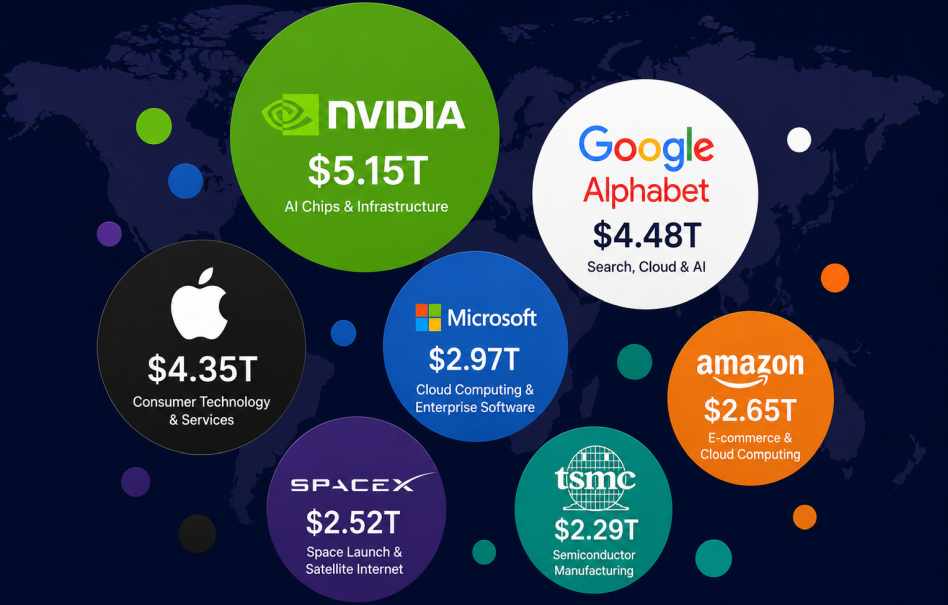
The seven most valuable companies on Earth now command a combined market value of more than $24 trillion. Their businesses span AI chips, cloud computing, consumer electronics, e-commerce, reusable rockets, internet satellites, and semiconductor manufacturing. Together, they offer a snapshot of where investors believe the next decade of growth will come from.
World’s Most Valuable Companies
Here are the seven most valuable companies in the world, ranked by market value, along with the revenue and profit figures that help explain their extraordinary valuations.
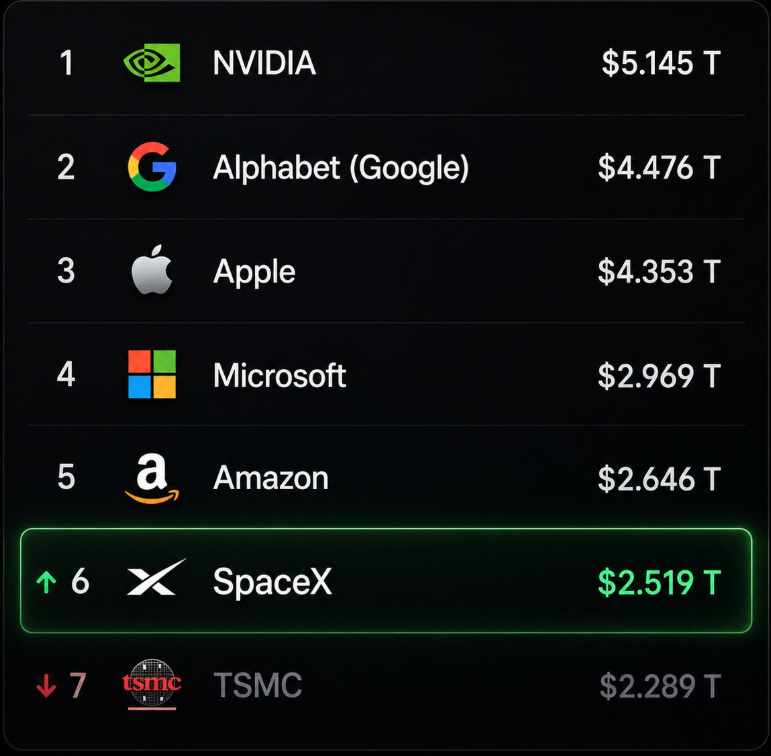
1. Nvidia
Market Value: $5.15 trillion
Revenue: $215.9 billion
Net Income: $117.0 billion
Nvidia sits at the top of the ranking, a position few would have predicted just a few years ago.
The company generates less than one-third of Amazon’s revenue, yet investors value it at nearly twice Amazon’s market capitalization. The reason lies in Nvidia’s central role in the AI race.
Its graphics processors have become the foundation of modern AI infrastructure. Tech giants, startups, governments, and research institutions are spending billions of dollars on Nvidia hardware to train and deploy AI systems.
The company’s financial performance reflects that demand. Nvidia earned roughly $117 billion in profit on $215.9 billion in revenue, producing margins that are rare among companies of its size.
Investors are betting that demand for AI computing will remain strong for years to come, making Nvidia one of the largest beneficiaries of the AI boom.
2. Alphabet
Market Value: $4.48 trillion
Revenue: $402.8 billion
Net Income: $132.2 billion
Alphabet may be the most diversified business in the ranking.
Its empire includes Google Search, YouTube, Android, Google Cloud, and Gemini AI. Search remains a cash machine, YouTube dominates online video, and Google Cloud has emerged as a major force in enterprise AI infrastructure.
Alphabet generated more than $400 billion in annual revenue and posted roughly $132 billion in profit, making it one of the most profitable companies on the planet.
The company is investing heavily in AI while defending its position in search, a business that remains one of the internet’s largest advertising platforms.
3. Apple
Market Value: $4.35 trillion
Revenue: $416.2 billion
Net Income: Approximately $112 billion
Apple remains one of the most profitable consumer technology companies ever created.
The iPhone continues to anchor its business, though services have become an increasingly important source of revenue and profit. The company’s ecosystem now spans hardware, software, subscriptions, payments, entertainment, and cloud services.
Apple’s installed base reaches billions of active devices worldwide, creating customer loyalty that few businesses can match.
Its valuation reflects the strength of that ecosystem and the company’s ability to generate enormous cash flow year after year.
4. Microsoft
Market Value: $2.97 trillion
Microsoft has successfully reinvented itself multiple times over the past several decades.
The company built its dominance during the personal computer era, expanded into enterprise software, became a cloud computing powerhouse through Azure, and now sits near the center of the AI race.
Its portfolio includes Windows, Microsoft 365, Azure, GitHub, LinkedIn, and a growing collection of AI products and services.
Investors view Microsoft as one of the safest ways to participate in the AI transformation, thanks to its deep relationships with businesses around the globe and its expanding cloud infrastructure.
5. Amazon
Market Value: $2.65 trillion
Revenue: $716.9 billion
Net Income: $77.7 billion
No company in this ranking generates more revenue than Amazon.
The e-commerce giant produced nearly $717 billion in annual sales, far ahead of every other company on the list. Yet Amazon ranks below Nvidia, Alphabet, Apple, and Microsoft in market value.
That contrast highlights a shift in how investors assess corporate value.
Amazon’s retail operations generate enormous sales volumes, though margins remain lower than those of businesses such as software, cloud computing, and AI infrastructure.
AWS continues to serve as one of Amazon’s most important profit engines and remains a major player in the global cloud market. Even so, Nvidia’s dominance in AI chips has convinced investors that its future growth potential warrants a higher valuation.
6. SpaceX
Market Value: $2.52 trillion
Revenue: $18.7 billion
Net Income: Loss of $4.9 billion
SpaceX stands out from every other company in this ranking.
It generates the least revenue and is the only company reporting a loss. Yet investors value it at more than $2.5 trillion.
That valuation reflects expectations rather than current financial performance.
The company dominates orbital launches, operates the rapidly growing Starlink satellite internet network, and continues to pursue ambitious long-term goals that extend far beyond traditional aerospace.
SpaceX has become one of the clearest examples of investors placing a premium on future opportunity. Its valuation is based on the belief that its launch business, satellite network, government contracts, and future ventures could generate substantial economic value over time.
7. Taiwan Semiconductor Manufacturing Company (TSMC)
Market Value: $2.29 trillion
Revenue: $122.4 billion
Net Income: $55.2 billion
TSMC may be the most important company that many consumers have never heard of.
The company manufactures advanced chips for Nvidia, Apple, AMD, Qualcomm, and many other technology leaders. Without TSMC’s production capabilities, much of the AI boom would not be possible.
Its factories produce some of the most advanced semiconductors ever made, giving the company a position that few competitors can challenge.
TSMC earns less revenue than many of the companies above it in the rankings, yet its strategic importance has made it one of the most valuable businesses on Earth.
Key Takeaways from the Rankings
Revenue Doesn’t Equal Value
Amazon generates the most revenue yet ranks fifth by market value.
Profit Doesn’t Always Determine Value
SpaceX reported a net loss yet ranks among the world’s most valuable companies.
AI Infrastructure Commands a Premium
Nvidia and TSMC sit at the center of the AI boom.
Strategic Position Matters More Than Ever
The companies controlling chips, cloud platforms, AI systems, and critical infrastructure are attracting the highest valuations.
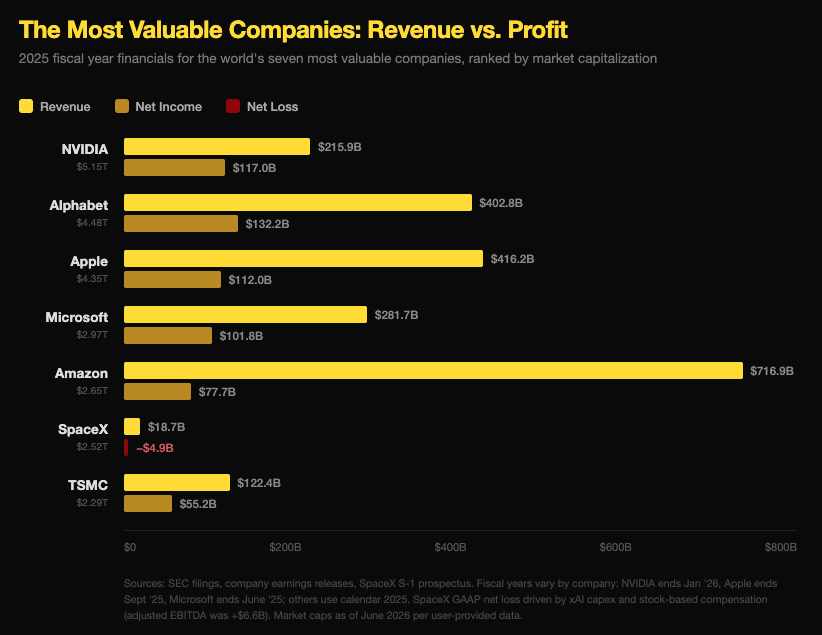
The Most Valuable Companies by Revenue and Profit (Source: SEC filings)
Below is a table of the world’s 7 most valuable private companies, based on the SEC filings.
The World’s Most Valuable Companies: Revenue vs. Profit
Methodology: Market values reflect public market capitalizations and private company valuations as of June 2026. Revenue and net income figures are based on each company’s most recent fiscal-year results reported in SEC filings, annual reports, earnings releases, and company disclosures.
| Rank | Company | Market Value ($T) | Revenue ($B) | Net Income ($B) | Country | Key Focus Area |
|---|---|---|---|---|---|---|
| 1 | Nvidia | 5.15 | 215.9 | 117.0 | United States | AI Chips & Infrastructure |
| 2 | Alphabet | 4.48 | 402.8 | 132.2 | United States | Search, Cloud & AI |
| 3 | Apple | 4.35 | 416.2 | 112.0 | United States | Consumer Technology & Services |
| 4 | Microsoft | 2.97 | 315.0 | 109.0 | United States | Cloud Computing & Enterprise Software |
| 5 | Amazon | 2.65 | 716.9 | 77.7 | United States | E-commerce & Cloud Computing |
| 6 | SpaceX | 2.52 | 18.7 | (4.9) | United States | Space Launch & Satellite Internet |
| 7 | TSMC | 2.29 | 122.4 | 55.2 | Taiwan | Semiconductor Manufacturing |
What These Rankings Reveal
A generation ago, revenue was often viewed as the ultimate measure of corporate success. Today’s rankings tell a more nuanced story.
Amazon generates the most revenue. Alphabet produces the highest profit. Nvidia commands the highest valuation. SpaceX loses money. TSMC quietly powers much of the technology industry.
Each company reached the top through a different path.
The common thread is strategic importance.
Investors are rewarding businesses that control critical infrastructure, dominate key platforms, enable AI development, or occupy positions that competitors struggle to replicate.
The result is a new corporate hierarchy where future growth potential can carry as much weight as current revenue and profit.
These seven companies are not simply the largest businesses on Earth. They are the companies investors believe will have the greatest influence on the next decade of technology, AI, and global economic growth.