Corca raises $7.8M to build an AI-powered ‘Cursor for math’ and replace decades-old workflows
 Daniel Levi
Posted On June 10, 2026
Daniel Levi
Posted On June 10, 2026

People can generate software with AI, create videos from text, and build websites in minutes. Yet many engineers, scientists, and financial analysts still rely on tools and workflows that have changed little since the 1980s. Equations are passed around in screenshots, shared as PDFs, or written using specialized syntax that can take years to master.
Corca thinks it’s time for that to change.
The New York-based startup, which is building what it describes as a “Cursor for Math,” announced Wednesday that it has raised $7.8 million in funding led by NEA. The round included participation from Bloomberg Beta, Daft Capital, and NVentures, NVIDIA’s venture capital arm.
Founded in 2023 by Anton Gladkoborodov and Oleg Shevlyagin, Corca is developing a browser-based workspace that combines math editing, symbolic computation, collaboration, and AI assistance in a single environment. The company wants to replace the fragmented collection of tools that many technical teams use today across engineering, physics, finance, scientific research, and AI development.
The opportunity is larger than it might appear.
Mathematical computing sits at the center of industries ranging from aerospace and defense to energy and academia. Yet much of the software infrastructure supporting those workflows traces its roots back decades. Engineers often move between separate applications for equations, simulations, calculations, documentation, and collaboration. Many platforms still require users to learn programming languages or formatting systems such as LaTeX before they can begin meaningful work.
According to Corca, more than 100,000 organizations across over 180 countries rely on these disconnected workflows.
Math Software Hasn’t Changed Much in 40 Years. Corca Raises $7.8M to Fix It
Why Mathematical Workflows Have Remained Stuck in the 1980s
For decades, technical professionals have relied on specialized software vendors, each solving a different part of the problem.
MathWorks’ MATLAB became a standard tool for engineering and numerical computation. Companies such as Dassault Systèmes, PTC, and Ansys built large businesses around simulation, modeling, and physics applications. Each product serves a purpose, yet teams frequently move data between multiple systems to complete a single project.
Corca’s pitch is straightforward: bring math creation, computation, collaboration, and AI assistance into one shared workspace.
Users can write mathematical expressions naturally instead of learning specialized markup languages. Calculations run in real time. Multiple people can collaborate on the same document in a way that feels closer to Google Docs or Figma than traditional engineering software.
Built-in AI tools can help solve problems, manipulate symbolic expressions, and generate code without requiring users to jump between separate applications.
“In 2026, people still do math on paper, and there was no real math editor on the market with over five million users. All of them struggle with broken workflows daily,” said Anton Gladkoborodov, Co-Founder and CEO of Corca Research. “If you want to type mathematics on a computer, your main option isn’t an editor, but rather a layout language. We started Corca to build something faster and more intuitive.”
The company points to engineering projects as one example. A team designing an air conditioning system may need equations, simulations, code, and modeling tools to study how heat moves through materials. Corca’s goal is to keep that process within a single workspace rather than spread it across multiple applications.
The startup says it has attracted more than 10,000 users through organic growth and reports that some users complete equation-heavy work up to twice as fast as traditional workflows.
“We aim to make math more accessible and plan to keep the core editor always free for academic users. Our society will benefit from more engineering and science talent if everyone is able to interact more easily with math from an early age. If I had Corca in my school days, I bet I would never have a single ‘C’ in math,” Gladkoborodov said.
Corca’s vision arrives at a moment when investors are increasingly looking beyond AI chatbots and searching for applications that solve domain-specific problems.
Luke Pappas, Partner at NEA, believes mathematics represents one of those opportunities.
“We believe AI models will dramatically accelerate advancements in hard sciences,” said Pappas. “However, traditional LLMs have struggled with math because written math is not simply a string of textual tokens, but is instead a sequence of symbols of higher meaning. Corca has built a symbolic math engine from the ground up, which we believe makes it the best application for mathematical workflows enhanced by AI.”
The new funding will support product development, AI research, and hiring as Corca works to modernize a category that has seen little fundamental change for decades.
If the company succeeds, the biggest shift may not be teaching AI how to do math. It may be giving humans a better place to do it.
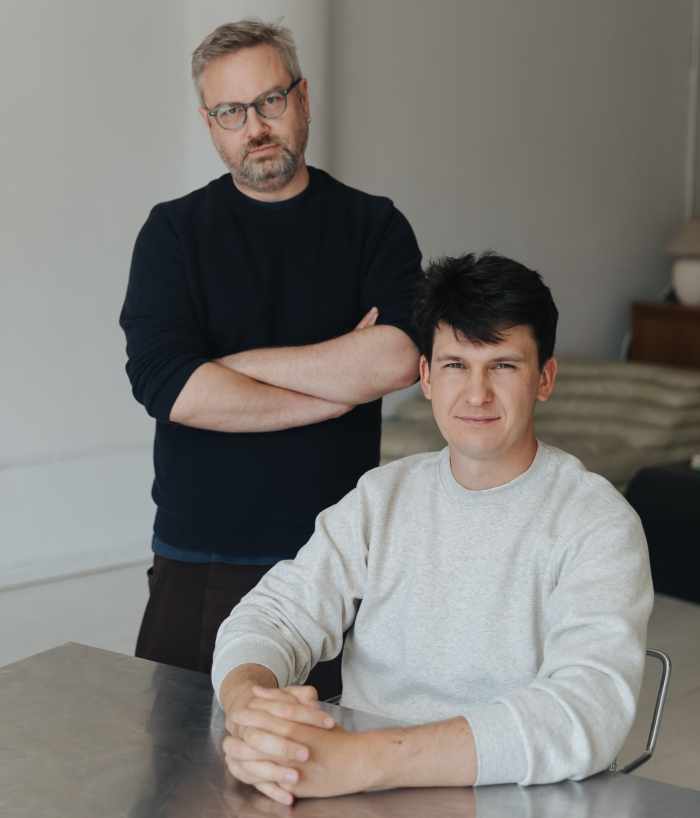
Corca founders Anton Gladkoborodov and Oleg Shevlyagin (Image credit: Corca)
Trending Now