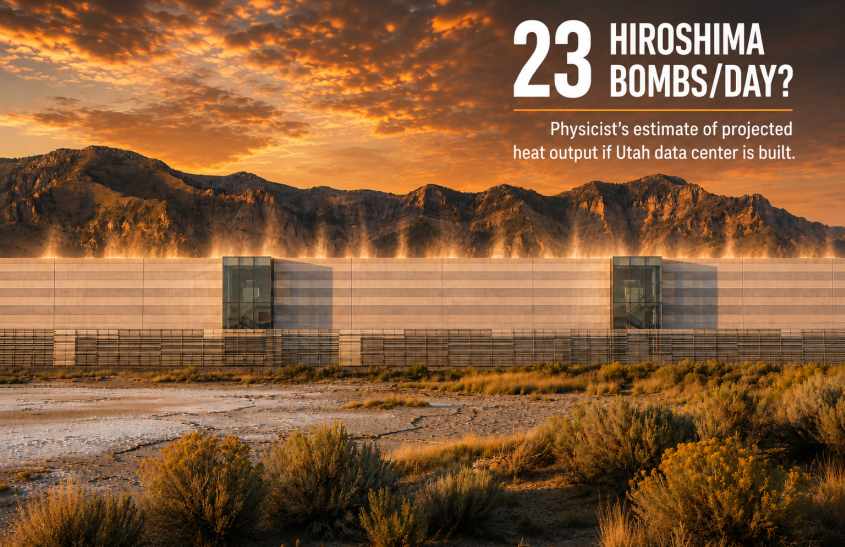
Proposed Utah AI data center could generate heat equivalent to 23 Hiroshima bombs per day, physicist warns
 Daniel Levi
Posted On June 8, 2026
Daniel Levi
Posted On June 8, 2026
The race to build artificial intelligence is no longer confined to chips, models, and software. It is increasingly becoming a battle for land, electricity, water, and energy generation.
Tech companies are expected to spend hundreds of billions of dollars on AI infrastructure this year as they race to build the data centers needed to train and run increasingly powerful AI systems. The Financial Times recently reported that global spending on AI infrastructure could eventually reach $9 trillion by 2030.
Bloomberg also reported that roughly 140 new data centers are expected to come online in the United States this year, representing about 12 gigawatts of computing capacity, enough electricity to power millions of homes.
That surge in construction has sparked growing opposition across the country as communities raise questions about electricity demand, water consumption, and environmental impact.
One of the most controversial projects is a proposed 40,000-acre AI data center development in Box Elder County, Utah.
“A Utah State University physics professor claims the proposed Box Elder County data center could release heat equaling ’23 atomic bombs’ per day, while possibly raising temperatures throughout the day,” local Utah news outlet Fox 13 reported.
The report refers to an analysis by Robert Davies, a physics professor at Utah State University, who examined the potential environmental impact of the proposed project. Davies’ findings have become a focal point in a growing debate over the energy demands of AI infrastructure and whether communities are prepared for data centers operating at unprecedented scale.
The project, known as Stratos, has emerged as one of the most closely watched AI infrastructure developments in the United States, drawing scrutiny from environmental groups, local residents, and technology investors alike. Davies’ analysis, shared through Grow the Flow, a Utah nonprofit focused on water conservation, argues that the project’s thermal footprint could significantly affect local temperatures and place additional stress on a watershed already facing environmental challenges if the facility is built at its planned scale.
One of the largest AI infrastructure projects ever proposed
The Stratos project has been promoted as a major AI infrastructure development at a time when technology companies are racing to secure computing capacity for the next generation of artificial intelligence systems.
Publicly available plans indicate the project could require approximately 9 gigawatts of electricity at full buildout. That figure alone would place it among the largest energy consumers in the country.
For perspective, many large cities operate on less electricity than what the facility is expected to consume.
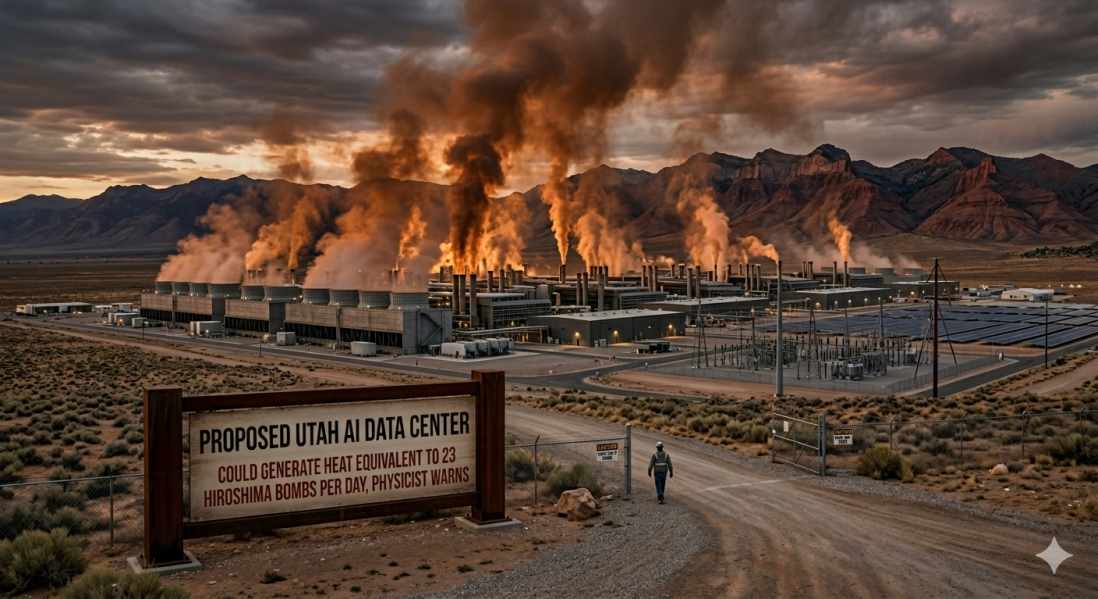
Illustrative Image Credit: Gemini
The project’s size has attracted support from business leaders, who argue that the United States needs large-scale AI infrastructure to remain competitive as demand for computing resources continues to climb.
Among the project’s backers is entrepreneur and Shark Tank investor Kevin O’Leary, who has publicly defended the development against environmental criticism.
The physics behind the “23 atomic bombs” claim
The most widely discussed claim surrounding the project stems from Davies’ analysis of its projected thermal load.
According to the report, project developers estimate the facility would require roughly 9 gigawatts of electricity to operate.
Davies argues that the energy demand tells only part of the story.
His analysis estimates the project would generate an additional 7 to 8 gigawatts of waste heat, bringing the total thermal load to roughly 16 gigawatts.
That thermal output formed the basis of his comparison to approximately 23 Hiroshima-scale atomic bombs’ worth of energy released over a 24-hour period.
The comparison refers to energy output and heat generation rather than explosive force.
Davies said the scale of the project creates environmental effects that cannot be ignored.
“The thermal load from the proposed Stratos project is extreme,” Davies said in the report. “There is no way around the physics. This is the energy output of two-and-a-half New York City’s poured into a single confined desert basin, in a watershed that’s already in crisis. Of course, it has effects. One of those effects is this: This facility imposes substantial drying on a watershed and ecosystem already in active collapse.”
The analysis has attracted significant attention online as concerns grow over the energy footprint of large AI facilities.
Could the AI data center project alter local temperatures?
Davies’ report goes beyond energy consumption.
According to the analysis, the facility could raise daytime temperatures in the Hansel Valley by up to 5 degrees Fahrenheit and increase nighttime temperatures by up to 12 degrees Fahrenheit.
The report argues that sustained warming could increase evaporation rates across the basin and worsen drying conditions in surrounding ecosystems.
Davies wrote that permanent increases in nighttime temperatures could contribute to additional water loss in an area already facing environmental stress.
Those projections have become a central point in the broader debate surrounding the project.
The estimates are based on Davies’ analysis and do not represent findings from a completed environmental impact study.
Kevin O’Leary pushes back
Project supporters reject the idea that the development poses an environmental threat on the scale critics describe.
Speaking about the project, O’Leary said concerns surrounding the development have been overstated and pointed to his background in environmental studies.
“I’m the only developer of data centers on earth that graduated from environmental studies,” O’Leary said during public comments on the project.
O’Leary said the facility could use alternative energy sources, including wind, solar, and battery storage technologies.
Current project plans made public indicate reliance on natural gas supplied through the Ruby Pipeline, a point that has fueled criticism from environmental groups.
In a separate development, project developer Bar H Ranch recently withdrew its water-rights application tied to the project. The company indicated it still intends to proceed with development and plans to submit a new application at a later date.
AI’s infrastructure era has arrived
The debate unfolding in Utah reflects a broader shift taking place across the technology industry.
For years, conversations around artificial intelligence focused on models, software, and computing breakthroughs.
Today, the conversation is increasingly centered on land, electricity, water resources, transmission lines, and power generation.
As technology companies pour hundreds of billions of dollars into AI infrastructure, questions once reserved for utilities, environmental planners, and industrial developers are becoming central to the future of artificial intelligence.
The proposed Stratos project has become one of the clearest examples of that shift.
Whether Davies’ projections prove accurate or not, the controversy surrounding the project highlights a reality facing the AI industry: the next stage of the AI race may be constrained as much by physical infrastructure as by advances in algorithms and computing hardware.
The controversy gained wider attention after YouTube creator ColdFusion featured the project in a video titled “Why Building AI Data Centers Isn’t Working Anymore.” The video explores the growing challenges facing large-scale AI infrastructure projects, including energy demand, heat generation, water usage, and community opposition.