AI is killing the unicorns: More than 220 unicorn startups are now worth less than half their peak value
 Daniel Levi
Posted On June 1, 2026
Daniel Levi
Posted On June 1, 2026
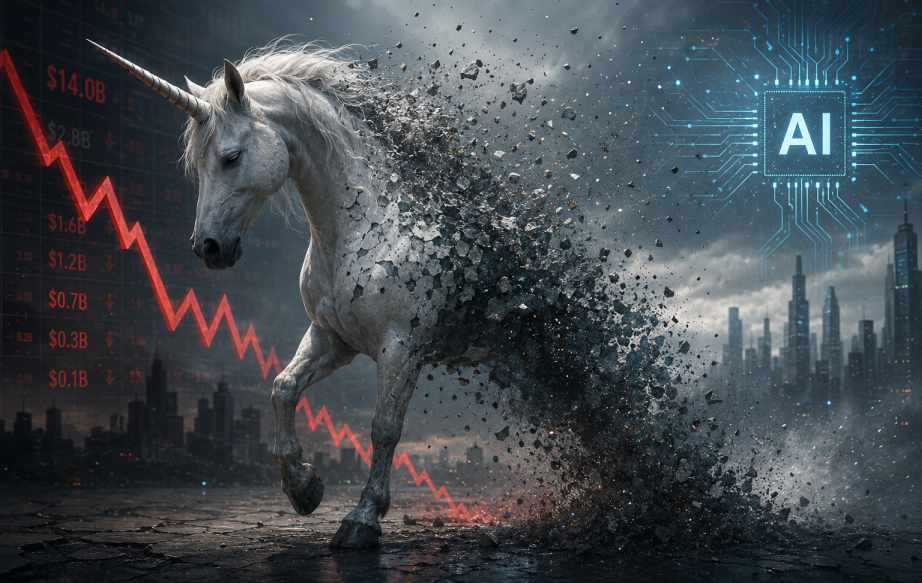
Five years ago, Chegg looked unstoppable.
The online education company rode the pandemic boom to a market value of more than $14 billion. Investors loved the story. Millions of students relied on the platform for homework help, tutoring, and study tools. Digital learning was surging, and Chegg appeared perfectly positioned for the future.
Then ChatGPT arrived.
Students suddenly had access to an AI tutor that could explain concepts, answer questions, write essays, and solve problems in seconds. The shift was swift. Traffic declined. Growth slowed. Investor confidence evaporated.
By late 2025, Chegg laid off 45% of its workforce, citing what it called the “new realities” created by artificial intelligence and falling web traffic.
Chegg wasn’t one of the venture-backed unicorn startups now appearing on PitchBook’s list of fallen startups.
It was something else.
Five years after reaching a market value of more than $14 billion, Chegg is worth just $146.67 million, as of the time of writing.
It was one of the first major casualties of the AI era.
Across Silicon Valley, a similar story is unfolding behind the scenes. Hundreds of startups that raised money during the venture capital frenzy of 2020 and 2021 are discovering that the assumptions that justified their billion-dollar valuations no longer hold.
A recent CNBC analysis of PitchBook data paints a stark picture. More than 220 U.S. startups that once carried valuations of $1 billion or more have become fallen unicorns. Many are now worth less than half of what investors once believed.
“Nearly half of America’s 857 unicorn startups haven’t raised fresh funding in three years, PitchBook data shows. Startups that last raised in 2021 are worth 68% less on average, PitchBook found, while those that last raised in 2022 have seen their valuations decline 52%,” CNBC reported.
The shift marks one of the largest valuation resets in startup history.
220 Unicorn Startup Valuations Have Crashed Since ChatGPT. Here’s What Happened
During the pandemic-era funding boom, investors poured money into companies selling everything from scheduling software to direct-to-consumer products. Cheap capital, low interest rates, and a rush toward digital services pushed valuations to extraordinary levels.
Founders believed they had time to grow into those valuations. Investors largely agreed.
Then generative AI changed the equation.
“The ChatGPT moment was when people said, ‘Holy smokes, the next generation of entrepreneurs, their coding language is spoken English,’” said Samir Kaul, a partner at venture firm Khosla Ventures and an early OpenAI backer.
“Now you’re seeing 50 engineers do what it would’ve taken 500 engineers to do five years ago,” Kaul said. “We had to completely reshuffle how we valued these companies.”
The consequences extend far beyond public markets.
From Unicorns to Fallen Stars: How AI Is Reshaping the Startup World
Much of the attention surrounding AI has focused on the enormous sums flowing into companies such as OpenAI and Anthropic ahead of anticipated public offerings. Investors have committed more than $250 billion to those firms, creating a new generation of AI giants almost overnight.
Less visible is what has happened to the companies left behind.
PitchBook counts 857 U.S. startups with unicorn status. Nearly half have not raised fresh capital in more than three years, leaving many valuations frozen in time. According to PitchBook estimates, startups that last raised funding in 2021 have lost an average of 68% of their value. Companies that last raised in 2022 have declined by roughly 52%.
| Company | Estimated Value (Dec. 31, 2025) |
Peak Valuation | Decline |
|---|---|---|---|
| Paxos | $997M | $2.4B | 🔻 -59% |
| Glossier | $983M | $1.8B | 🔻 -45% |
| The Farmer’s Dog | $970M | $1.47B | 🔻 -34% |
| SeatGeek | $851M | $1.34B | 🔻 -36% |
| Formlabs | $820M | $2.08B | 🔻 -61% |
| Calendly | $793M | $3B | 🔻 -74% |
| LTK | $742M | $2.55B | 🔻 -71% |
| AG1 | $699M | $1.32B | 🔻 -47% |
| Cirkul | $696M | $1.07B | 🔻 -35% |
| Betterment | $692M | $1.3B | 🔻 -47% |
| Articulate | $683M | $3.75B | 🔻 -82% |
| Thirty Madison | $673M | $1.04B | 🔻 -35% |
| Picsart | $669M | $1.23B | 🔻 -46% |
| Brooklinen | $659M | $1B | 🔻 -34% |
| Character.ai | $642M | $1B | 🔻 -36% |
| Nova Labs | $568M | $1.33B | 🔻 -57% |
| Breeze Airways | $516M | $1.24B | 🔻 -58% |
| Skydio | $509M | $2.5B | 🔻 -80% |
| Savage X Fenty | $390M | $1B | 🔻 -61% |
| Rothy’s | $339M | $1B | 🔻 -66% |
Those figures point to a growing divide between startups built before ChatGPT and startups built after it.
“A lot of those companies are pre-AI, not just in their cost structure, but also in their products,” Mercury CEO Immad Akhund told CNBC.
“They’re definitely in a difficult spot,” he said. “All the attention’s on AI, so if you’re not an AI-first company, you need really strong numbers to raise.”
That challenge is showing up across sectors.
The list of fallen unicorns includes consumer brands such as Glossier, Brooklinen, Rothy’s, The Farmer’s Dog, and Savage X Fenty. Fintech firms, software startups, and marketplace companies appear throughout the rankings.
The largest group is software.
PitchBook identified 75 software-as-a-service companies among the fallen unicorns, roughly twice the number of fintech firms on the list.
That statistic cuts to the heart of the problem.
For more than a decade, software startups benefited from a simple formula: hire more engineers, build more features, add more users, and charge more seats. Investors rewarded that model with increasingly rich valuations.
AI is rewriting those rules.
David Zhu, a former engineering leader at DoorDash, believes the disruption has only begun.
“The thesis I had was that all workflow-driven enterprise SaaS companies will be either disrupted or dead in the next decade,” Zhu told CNBC.
Companies built before generative AI often carry large teams, expensive operating structures, and products created for a different era of software. New AI-native startups are arriving with smaller teams, lower costs, and products built around automation from day one.
That has changed investor behavior.
“What that means is that investors would rather just bet on new entrepreneurs at lower valuations rather than double down on older startups,” Zhu said.
For many founders, the biggest challenge isn’t competition.
It’s relevance.
The question facing hundreds of once-promising startups is no longer whether they can grow.
It’s whether they can adapt before AI leaves them behind.