How Tech Startups Use Advanced Outreach Tools to Grow on LinkedIn
 Daniel Levi
Posted On May 28, 2026
Daniel Levi
Posted On May 28, 2026
Early-stage founders face a unique set of challenges as they navigate the crowded world of professional networking. Advanced outreach tools on LinkedIn are redefining how tech startups find first customers, partners, and hires. Understanding and leveraging these technologies can shape the trajectory of a startup’s growth.
As the technology landscape becomes more competitive, relying on traditional manual prospecting is less effective than using automated, structured outreach solutions. Many teams turn to LinkedIn lead generation services, which facilitate systematic outreach and help address the issues of scale and personalization common to early growth stages. These services help startups effectively manage rising noise and stricter buyer expectations by offering crucial features that streamline engagement. For tech startups, adopting the right outreach tools is key to fostering authentic conversations and building scalable pipelines.
Why founders value LinkedIn as a core channel
LinkedIn remains a primary channel for tech startups due to its ability to provide direct access to prospective customers, early partners, and industry talent. Founders and go-to-market teams often prioritize it for customer discovery, as the platform delivers real-time insights into professional activity and emerging business needs.
Recently, growing competition has led to a higher volume of outreach on the platform. Decision-makers are receiving more messages each day, raising the expectations for relevant and precisely targeted communication. Adapting to these changes requires building higher-quality connections and tailoring outreach to more specific segments.
The evolution from manual prospecting to structured processes
Startups frequently encounter challenges when relying on manual, unstructured outreach. Inconsistent follow-up and generic messaging can lead to missed opportunities, while the absence of a standard process makes it difficult to track pipelines and refine strategies.
Implementing structured outreach systems allows teams to organize every stage of engagement, from initial contact to conversion. This brings consistency and enables continuous learning from outreach experiences. Automating tasks such as sequencing, reminders, and analytics helps small teams remain responsive without compromising quality or compliance.
Capabilities that matter in advanced outreach platforms
Modern outreach platforms provide tools to build and refine prospect lists using detailed filters such as company size, funding stage, and hiring indicators. By narrowing discovery in this way, outreach efforts become more targeted, reducing wasted messages and increasing response rates among relevant audiences.
Segmentation and personalization at scale remain essential. Startups benefit from solutions that let them adjust messaging based on role, engagement history, or recent activity, enabling timely, relevant follow-ups that avoid repetitive or overly automated communication.
Furthermore, selecting platforms that integrate with CRM systems supports smooth data flow and maintains important context throughout every interaction. Automation in sequencing outreach steps and analytic feedback is also important for clarity and ongoing strategy improvement.
Effective platforms include features for campaign sequencing that schedule follow-ups and track responses, while analytics dashboards reveal which outreach elements are most successful. Collaboration tools such as role-based permissions and messaging guidelines help ensure consistency and reduce compliance issues within teams.
Building effective personalization and measuring results
Personalization in outreach should move beyond basic details like name or job title. Startups that perform well in outreach often leverage context signals, such as technology stack, hiring trends, or recent public posts, to offer more relevant and customized communication.
This method respects the prospect’s time and demonstrates clear intent, minimizing the risk of messages appearing scripted or unsolicited. Measuring success means looking beyond connection or open rates to understand deeper engagement.
Key metrics include reply quality, meeting-to-opportunity conversion, and pipeline impact. Even with limited volumes, simple A/B testing can indicate which messaging sequences are most effective and where further refinement might lead to better results.
Maintaining compliance and protecting reputation are critical. Teams should follow LinkedIn’s usage policies, manage data responsibly, and ensure that all outreach adheres to platform norms to sustain continued success.
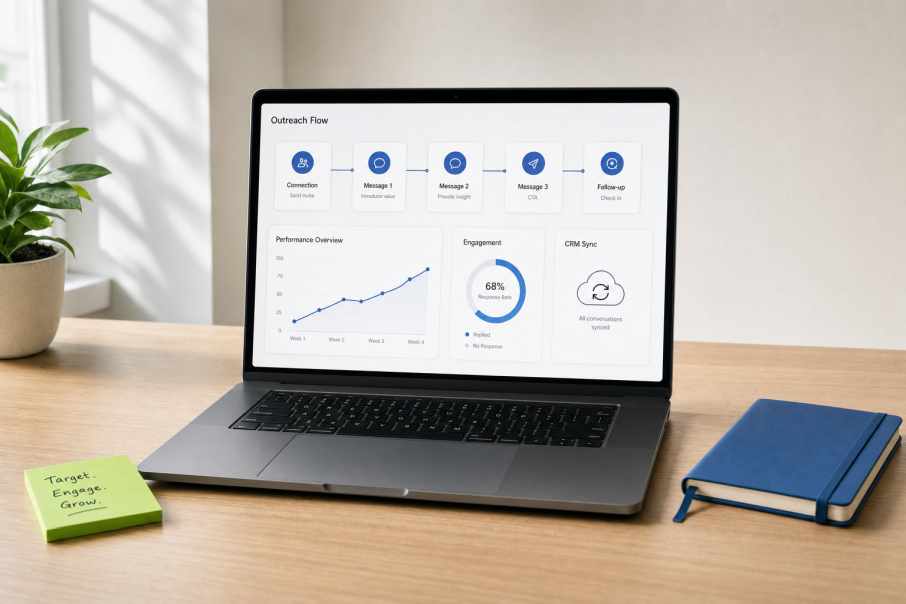
Sustainable outreach strategies focus on building trust and reinforcing a positive brand image. A well-designed outreach workflow integrates clear ICP definition, intentional prospect discovery, message creation, automated follow-up, seamless CRM handoff, and regular iteration.
With these elements in place, early-stage teams can scale their approach and achieve more meaningful results through LinkedIn lead generation services.