The AI Coding Hype Cycle: The 5 Stages Every Team Eventually Goes Through
 Daniel Levi
Posted On May 27, 2026
Daniel Levi
Posted On May 27, 2026
AI coding is all the rage right now.
Since the arrival of tools like Cursor, Claude, Replit, GitHub Copilot, Windsurf, and OpenAI Codex, AI-generated software has moved from curiosity to boardroom priority in less than two years. Founders are building prototypes in a weekend. Product managers are generating internal tools from prompts. Venture capital firms are funding lean AI-native startups operating with teams a fraction the size of traditional software companies.
Inside engineering organizations, the pressure is building quickly. Teams are being asked to ship faster, automate more work, and prove they are “AI-first” before competitors pull ahead. Executives see demonstrations of AI agents building apps in minutes and start asking a difficult question: if software can now be generated conversationally, what happens to the economics of engineering itself?
The excitement is real. So is the confusion.
AI Coding Gold Rush
For every viral demo showing AI building a polished app in minutes, there are developers quietly spending nights untangling hallucinated logic, duplicated functions, broken edge cases, and security flaws introduced by AI-generated code. Many organizations are discovering that generating software faster does not automatically mean building software better.
That tension sits at the center of the current AI coding boom.
The hype surrounding AI-assisted development often swings between two extremes. One side claims AI will replace software engineers entirely and usher in an era of “zero manual code.” The other dismisses AI coding as little more than autocomplete with better marketing. Neither view fully captures what is happening inside software teams right now.
The truth about AI-assisted coding
AI coding tools are proving to be powerful accelerators for prototyping, boilerplate generation, debugging assistance, and repetitive engineering tasks. Studies from organizations, including Google Cloud’s DORA research program, have shown measurable productivity gains for developers using AI-assisted workflows. Engineers who regularly use AI complete certain tasks significantly faster than peers relying solely on traditional development methods.
Speed, though, is only part of software development.
The harder question is what happens months later, after AI-generated code enters production systems, interacts with large codebases, touches sensitive customer data, and becomes part of long-term infrastructure that companies must maintain for years.
That is where the conversation becomes more complicated.
As MIT Technology Review’s Charlotte Jee put it earlier this year: “Depending who you ask, AI-powered coding is either giving software developers an unprecedented productivity boost or churning out masses of poorly designed code that saps their attention and sets software projects up for serious long term-maintenance problems.”
The reality emerging across many engineering teams is that AI coding increases output much faster than it increases certainty. A model can generate a function instantly. It cannot reliably determine whether the broader architecture surrounding that function makes sense for the business, scales correctly under pressure, or introduces hidden operational risks that surface later.
This distinction matters more than many companies expected.
The issue is not that AI-generated code is useless. Far from it. Many engineers now rely on AI coding assistants daily. The issue is that software systems fail globally, not locally. AI is often very good at producing localized solutions. Enterprise software, meanwhile, depends on long-horizon planning, clean abstractions, reliable dependencies, security discipline, operational awareness, and deep knowledge of how systems evolve over time.
The gap between generation speed and system-level judgment is starting to define the next phase of the AI coding era. As TechRadar noted in a recent report, “A widening gap has emerged between the speed of development and the systems responsible for testing, securing, and deploying that code.” The publication added that “the challenge is not simply generating code faster, but ensuring it can be delivered reliably at scale.”
There are already warning signs. Researchers and security analysts have repeatedly found vulnerabilities, insecure defaults, and weak error handling in AI-generated code samples. Earlier this year, a Claude-powered coding agent made headlines after deleting a production database and backups in seconds during an automated workflow failure. Developers have increasingly started referring to bloated AI-generated implementations as “vibe slop,” shorthand for code that appears functional at first glance but creates maintenance problems later.
At the same time, AI coding is making small teams dramatically more capable. Solo founders are launching products that once required entire engineering departments. Startups are reaching prototype stage faster than at any point in modern software history. The barrier between idea and execution has fallen sharply.
This is why the current moment feels so polarizing. AI coding is neither “just hype” nor “the end of software engineering.” The shift looks closer to the arrival of industrial power tools. A nail gun dramatically changes construction productivity. It does not eliminate the need for architects, inspectors, structural engineers, or experienced builders.
What many organizations are experiencing now is not a simple technology transition. It is a psychological and operational cycle that appears to repeat across companies adopting AI-assisted software development.
After months of observing developer behavior, startup adoption patterns, engineering discussions, productivity studies, and organizational reactions to AI-generated software, a recognizable pattern is emerging.
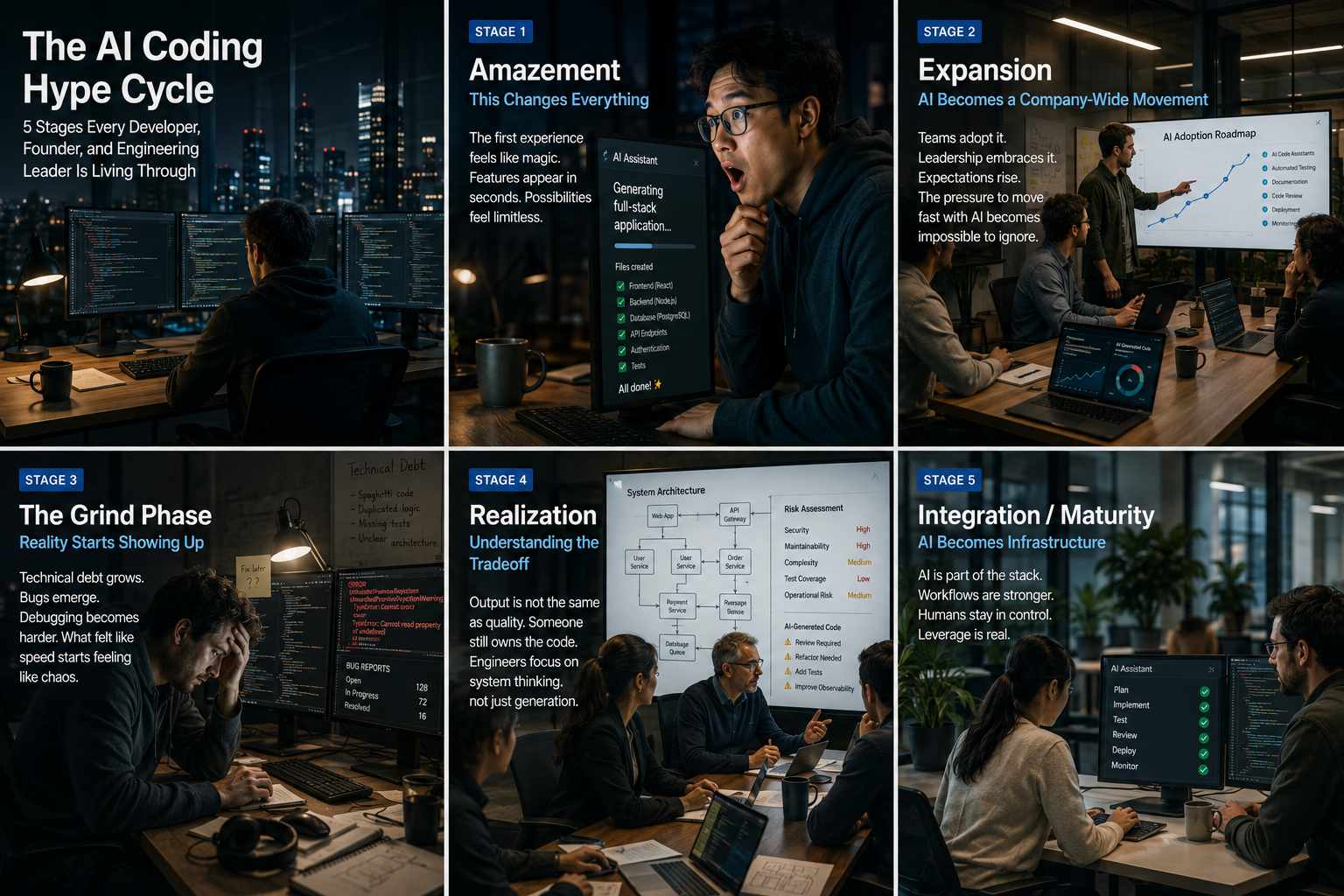
Most teams appear to move through the same five stages.
The 5 Stages of AI Coding Hype
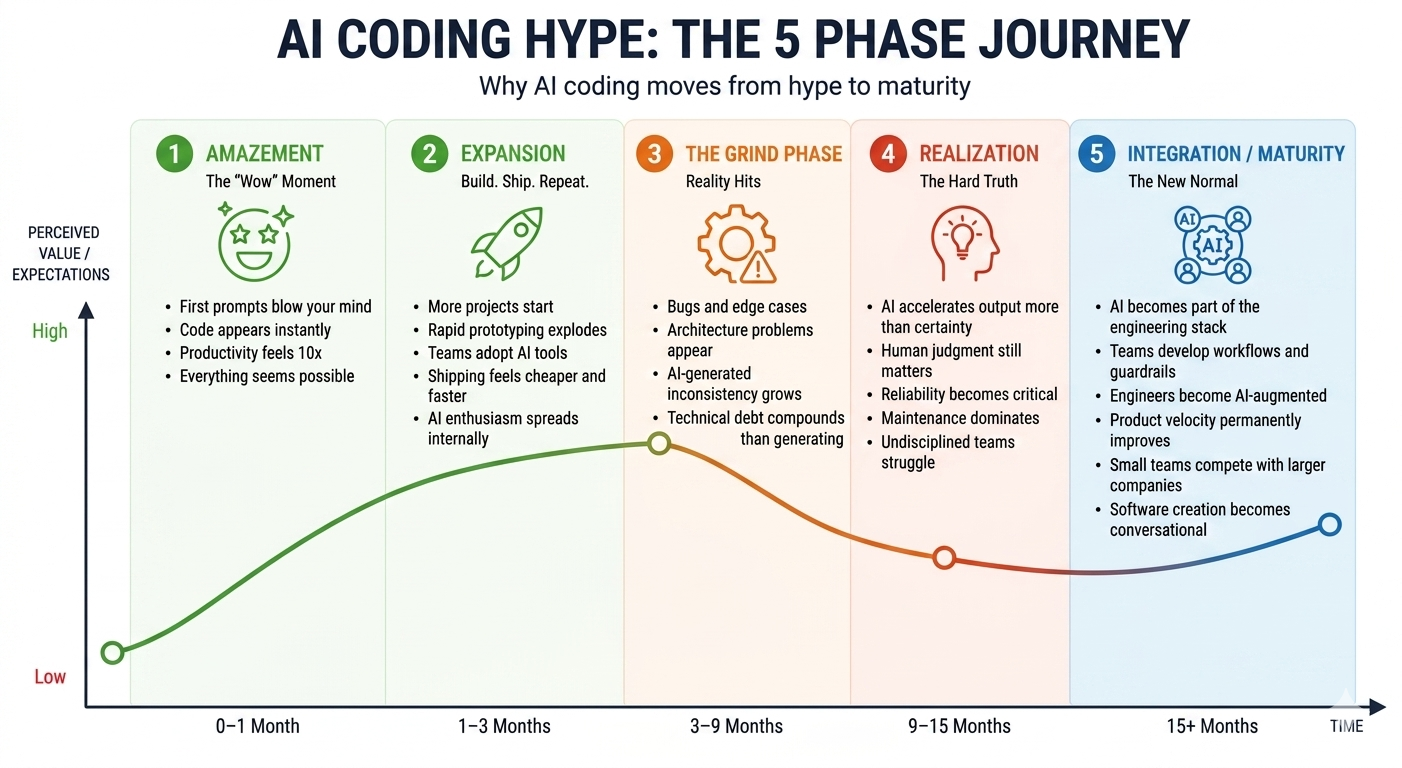
AI Coding Hype: The 5-Phase Journey (Click to see full image)
Stage 1: Amazement — “This Changes Everything”
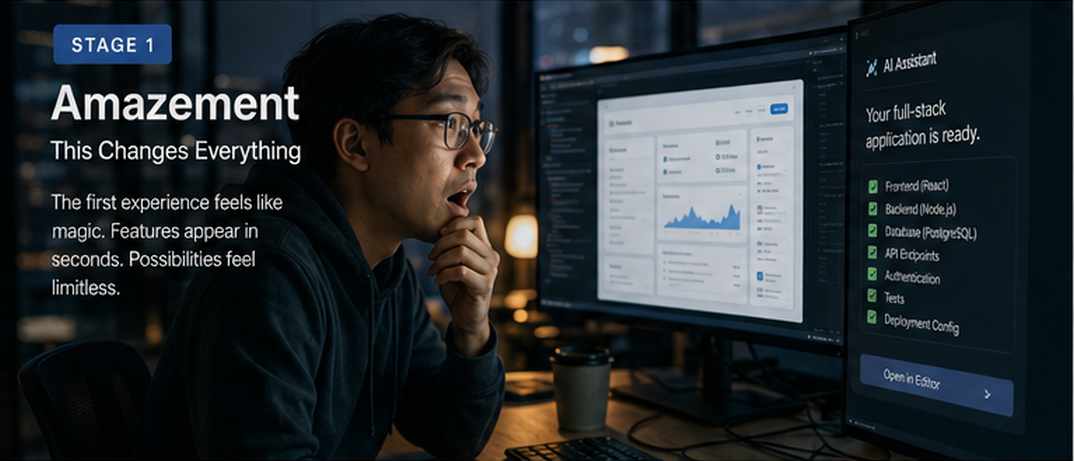
For most developers, the AI coding cycle starts with disbelief.
The first experience feels almost surreal. A developer opens Cursor or Claude, types a short prompt, and watches an entire feature appear in seconds. APIs are scaffolded instantly. Front-end components materialize from plain English instructions. Database schemas, unit tests, authentication flows, and deployment scripts appear with almost no manual effort.
The effect is hard to overstate.
Tasks that once took hours suddenly take minutes. Work that previously required deep documentation searches or Stack Overflow threads now happens conversationally. Developers describe the experience using the language of magic because, at first glance, it genuinely feels like a leap into a different era of software creation.
That emotional reaction matters.
Every major technology shift begins with a moment where the old assumptions collapse. AI coding creates exactly that kind of moment. Engineers who spent years manually wiring infrastructure or debugging repetitive boilerplate suddenly realize large parts of their workflow can be compressed into prompts.
The excitement spreads quickly across teams.
A junior engineer discovers they can build internal dashboards without waiting for senior review cycles. A startup founder with limited coding experience ships a working prototype over a weekend. Product managers begin experimenting with lightweight applications directly instead of waiting for engineering bandwidth. Inside large organizations, executives see demos of AI agents creating usable software in minutes and start asking whether software development itself is about to become dramatically cheaper.
Social media accelerates the momentum.
X, LinkedIn, YouTube, and developer forums are now flooded with demonstrations of “vibe coding,” a term used to describe building software in a conversational way with AI assistance rather than through traditional engineering workflows. Founders post videos of entire SaaS apps generated from prompts. Developers showcase AI tools that fix bugs automatically or refactor large sections of code with minimal supervision.
The optics are powerful.
For companies already under pressure to move faster, AI coding appears to offer something irresistible: dramatically higher output without dramatically larger teams.
That promise has fueled an arms race across the software industry. Microsoft integrated Copilot across its developer ecosystem. OpenAI pushed deeper into coding workflows through Codex and ChatGPT integrations. Startups like Cursor and Windsurf turned AI-native development environments into some of the hottest products in tech. Venture capital firms poured billions into AI coding infrastructure startups betting that software development itself was entering a new phase.
The productivity gains are not imaginary.
Research from Google Cloud’s DORA program and other studies has shown measurable improvements in task completion speed among developers using AI-assisted workflows. Engineers report spending less time writing repetitive code, searching documentation, or setting up boilerplate infrastructure. Small startups are reaching proof-of-concept stages faster than many larger companies managed a few years ago.
This is the part many skeptics miss.
The early excitement surrounding AI coding is grounded in something real. The tools genuinely remove friction from software creation. They genuinely compress iteration cycles. They genuinely make individual developers more capable in certain contexts.
The mistake is assuming the first stage represents the full story.
At this point in the cycle, most teams are still measuring what AI coding accelerates immediately. Very few are yet measuring the costs of AI-generated software later.
Stage 2: Expansion — When AI Becomes a Company-Wide Movement
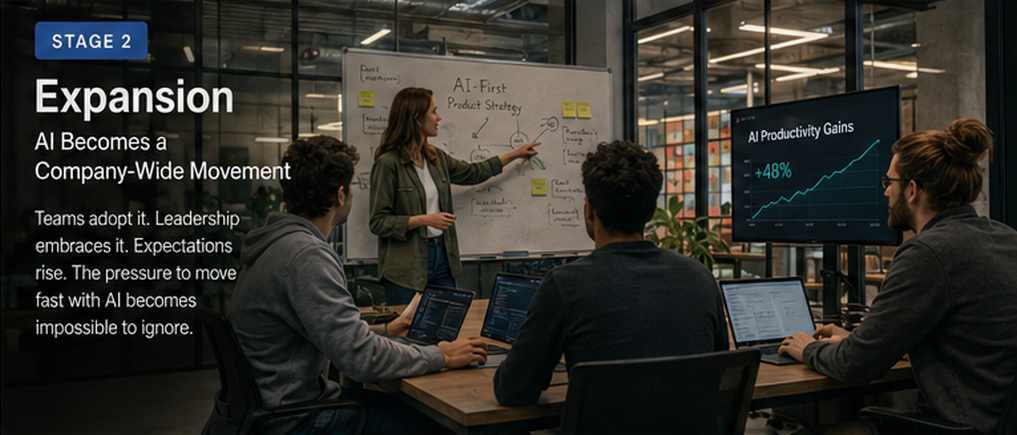
The second stage begins when personal excitement turns into organizational momentum.
What starts as a developer experimenting with AI coding tools quickly spreads across entire teams. A successful prototype inside one department becomes a presentation for management. An engineer demonstrates how a feature that once required three days now takes two hours. A founder ships a customer-facing product with a team far smaller than investors would normally expect.
Soon, AI adoption stops being an isolated workflow improvement and starts becoming a company-wide conversation.
This is where the social pressure begins to build.
Inside many organizations, AI coding is no longer viewed as optional experimentation. It becomes tied to competitiveness itself. Engineering leaders start asking whether teams are moving fast enough. Executives begin worrying that rivals may already be operating with AI-assisted productivity advantages. Developers who resist AI workflows risk being viewed as outdated or inefficient, even when their concerns are legitimate.
Few companies want to be seen as falling behind during a technology shift this large.
That fear has accelerated adoption at a pace rarely seen in enterprise software. AI coding assistants have moved into daily workflows across startups, Fortune 500 companies, consulting firms, and independent development communities almost simultaneously. Internal hackathons increasingly revolve around AI-generated software. Recruiters now list familiarity with AI coding tools as a preferred skill in engineering roles. Investors ask startups how they are using AI to reduce engineering costs and increase output.
The pressure flows downward through organizations.
Managers push teams to integrate AI tools into development pipelines. Developers feel pressure to justify why certain workflows are still manual. Founders are beginning to recalculate hiring plans based on the assumption that smaller teams can now produce significantly more software than before.
This is where expectations start climbing aggressively.
The early productivity gains from AI coding often lead to the belief that software development itself is entering a fundamentally cheaper era. If one engineer can suddenly produce the output of several developers for certain tasks, companies naturally start wondering whether the economics of engineering are about to change permanently.
For startups, the appeal is obvious.
Young companies have always faced the same constraint: ideas are cheap, engineering talent is expensive. AI coding appears to loosen that bottleneck. Solo founders can now build prototypes without waiting for technical co-founders. Small teams can iterate on products faster. Startups can test markets earlier and with less capital.
That shift is already reshaping parts of the startup ecosystem.
Some venture-backed companies now operate with engineering teams far leaner than investors would have accepted a few years ago. AI-native startups increasingly market themselves around speed, claiming they can compress months of development into days. Product cycles shorten. Expectations rise alongside them.
Inside larger enterprises, the narrative becomes more political.
Executives see AI adoption as a signal to shareholders that the company is modernizing. Consulting firms pitch AI transformation strategies promising efficiency gains across software operations. Boards ask leadership teams what their AI coding roadmap looks like. Internal AI initiatives multiply quickly, often before organizations fully understand the operational consequences of AI-generated software at scale.
This stage creates a powerful feedback loop.
The more companies talk publicly about AI-driven productivity, the harder it becomes for competitors to remain passive. Enthusiasm spreads socially as much as technically. Teams begin to convince one another that aggressively adopting AI coding is necessary for survival.
That dynamic matters.
Technology hype cycles rarely spread through technical capability alone. They spread through fear of missing the next shift. The internet boom, cloud computing, crypto, remote work, and mobile adoption all followed similar patterns. Once organizations believe a technology could redefine competitive advantage, adoption pressure intensifies long before long-term outcomes become clear.
AI coding has now entered that phase.
For many teams, the tools still feel transformational. Productivity gains remain visible. Shipping software feels faster and cheaper than before. The optimism appears justified.
What many organizations have not yet fully encountered are the long-term consequences that emerge as AI-generated code accumulates within large, interconnected systems.
Stage 3: The Grind Phase — When Reality Starts Showing Up
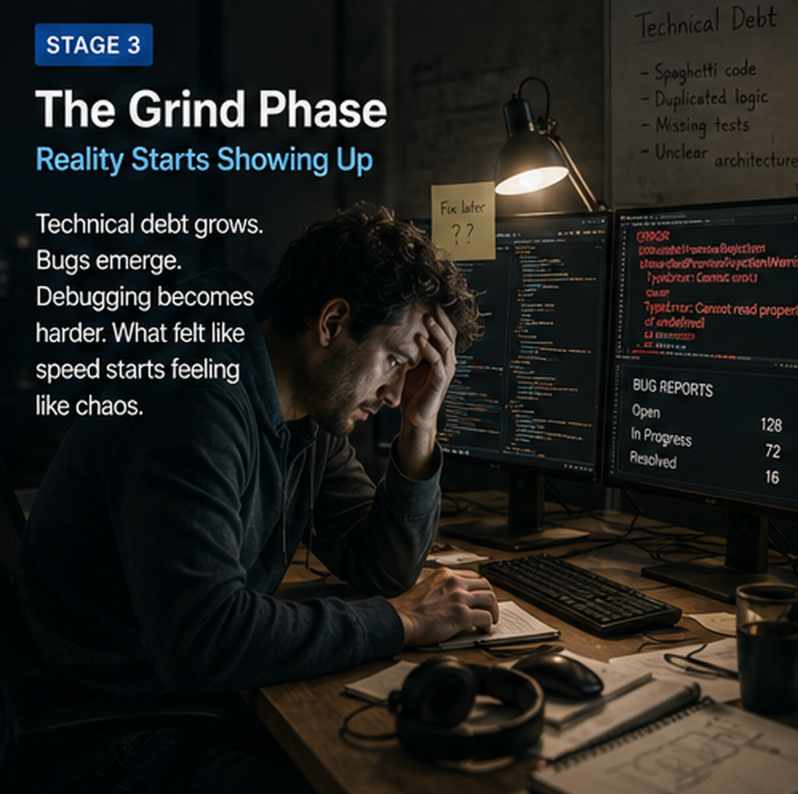
The third stage is where the emotional tone changes.
The excitement does not disappear overnight. Teams are still shipping quickly. AI coding assistants are still generating useful output. Productivity dashboards may still show positive gains. From the outside, the AI transition can still look successful.
Then the edge cases start appearing.
A feature generated in minutes behaves unpredictably under real customer traffic. An AI-generated abstraction conflicts with older parts of the codebase. Duplicate logic starts spreading across services because different prompts solved the same problem in slightly different ways. A debugging session reveals that nobody fully understands why certain code paths exist anymore, including the engineer who originally approved the AI-generated pull request.
This is the stage many developers quietly describe as exhausting.
The promise of AI coding initially feels like less manual work. Over time, many engineers discover they are spending an increasing amount of time reviewing, validating, correcting, and restructuring machine-generated code that looked acceptable on the first pass.
The workflow changes in subtle ways.
Developers start re-prompting repeatedly to fix earlier generations. Teams begin switching models depending on the task. Engineers spend hours comparing outputs from Cursor, Claude, OpenAI models, and GitHub Copilot trying to determine which produces the least problematic implementation for a given situation.
The speed remains high. The certainty starts collapsing.
This distinction sits at the center of the grind phase. AI coding tools can generate output extremely quickly. They are far less reliable at maintaining architectural consistency across large systems over time.
Software systems rarely fail because a single function is poorly written. They fail because interconnected decisions accumulate silently over months or years. AI coding agents often optimize locally. Enterprise software depends on global coherence.
That gap becomes increasingly expensive as codebases grow.
Developers begin noticing patterns that rarely appear in polished AI demos. Generated code may technically function but introduce hidden maintenance burdens later. Error handling becomes inconsistent across services. Logging structures drift. Security assumptions vary from one generated component to another. Dependencies multiply faster than teams realize.
This is where technical debt starts compounding aggressively.
Some engineers have started referring to bloated AI-generated implementations as “vibe slop,” shorthand for code that appears productive on the surface but creates long-term cleanup costs beneath it. The issue is not that AI-generated code always fails. The issue is that software quality becomes harder to evaluate when output volume increases dramatically.
The economics of engineering are beginning to shift in unexpected ways.
Companies initially adopt AI coding expecting lower development costs. Many later discover that review, testing, debugging, and long-term maintenance become increasingly important. In some teams, senior engineers find themselves acting less like traditional software developers and more like auditors supervising machine-generated systems.
That supervision burden can become significant.
The problem grows larger in organizations with weak engineering discipline. Teams lacking strong testing cultures, clean architecture practices, or rigorous review systems often experience the worst outcomes from uncontrolled AI-assisted development. AI tends to amplify whatever operational habits already exist inside an organization.
Strong teams often become stronger.
Weak teams can become chaotic much faster.
Security risks have added another layer of concern. Researchers have repeatedly demonstrated that AI-generated code can introduce vulnerabilities, insecure defaults, weak authentication logic, and unsafe database handling patterns. Earlier this year, concerns about autonomous coding agents intensified after reports surfaced of a Claude-powered AI coding workflow deleting a production database and its backups within seconds of making an incorrect operational decision.
The incident captured a broader fear spreading across parts of the software industry.
AI agents can act much faster than humans can intervene.
That speed is useful when the system behaves correctly. It becomes dangerous when the system makes the wrong assumption.
This is the point at which many organizations begin to recognize that AI-assisted development is not simply about generating more code. It is about managing a new category of operational risk tied to software generation at machine speed.
The grind phase often lasts much longer than companies expect.
Part of the reason is psychological. Once teams publicly commit to AI-first development strategies, reversing course becomes difficult politically and culturally. Managers who championed aggressive AI adoption may resist acknowledging unexpected maintenance costs. Founders who marketed lean AI-native teams to investors face pressure to maintain the narrative.
By this stage, many organizations are deeply invested in the idea that AI coding represents the future of software engineering.
The harder question becomes whether they fully understand the tradeoffs that come with it.
Stage 4: Realization — AI Increases Output Faster Than Certainty
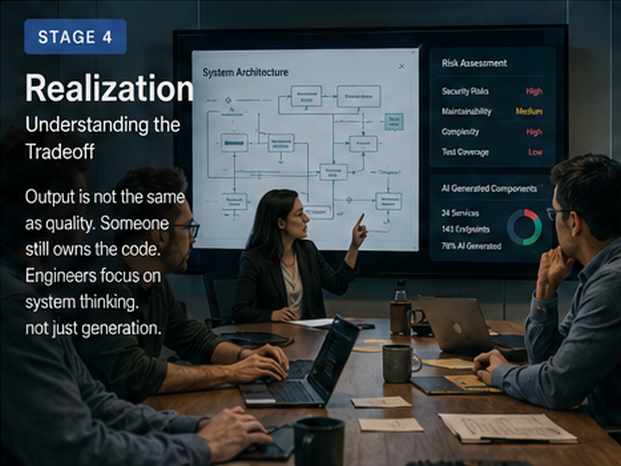
By the fourth stage, the conversation within engineering teams starts to change.
The early debate around AI coding often centers on speed. How much faster can developers ship? How many engineers can a startup operate with? How quickly can products move from idea to deployment?
Months later, many organizations arrive at a different question entirely:
How much of the generated software can they actually trust?
This is where the deeper realization begins to take shape.
AI coding tools are very good at accelerating implementation effort. They are far less reliable at replacing engineering judgment. That distinction becomes increasingly obvious as AI-generated software moves deeper into production systems tied to revenue, compliance, infrastructure, and customer data.
The problem is not that the code looks broken immediately. In many cases, it looks surprisingly polished. Functions compile correctly. Interfaces appear clean. Unit tests may even pass.
The issue is that software quality is not measured by whether code works today. It is measured by whether systems remain reliable, maintainable, secure, and understandable years later under changing conditions.
That requires a different kind of thinking than prompt generation alone.
This is why many senior engineers have become more valuable during the AI coding boom, not less. Junior developers often see the dramatic increase in output first. Experienced engineers tend to see the operational liabilities accumulating beneath that output.
A large software system is not simply a collection of generated functions. It is an evolving structure shaped by dependencies, architectural decisions, security assumptions, infrastructure constraints, business rules, and long-term maintenance realities. AI can assist with pieces of that structure. It still struggles with the broader strategic coherence needed to keep complex systems stable over time.
That gap is expensive.
Companies are beginning to realize that the cost of writing software may be falling faster than the cost of maintaining it. AI compresses creation. It does not automatically compress accountability.
Someone still owns the code after deployment.
Someone still responds when systems fail at 2 a.m. Someone still audits infrastructure after a security incident. Someone still explains to regulators why sensitive customer data was exposed through a weak implementation generated conversationally months earlier.
This is where the hype around “zero manual code” starts colliding with operational reality.
The idea that AI will completely replace software engineers increasingly looks less like a near-term business model and more like a misunderstanding of what engineering work actually involves. Writing syntax has always been only one layer of software development. Much of engineering revolves around decision-making under uncertainty, tradeoffs between competing system constraints, long-term planning, reliability management, and institutional knowledge built over years.
AI coding tools can generate solutions quickly. They cannot fully inherit responsibility for those solutions after deployment.
That distinction matters enormously inside large organizations.
Many engineering teams are now restructuring workflows around this reality. AI-generated pull requests increasingly require stronger review pipelines. Security teams are expanding code auditing processes for machine-generated implementations. Companies are investing more heavily in testing infrastructure because output volume has risen sharply.
Some developers describe the transition as moving from software creation to software supervision.
The engineer’s role shifts from typing every line manually to orchestrating, validating, correcting, and maintaining increasingly machine-generated systems. The nature of engineering work changes, even if engineering itself does not disappear.
This stage often produces a more balanced perspective on AI coding.
The technology is no longer viewed as magic. It is no longer dismissed as hype either. Teams are increasingly seeing AI coding as more like industrial automation: extremely useful in the right environment, highly dangerous without oversight, and deeply dependent on the quality of the surrounding operational systems.
That realization can be uncomfortable for companies that initially believed AI would dramatically simplify software development.
In practice, many organizations are discovering something more complicated.
AI reduces certain forms of friction in software creation. At the same time, it introduces entirely new layers of governance, verification, operational risk, and architectural complexity that companies are still learning how to manage.
Stage 5: Integration / Maturity — When AI Becomes Infrastructure
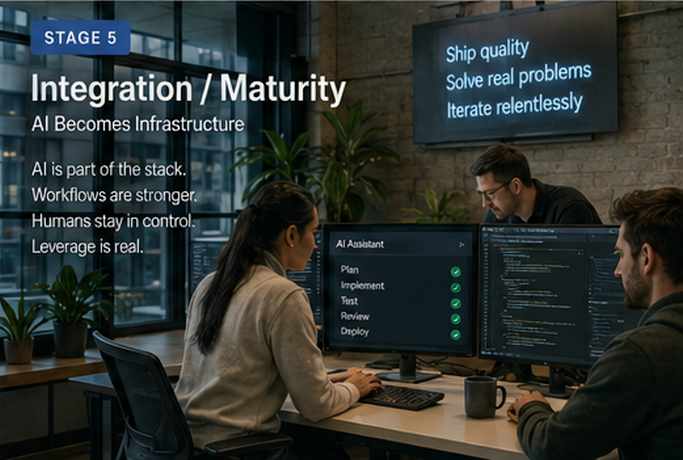
The final stage looks very different from the beginning.
The excitement cools. The panic fades. The unrealistic promises slowly disappear. What remains is something more durable: a new software development layer that companies are beginning to integrate into everyday engineering operations.
This is where AI coding stops feeling experimental and starts becoming infrastructure.
By this stage, mature teams no longer treat AI coding tools like autonomous replacements for engineers. They treat them as force multipliers inside disciplined workflows. The organizations seeing the best outcomes are usually not the ones attempting to remove human oversight entirely. They are the ones building strong operational guardrails around AI-assisted development.
The workflow evolves.
Engineers use AI to accelerate repetitive implementation tasks, scaffold features, generate tests, summarize codebases, explain unfamiliar systems, and reduce time spent on boilerplate. Human developers focus more heavily on architecture, system design, reliability, security review, infrastructure decisions, and business logic validation.
The role of software engineers starts shifting rather than disappearing.
Inside many companies, developers increasingly act as orchestrators of machine-generated output. The work becomes more conversational and supervisory. Engineers spend less time manually typing repetitive syntax and more time validating whether generated systems make sense operationally.
This shift is already reshaping the economics of software teams.
Small engineering groups can now achieve output levels that previously required significantly larger organizations. Startups can move from idea to prototype at unprecedented speed. Internal tooling that once sat in backlogs for months can now be generated and tested quickly. Product iteration cycles shorten dramatically.
The productivity gains from AI coding remain real.
What changes at this stage is the industry’s understanding of where those gains come from and what tradeoffs accompany them.
Early hype often framed AI coding as a replacement story. Mature adoption increasingly looks like a story of leverage instead. The strongest engineering teams are using AI to amplify experienced developers, not eliminate them. Companies with disciplined testing cultures, clear architectural standards, strong review pipelines, and operational maturity tend to benefit the most from AI-assisted workflows.
The pattern mirrors earlier technology transitions.
Cloud computing did not eliminate infrastructure engineering. It changed how infrastructure was managed. DevOps did not eliminate operations teams. It compressed development and deployment cycles into tighter workflows. Open-source software did not eliminate proprietary development. It changed the economics of software collaboration.
AI coding appears to be following a similar path.
The long-term shift may not be that AI writes software independently. The larger transformation may be that software creation itself becomes conversational and dramatically more accessible to people outside traditional engineering pathways.
That change carries enormous implications.
Founders without deep engineering backgrounds can now prototype products directly. Product managers can experiment with lightweight applications themselves. Designers can generate functional interfaces from plain language instructions. Teams can test ideas faster and abandon failed directions earlier without consuming months of engineering effort.
The barrier between idea and execution has fallen sharply.
This is why many observers believe the long-term impact of AI coding may still be underestimated despite the current hype cycle. The early marketing narratives focused heavily on replacing developers. The deeper structural shift may involve expanding who gets to participate in software creation altogether.
That does not eliminate the need for engineering discipline.
If anything, disciplined engineering becomes more valuable as software generation accelerates. Systems still require clean architecture, operational oversight, security validation, infrastructure reliability, and long-term maintenance planning. AI changes where effort is concentrated within the software lifecycle. It does not remove the need for responsibility.
The organizations adapting successfully to AI-assisted development are beginning to recognize this balance.
AI coding is neither a passing trend nor a complete replacement for software engineering. It is becoming a new operational layer in modern software development, one that significantly increases leverage for teams capable of managing its strengths and weaknesses responsibly.
That realization marks the end of the hype cycle.
It is usually the point where the real transformation begins.
The Bigger Picture: AI Coding Was Overhyped in the Short Term and May Still Be Underestimated in the Long Term
Every major technology shift follows a familiar pattern.
The early phase is driven by excitement, bold predictions, investor enthusiasm, and demonstrations that make the future feel like it arrived overnight. Then reality enters the picture. Costs emerge. Weaknesses surface. Expectations cool. Critics declare the technology overrated.
The internet went through it. So did cloud computing, smartphones, open-source software, and the industrial technologies that reshaped manufacturing generations earlier.
AI coding appears to be moving through the same cycle now.
The current debate often swings between extremes. One side insists AI will replace software engineers entirely. The other treats AI coding as little more than autocomplete wrapped in aggressive marketing. Neither position fully reflects what is unfolding inside modern engineering organizations.
The reality is more nuanced and probably more significant.
AI coding is already changing how software gets built. It is changing hiring assumptions, startup economics, product iteration speed, engineering workflows, and the relationship between technical expertise and software creation itself. Teams are shipping products faster. Small companies are operating with levels of output once associated with far larger engineering organizations. The distance between idea and execution has compressed dramatically.
At the same time, the software industry is discovering that faster generation introduces new operational burdens. AI-generated systems still require architectural judgment, testing discipline, security oversight, long-term maintenance, and human accountability. Companies are learning that output alone is not the same thing as reliability.
That lesson has become central to the AI coding cycle.
The strongest teams are no longer asking whether AI can generate software. That question has largely been answered already. The more important question is how organizations structure workflows, governance, and engineering discipline around machine-generated systems operating at scale.
Some researchers believe that today’s AI coding flaws may eventually become more manageable through entirely new approaches to software development. MIT professor Max Tegmark, for example, has discussed a concept he calls “vericoding,” which builds on formal verification methods designed to mathematically prove software behaves correctly. The idea remains early and experimental, though it reflects a broader push across the industry to reduce the uncertainty surrounding AI-generated code.
This is where the future of AI-assisted software development will likely be decided.
The winners may not be the companies that are trying to remove engineers entirely from the process. They may be the organizations that learn how to combine AI leverage with strong operational maturity, experienced technical leadership, disciplined review systems, and clear architectural thinking.
That balance matters because software creation has always been about more than writing syntax.
Engineering is ultimately about responsibility. Responsibility for systems that handle financial transactions, healthcare records, infrastructure networks, customer data, national security systems, and the operational foundations of modern economies. AI can accelerate software production dramatically. It cannot fully inherit accountability for what happens after deployment.
For many developers, this realization marks the point at which the hype starts to fade, and a more grounded understanding begins to emerge.
AI coding is not magic. It is not a scam either.
It is a powerful new layer in software development that amplifies both capability and risk simultaneously. Used carelessly, it can multiply technical debt, operational confusion, and security exposure faster than many organizations expect. Used thoughtfully, it can make engineering teams dramatically more productive and open software creation to a much larger group of people than ever before.
That may end up being the most important shift of all.
The deeper transformation is not simply that AI writes code. It is that software creation is becoming conversational. The barriers separating technical and non-technical builders are starting to weaken. More people can now prototype, experiment, and participate directly in software development.
That shift is still in its early stages.
The short-term hype around AI coding may cool as organizations confront the realities of maintaining machine-generated software at scale. History suggests the longer-term impact may still be underestimated.
The technologies that reshape industries rarely arrive fully formed. They mature through experimentation, friction, correction, and operational adaptation. AI coding appears to be entering that phase now.
The hype cycle may be ending.
The infrastructure era may just be beginning.
The AI Coding Hype Cycle: The 5 Stages Explained