Emerging Technology Trends That Will Shape 2026 and Beyond
 Daniel Levi
Posted On May 22, 2026
Daniel Levi
Posted On May 22, 2026
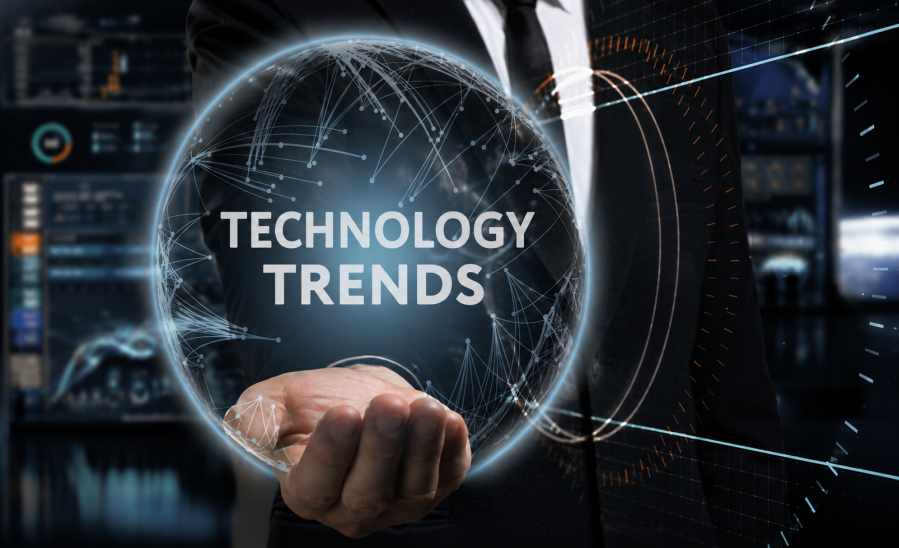
It’s been five years since we first examined the technology trends shaping the future of business and the digital economy. Much of what felt experimental at the time, from generative AI and autonomous systems to spatial computing and machine-driven infrastructure, is now moving closer to operational reality.
Many of the ideas once confined to research labs, startup demos, and pilot programs have steadily moved into the operational core of modern enterprises. Advances in artificial intelligence, compute infrastructure, robotics, and automation are accelerating far faster than many executives anticipated.
The AI industry spent much of the past two years experimenting with copilots, chatbots, and productivity tools. In 2026, the focus is shifting toward something larger: rebuilding enterprise infrastructure around autonomous systems.
For companies, investors, and corporate strategists, a new generation of emerging technology trends is beginning to move from experimental deployments into operational reality. Agentic AI systems are taking on multi-step workflows once managed by teams of employees. Physical AI is pushing machine intelligence beyond software and into factories, warehouses, and logistics networks. At the same time, advances in sovereign compute, programmable finance, spatial computing, and digital provenance are reshaping how organizations manage data, labor, security, and capital flows.
The broader shift is creating a growing divide between companies that are layering AI tools onto legacy systems and those redesigning operations around AI-native infrastructure.
That distinction increasingly matters. Enterprises built around fragmented software stacks and manual coordination face mounting pressure to modernize as autonomous systems become more capable of operating across departments, applications, and data environments with limited human oversight. In many industries, the gap between automated workflows and autonomous operations is widening.
The emerging technology trends shaping 2026 share a common theme: software is evolving from a passive tool into an active operational layer capable of reasoning, coordinating, and executing tasks in real time.
For executives and investors, the challenge is no longer deciding whether these technologies matter. It is determining which shifts are durable, which are overhyped, and how quickly organizations need to adapt as AI moves deeper into the foundations of the enterprise economy.
The trends below offer a snapshot of the technologies likely to shape the next phase of that transition.
1. Agentic AI & Autonomous Enterprises
The first wave of enterprise AI focused largely on assistance. Companies deployed chatbots to answer questions, generate content, summarize meetings, and help employees work faster. In 2026, the emphasis is beginning to shift from assistance to execution.
A growing number of organizations are experimenting with agentic AI systems capable of handling complex, multi-step tasks with limited human involvement. Unlike traditional software automation, which relies on predefined rules and workflows, these systems can reason through objectives, adapt to changing conditions, and coordinate actions across multiple applications and data environments.
The result is the emergence of what many executives increasingly describe as the autonomous enterprise.
Rather than functioning as isolated tools, AI agents are beginning to operate more like digital coworkers embedded across the organization. In software development, agents can generate code, run tests, identify vulnerabilities, and monitor deployments. In finance departments, they are being used to flag anomalies, assist with compliance reviews, and automate reporting workflows. Supply chain teams are experimenting with agents capable of monitoring inventory, coordinating procurement, and responding to disruptions in real time.
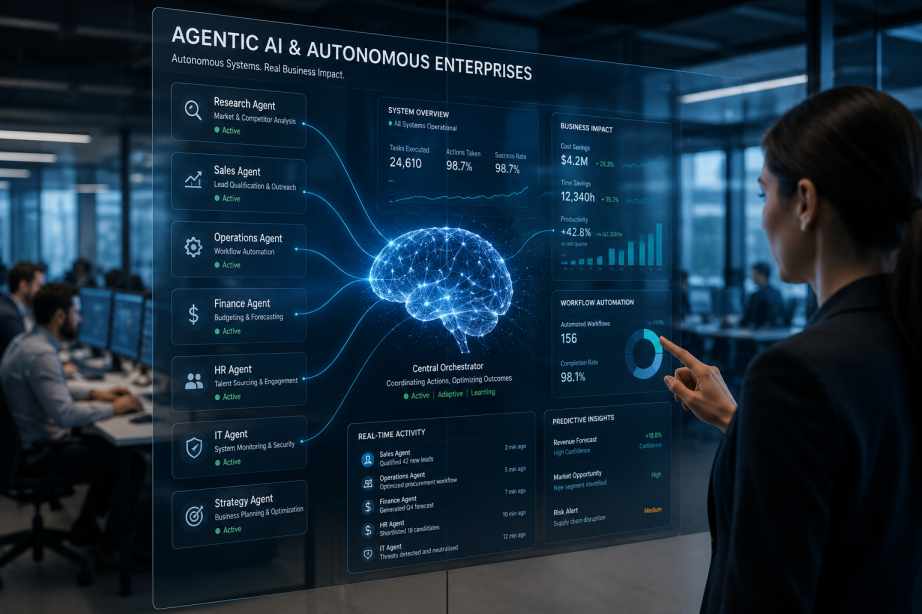
Agentic AI & Autonomous Enterprises
The broader transition is forcing companies to rethink how enterprise software is designed.
For decades, most business applications were built around human interaction: employees clicking dashboards, moving data between systems, and manually coordinating workflows. Agentic AI changes that dynamic by allowing software systems to interact directly with one another through machine-driven orchestration layers.
Protocols such as Anthropic’s Model Context Protocol (MCP) are accelerating that shift by creating standardized ways for AI systems to connect with external tools, enterprise software, and data infrastructure. The long-term implication is that software increasingly becomes machine-facing rather than human-facing, with AI systems acting as operational intermediaries across the enterprise stack.
That transition may have significant economic consequences.
Organizations capable of redesigning workflows around autonomous execution could see substantial gains in speed, operational efficiency, and scalability. At the same time, companies built on fragmented legacy systems may struggle to integrate agentic infrastructure effectively, widening the gap between AI-native firms and those still treating AI as a productivity layer added atop older architectures.
The distinction between automated enterprises and autonomous enterprises is becoming increasingly important.
Automated organizations still depend heavily on human supervision to initiate and coordinate workflows. Autonomous enterprises, by contrast, are beginning to delegate portions of operational decision-making and execution to networks of AI systems operating continuously in the background.
For many executives and investors, that shift is starting to look less like a product cycle and more like the early stages of a broader architectural transition in how modern companies operate.
2. Physical AI & Robotics
Artificial intelligence is beginning to move beyond screens and software interfaces and into the physical economy.
For much of the past decade, AI systems operated primarily in digital environments — generating text, analyzing data, recommending content, or automating software-based workflows. In 2026, advances in physical AI are allowing machine intelligence to interact directly with the real world through robotics, industrial systems, autonomous machines, and sensor-rich environments.
The shift is expanding the reach of automation into sectors that historically depended on human dexterity, spatial reasoning, and real-time decision-making.
Companies including Nvidia, Tesla, and Figure AI are investing heavily in systems that combine large-scale AI reasoning with robotics platforms capable of navigating warehouses, factory floors, logistics networks, and, eventually, consumer environments.
Unlike traditional industrial robots, which typically perform repetitive actions inside tightly controlled settings, newer AI-powered machines are being trained to adapt to unpredictable conditions. Advances in multimodal AI, computer vision, simulation environments, and real-time sensor processing are enabling machines to interpret their surroundings, respond dynamically, and improve performance through continuous learning.
That distinction matters because the physical world is significantly more complex than digital environments.
Software systems operate within structured parameters. Physical environments contain uncertainty: moving objects, changing lighting conditions, inconsistent materials, unexpected obstacles, and human behavior. Building machines capable of functioning reliably within those conditions has long been one of the most difficult problems in artificial intelligence.
Recent advances in foundation models and simulation-based training are beginning to narrow that gap.
Manufacturing is emerging as one of the earliest large-scale testing grounds. Companies are deploying AI-powered robotics systems to handle repetitive assembly work, warehouse operations, inventory movement, and industrial inspection tasks. Logistics firms are exploring autonomous delivery systems and robotic fulfillment centers designed to reduce operational bottlenecks and labor shortages.
The long-term implications extend far beyond factories.
Physical AI could eventually reshape industries ranging from construction and agriculture to elder care and household services. In healthcare, robotics systems are already assisting with surgeries, patient monitoring, and hospital logistics. In transportation, autonomous driving platforms continue to evolve toward broader commercial deployment. Even office environments are beginning to integrate intelligent sensing systems that monitor occupancy, energy use, and physical security in real time.
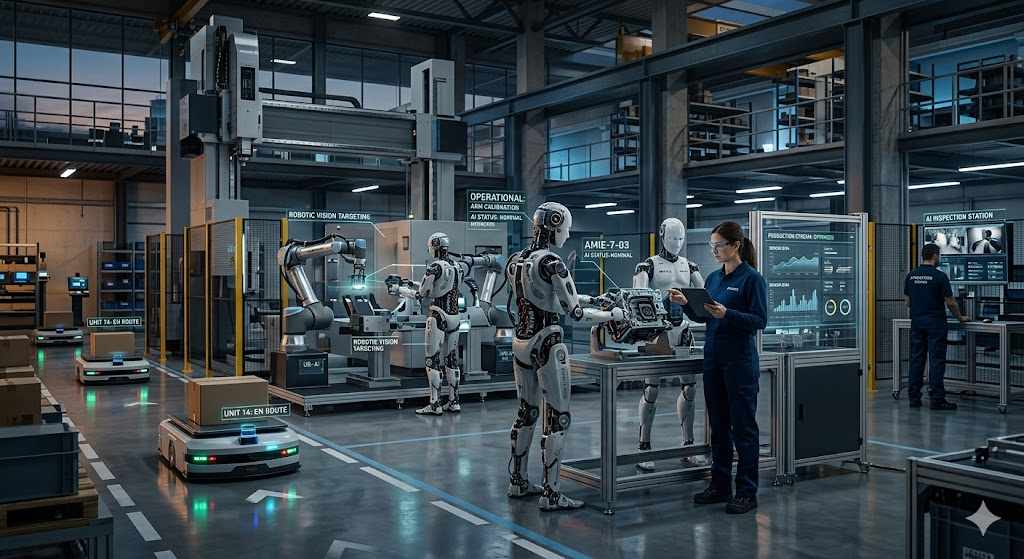
Physical AI & Robotics
For investors and enterprise leaders, the broader significance of physical AI lies in its ability to bridge the gap between digital intelligence and real-world economic output.
The software era transformed information work. Physical AI has the potential to transform industrial work in much the same way.
That transition is unlikely to happen evenly or quickly. High hardware costs, infrastructure constraints, safety requirements, and regulatory scrutiny remain major barriers to large-scale deployment. Still, the direction of travel is becoming clearer: AI is no longer confined to software applications operating inside data centers.
It is increasingly becoming embedded in machines capable of interacting directly with the physical world.
3. AI-Native Infrastructure & Sovereign Compute
The AI boom is forcing companies and governments to confront a growing reality: modern artificial intelligence is no longer just a software challenge. It is becoming an infrastructure challenge.
Training and operating advanced AI systems requires enormous amounts of computing power, energy, networking capacity, and data orchestration. As enterprises move from isolated AI experiments to production-scale deployment, the underlying infrastructure supporting those systems is becoming a strategic priority in its own right.
That shift is fueling the rise of what many industry leaders now describe as AI-native infrastructure.
Unlike traditional cloud architectures designed primarily for web applications and enterprise software, AI-native environments are being built specifically to support large-scale model training, real-time inference, autonomous agents, multimodal processing, and distributed machine coordination. The emphasis is shifting from general-purpose computing toward infrastructure optimized for continuous AI operations.
The economic implications are significant.
Over the past year, some of the world’s largest technology companies have committed hundreds of billions of dollars toward expanding AI data centers, securing advanced chips, and strengthening energy capacity to support growing computational demand. The race is no longer simply about building better models. It is increasingly about controlling the infrastructure required to power them.
That dynamic is reshaping the competitive landscape across the semiconductor, cloud, networking, and energy industries.
Companies such as Nvidia, AMD, Broadcom, and TSMC have become central players in the AI economy because they sit at critical points within the infrastructure stack. At the same time, cloud providers including Microsoft, Amazon, and Google are racing to expand hyperscale AI capacity while developing proprietary chips and vertically integrated AI ecosystems.
Yet the infrastructure race is no longer confined to private companies.
Governments are increasingly treating AI compute capacity as a matter of economic security and geopolitical influence. Concerns around data sovereignty, national security, and dependence on foreign infrastructure are driving new investments in domestic AI ecosystems across the United States, Europe, the Middle East, and Asia.
That trend is accelerating interest in sovereign compute.
Rather than relying entirely on external cloud providers or foreign AI platforms, enterprises and governments are exploring ways to build localized AI infrastructure to maintain greater control over sensitive data, proprietary models, and computational resources. In highly regulated industries such as healthcare, finance, defense, and critical infrastructure, sovereignty is becoming a core architectural requirement rather than a secondary consideration.
At the same time, companies are beginning to rethink how AI workloads are distributed across cloud, edge, and on-premise environments.
The original cloud era encouraged centralization. AI-native infrastructure may push parts of the industry back toward distributed architectures, particularly as inference workloads expand and real-time AI systems require lower latency, greater resilience, and tighter control over where data is processed.
That transition is also changing the economics of software development itself.
AI-native systems are computationally intensive, energy-hungry, and increasingly dependent on specialized hardware. As a result, access to infrastructure may become one of the defining competitive advantages of the next decade, creating a widening gap between organizations capable of scaling AI operations efficiently and those constrained by limited compute access or outdated architectures.
For enterprise leaders and investors, the broader message is becoming difficult to ignore: in the AI economy, infrastructure is no longer a background layer.
It is rapidly becoming the foundation upon which competitive advantage is built.
4. Spatial Computing & Ambient Interfaces
For decades, the relationship between humans and computers has been defined largely by screens.
Keyboards, smartphones, monitors, and touch interfaces shaped how people interacted with software, consumed information, and performed digital work. A growing number of technology companies now believe that model is beginning to evolve into something more immersive, persistent, and spatial.
The emerging technology trend broadly known as spatial computing aims to blend digital systems directly into physical environments through augmented reality, mixed reality, wearable interfaces, and sensor-rich computing platforms.
While consumer enthusiasm around the metaverse faded after the hype cycle of 2021 and 2022, the underlying technologies continued to mature quietly inside enterprise, industrial, healthcare, and defense environments. In 2026, spatial computing is increasingly being repositioned less as a virtual social experience and more as a long-term interface layer for the AI era.
That distinction is important.
The shift toward AI-native systems is generating growing amounts of real-time data, autonomous workflows, and machine-generated intelligence. Traditional two-dimensional interfaces may become increasingly inadequate for managing highly dynamic environments involving robotics, digital twins, industrial operations, and multimodal AI systems operating simultaneously.
Spatial interfaces offer a different approach.
Instead of interacting with information through isolated windows and dashboards, users can visualize and manipulate digital objects directly within physical space. Engineers can collaborate around 3D models layered onto factory floors. Surgeons can access contextual imaging data during procedures. Field technicians can receive real-time diagnostics through wearable displays while servicing industrial equipment.
Companies including Apple, Meta, and Microsoft continue to invest heavily in augmented and mixed-reality ecosystems, betting that spatial interfaces could eventually become as important as smartphones and PCs were during previous computing cycles.
At the enterprise level, some of the earliest adoption is occurring in areas where visualization and spatial awareness directly affect operational outcomes.
Manufacturing firms are using augmented reality systems for industrial maintenance and workforce training. Architecture and engineering companies are deploying digital twins to simulate complex infrastructure projects before construction begins. Hospitals and medical schools are experimenting with immersive training environments designed to improve procedural accuracy and reduce risk.
The rise of ambient computing is closely connected to this trend.
Rather than requiring users to constantly open applications and manually interact with devices, ambient systems aim to continuously embed intelligence in the environment through sensors, wearables, voice interfaces, and context-aware AI systems that operate in the background.
In practical terms, that could gradually reduce the prominence of traditional screens altogether.
Voice-driven AI assistants, intelligent glasses, gesture controls, biometric sensing, and real-time environmental awareness are beginning to reshape how people access information and interact with digital systems throughout the day. Over time, computing may become less tied to a single device and more distributed across physical environments.
The transition remains early and uneven.
Hardware limitations, battery constraints, social adoption challenges, and high device costs continue to slow mainstream deployment. Many consumers remain unconvinced that current-generation headsets justify widespread daily use.
Still, investors and enterprise leaders increasingly view spatial computing less as a short-term consumer product category and more as a foundational shift in interfaces that could unfold gradually over the next decade.
If the smartphone era placed the internet in people’s pockets, spatial computing aims to place digital intelligence directly into the world around them.
5. Digital Provenance & Preemptive Cybersecurity
The rise of generative AI is creating a new problem for governments, enterprises, and digital platforms: determining what information can still be trusted.
For much of the internet era, cybersecurity focused primarily on protecting systems from unauthorized access, malware, and data breaches. In 2026, that definition is expanding rapidly. Organizations are now confronting a broader challenge involving synthetic media, AI-generated impersonation, autonomous cyberattacks, and the growing difficulty of verifying the authenticity of digital information itself.
That shift is accelerating interest in digital provenance.
Digital provenance refers to the ability to verify where a piece of content originated, how it was created, whether it has been modified, and whether it can be trusted. As AI-generated text, images, audio, and video become increasingly realistic, provenance systems are emerging as a foundational trust layer for the AI economy.
The stakes are rising quickly.
Deepfake technology has improved dramatically over the past two years, making it easier to generate convincing synthetic videos, cloned voices, and fabricated media at scale. Security researchers and intelligence agencies have warned that AI-driven impersonation campaigns could increasingly target financial institutions, political systems, enterprise communications, and identity verification processes.
For companies, the implications extend far beyond misinformation.
A growing number of enterprises are beginning to view provenance as a core operational requirement tied to legal liability, brand integrity, regulatory compliance, and cybersecurity resilience. In highly regulated industries, organizations may eventually need to prove not only that data is secure, but also that it is authentic and untampered with throughout its lifecycle.
Technology companies are responding with a range of approaches.
Cryptographic watermarking, content authentication standards, blockchain-backed verification systems, and AI-driven media analysis tools are all being explored as mechanisms for validating digital assets. Industry initiatives such as the Coalition for Content Provenance and Authenticity (C2PA) are working to establish technical standards that allow images, video, and other media to carry embedded provenance metadata.
At the same time, cybersecurity itself is becoming increasingly predictive and autonomous.
Traditional security models often relied on perimeter defense and reactive incident response. Newer AI-driven systems are designed to identify behavioral anomalies, detect vulnerabilities, simulate attack paths, and respond to threats in real time before significant damage occurs.
That evolution is partly being driven by the growing sophistication of attackers.
Cybercriminal organizations are beginning to use AI tools to automate phishing campaigns, generate malware variants, exploit vulnerabilities more quickly, and conduct highly personalized social engineering attacks at scale. Defensive systems are increasingly being forced to operate at machine speed to keep pace.
The result is an escalating technological arms race between offensive and defensive AI systems.
For enterprises, that means cybersecurity can no longer function solely as a background IT responsibility. It is increasingly becoming a board-level issue tied directly to operational continuity, corporate trust, and long-term resilience.
The broader implication may be even larger.
As AI systems become more capable of generating convincing synthetic content, digital trust itself could emerge as one of the defining economic challenges of the next decade. In that environment, the ability to verify authenticity may become just as important as the ability to generate intelligence in the first place.
6. Programmable Finance & Machine-Speed Commerce
The financial system is beginning to undergo its own form of automation.
For decades, global commerce has depended on banking infrastructure built around batch processing, intermediaries, delayed settlement windows, and manually coordinated financial workflows. While consumer payment experiences became faster over time, much of the underlying institutional infrastructure remained comparatively slow, fragmented, and operationally complex.
A growing number of companies now believe artificial intelligence, stablecoins, and programmable financial systems could begin to change that.
In 2026, interest is rising around what some analysts describe as machine-speed commerce: financial systems capable of operating continuously, autonomously, and in real time without relying on many of the traditional delays embedded within legacy banking infrastructure.
Stablecoins are playing a central role in that transition.
Once viewed largely through the lens of cryptocurrency speculation, dollar-backed stablecoins are increasingly attracting attention from payment providers, fintech firms, multinational corporations, and even governments seeking faster cross-border settlement. Their appeal lies less in volatility and more in efficiency.
Traditional international transactions can still take days to settle due to intermediary banks, reconciliation layers, compliance checks, and regional payment fragmentation. Stablecoin-based systems have the potential to compress parts of that process into near real-time settlement windows operating around the clock.
The implications become more significant when combined with automation and AI systems.
Programmable finance allows transactions to execute automatically once predefined conditions are met. Instead of manually authorizing each step, companies can embed rules directly into financial workflows. Payments can be triggered automatically after shipment verification, contract fulfillment, inventory confirmation, or real-time operational milestones.
That capability could reshape how businesses manage liquidity, supply chains, and treasury operations.
In practice, enterprises are beginning to explore systems where AI agents monitor invoices, manage procurement workflows, optimize cash positioning, and coordinate financial execution across multiple systems with minimal human intervention. Over time, portions of corporate finance could become increasingly autonomous.
Large financial institutions are paying close attention.
Companies including Visa, Mastercard, and Stripe have expanded their efforts in stablecoin infrastructure and digital settlement systems, while major banks continue to explore tokenized assets, blockchain-based payments, and programmable financial rails.
Governments and regulators are also moving more aggressively into the space.
Concerns about monetary sovereignty, anti-money-laundering compliance, systemic risk, and the long-term role of central banks are intensifying as digital payment infrastructure evolves. Some countries are experimenting with central bank digital currencies (CBDCs), while others are focusing more heavily on regulated private-sector stablecoin ecosystems.
The broader trend extends beyond digital currencies themselves.
The larger shift involves transforming finance from a largely human-coordinated system into an increasingly automated operational layer that supports machine-to-machine economic activity. As autonomous AI systems become more common across supply chains, logistics networks, and digital platforms, financial infrastructure may eventually need to operate at comparable speed and scale.
That transition remains early and highly regulated.
Questions surrounding compliance, interoperability, cybersecurity, privacy, and regulatory oversight continue to slow adoption in many regions. Financial systems operate under levels of scrutiny that most software sectors do not face.
Still, the direction of travel is becoming increasingly difficult to ignore.
If the internet accelerated the movement of information, programmable finance aims to accelerate the movement of value itself.
7. Multimodal AI & Real-World Sensing
Early generations of artificial intelligence largely operated within narrow inputs.
One model processed text. Another analyzed images. Separate systems handled audio, video, or sensor data independently. In 2026, those boundaries are beginning to fade as AI systems become increasingly multimodal — capable of processing and synthesizing multiple forms of information simultaneously.
The shift is pushing artificial intelligence closer to how humans interpret the world.
People do not rely on a single stream of data to understand their surroundings. Human perception continuously integrates language, sound, visual context, motion, spatial awareness, and environmental signals in real time. Multimodal AI aims to replicate aspects of that capability by enabling machines to interpret diverse inputs within a unified reasoning process.
That evolution is opening new possibilities across enterprise, industrial, healthcare, and consumer environments.
Instead of analyzing isolated data points, multimodal systems can integrate video feeds, maintenance logs, sensor readings, voice interactions, geospatial information, and operational data to build a broader contextual understanding of what is happening within a system or environment.
The implications become especially significant in physical industries.
In manufacturing, multimodal AI systems can monitor equipment performance by simultaneously analyzing vibration patterns, thermal imaging, audio anomalies, and maintenance histories. In logistics networks, AI platforms can track shipments using computer vision, weather data, GPS signals, and warehouse telemetry at the same time.
Healthcare is emerging as another major area of interest.
AI systems are increasingly being trained to synthesize medical imaging, physician notes, lab results, genomic information, and patient histories together rather than treating each data source independently. Supporters argue that this could eventually improve diagnostic accuracy, accelerate research, and help clinicians identify patterns that may otherwise remain difficult to detect.
Consumer technology companies are also moving rapidly toward multimodal interfaces.
Large AI platforms are increasingly integrating voice, image recognition, live video understanding, and contextual memory into unified systems that interact more naturally with users. Instead of prompting a chatbot with isolated text commands, users are beginning to engage AI systems through simultaneous conversational, visual, and environmental interactions.
That shift could play an important role in the development of more capable autonomous systems.
Robotics, autonomous vehicles, industrial automation platforms, and spatial computing environments all require AI systems capable of interpreting highly dynamic real-world conditions. Multimodal reasoning allows machines to build richer contextual awareness rather than relying on narrow streams of structured input.
At the same time, advances in sensing technologies are expanding the amount of environmental data available to intelligent systems.
Radar sensing, LiDAR, thermal imaging, biometric monitoring, edge sensors, and distributed IoT infrastructure are creating increasingly data-rich physical environments. Combined with AI systems capable of synthesizing that information in real time, the result is a growing convergence between digital intelligence and physical-world awareness.
That convergence is also raising new concerns.
As AI systems gain deeper visibility into physical environments, debates around privacy, surveillance, consent, and data ownership are becoming more urgent. Enterprises and governments may face growing pressure to balance operational intelligence with stricter expectations around individual privacy and digital rights.
Still, the broader trajectory is becoming clearer.
The future of artificial intelligence may depend less on building systems that excel at isolated tasks and more on building systems capable of interpreting the world holistically across multiple layers of information at once.
8. Space-Based Compute & Orbital Infrastructure
The next major expansion of digital infrastructure may not happen on Earth.
As demands for artificial intelligence, remote sensing, and global connectivity continue to grow, a new generation of companies and governments is beginning to view space not just as a communications layer but as a computational and data-processing environment in its own right.
The shift is giving rise to what some analysts increasingly describe as orbital infrastructure: space-based systems designed to support data processing, Earth observation, autonomous coordination, and eventually distributed compute operations beyond traditional terrestrial networks.
For years, satellites primarily functioned as communication and imaging tools. In 2026, that role is beginning to expand.
Low Earth Orbit (LEO) satellite networks are becoming more sophisticated, more numerous, and increasingly integrated with cloud infrastructure, edge computing, and AI-driven analytics systems. Instead of merely transmitting raw data back to Earth, next-generation orbital systems are beginning to process portions of that information directly in space before distributing results to terrestrial networks.
That distinction matters because global data volumes are rising rapidly.
Earth observation systems, climate-monitoring networks, industrial IoT platforms, autonomous vehicles, military systems, and connected infrastructure are generating enormous streams of real-time information. Moving all of that raw data continuously across traditional networks can create latency, bandwidth, and operational bottlenecks.
Space-based compute infrastructure offers an alternative model.
By processing data closer to where it is collected, orbital systems can reduce transmission requirements, accelerate decision-making, and support faster responses to environmental, industrial, and logistical events occurring across the globe.
The implications extend across multiple sectors.
Governments are investing heavily in satellite intelligence capabilities tied to defense, weather prediction, navigation, disaster response, and critical infrastructure monitoring. Agricultural firms are using satellite imagery and AI analysis to optimize crop management and water usage. Energy companies are deploying orbital sensing systems to monitor pipelines, emissions, and environmental conditions in remote regions.
The commercial space sector is expanding alongside those trends.
Companies including SpaceX, Amazon, and Planet Labs continue investing in satellite ecosystems designed to support global connectivity, geospatial intelligence, and large-scale sensing networks. At the same time, startups are exploring orbital data centers, in-space manufacturing, and edge-compute platforms optimized for AI-driven workloads.
The broader shift reflects a deeper change in how digital infrastructure is being conceptualized.
The original internet era was largely built around centralized terrestrial networks. The AI era may increasingly depend on distributed infrastructure spanning cloud systems, edge devices, autonomous platforms, and orbital layers that operate simultaneously across different physical environments.
That evolution is also reshaping geopolitical competition.
Control over launch capacity, satellite networks, semiconductor supply chains, and space-based infrastructure is becoming increasingly strategic as governments view digital dominance, communications resilience, and AI capability as interconnected forms of national power.
The transition remains early and technically challenging.
Orbital compute systems face constraints related to launch costs, energy efficiency, radiation exposure, maintenance complexity, and international regulations. Many of the more ambitious visions surrounding space-based computing remain years away from large-scale commercial viability.
Still, momentum continues to build.
As the global economy becomes increasingly dependent on real-time intelligence, autonomous coordination, and distributed AI systems, space is gradually evolving from a communications frontier into part of the broader computational architecture of the modern digital economy.
9. Adaptive Governance & the End of Static Strategy
The speed of technological change is beginning to outpace the traditional rhythm of corporate decision-making.
For decades, most enterprises operated through relatively stable planning cycles. Technology roadmaps were often developed annually. Budget allocations were reviewed quarterly. Strategic priorities shifted gradually. In 2026, that operating model is coming under increasing pressure as AI systems, autonomous infrastructure, and emerging technologies evolve faster than many organizations can adapt.
The result is a growing push toward adaptive governance.
Rather than relying on static planning frameworks, companies are beginning to explore more dynamic approaches to technology strategy, risk management, and operational decision-making. The goal is not simply to deploy AI tools more efficiently, but to create organizations capable of responding continuously to changing technological, economic, and geopolitical conditions.
That shift reflects a broader reality of the AI era.
Artificial intelligence is accelerating product cycles, compressing development timelines, and increasing competitive volatility across industries. New capabilities can move from research papers to commercial deployment within months. Infrastructure assumptions that appeared stable a year earlier can become obsolete surprisingly quickly.
For executives and boards, that creates a difficult challenge.
Many organizations still operate with governance systems designed for slower-moving technology cycles. Procurement processes, compliance reviews, budget structures, and organizational hierarchies often struggle to adapt to environments where AI capabilities, security risks, and market conditions evolve continuously.
Adaptive governance attempts to close that gap.
Instead of treating strategy as a fixed annual exercise, organizations are increasingly building real-time monitoring systems that simultaneously track operational performance, technology adoption, regulatory developments, cyber risks, and market signals. AI-driven analytics platforms are beginning to play a larger role in helping executives model scenarios, stress-test assumptions, and reallocate resources more dynamically.
The implications extend beyond operational efficiency.
As AI systems become more autonomous, governance itself may increasingly shift from reactive oversight toward continuous supervision of machine-driven environments. Companies deploying autonomous agents, multimodal systems, and AI-powered infrastructure will likely require governance models capable of monitoring not only financial performance, but also algorithmic behavior, data integrity, cybersecurity exposure, and regulatory compliance in real time.
That challenge is becoming especially important in regulated industries.
Financial institutions, healthcare organizations, defense contractors, and critical infrastructure providers face growing pressure to demonstrate transparency, accountability, and resilience as they integrate increasingly complex AI systems into their core operations. Regulators are also beginning to focus more heavily on explainability, auditability, and operational safeguards surrounding autonomous technologies.
The geopolitical environment is adding another layer of complexity.
Trade restrictions, semiconductor controls, data localization requirements, and national AI policies are forcing multinational companies to rethink how they deploy technology infrastructure across regions. Strategic planning is becoming more tightly linked to geopolitical risk management, supply chain resilience, and sovereignty considerations.
The broader message is becoming difficult for many enterprise leaders to ignore.
The AI era is not simply introducing new technologies. It is challenging the institutional structures companies use to make decisions, allocate capital, govern risk, and adapt to change itself.
In that environment, organizations capable of continuous evolution may hold an increasing advantage over those still operating under slower, static planning models built for an earlier phase of the digital economy.
10. Quantum Computing & Post-Classical Systems
Quantum computing has long existed largely as a research ambition discussed within universities, government labs, and advanced computing circles. In 2026, it is beginning to attract broader attention from enterprises, investors, and geopolitical strategists as advances in hardware, error correction, and quantum networking continue to accelerate.
Unlike classical computers, which process information using binary bits, quantum systems use qubits that can represent multiple states simultaneously. In theory, that could allow certain classes of problems to be solved exponentially faster than conventional systems can handle today.
The practical implications could be significant.
Industries including pharmaceuticals, materials science, logistics, energy, and financial modeling are exploring how quantum systems might eventually improve molecular simulation, optimization problems, risk analysis, and advanced scientific research. Governments are also investing heavily in quantum research because of its potential implications for cybersecurity, communications, and national security.
The technology remains early and highly experimental. Large-scale commercial deployment is still constrained by hardware instability, error correction challenges, and enormous infrastructure complexity. Even optimistic forecasts suggest meaningful mainstream adoption may still be years away.
Yet momentum continues to build.
Major technology companies, including IBM, Google, and Microsoft, continue to invest aggressively in quantum research, while startups and governments race to secure leadership positions in what many view as a potentially transformative computing frontier.
The broader significance of quantum computing extends beyond speed alone.
As AI systems generate larger datasets and increasingly complex optimization problems, demand for next-generation computational models is expected to grow. Quantum systems may eventually complement classical and AI-driven infrastructure rather than replace it outright, creating hybrid computational environments optimized for different classes of tasks.
For enterprise leaders and policymakers, the challenge is not necessarily preparing for immediate disruption. It is recognizing that the global race for computational advantage is expanding beyond artificial intelligence into entirely new architectures of computing itself.
Executive Summary: The Emerging Technology Trends Defining 2026
1. Agentic AI & Autonomous Enterprises
What it is: AI systems capable of reasoning, coordinating, and executing multi-step workflows across enterprise environments with limited human oversight.
Impact: Organizations are shifting from isolated AI copilots toward autonomous operational systems that can manage software development, logistics, finance, compliance, and customer workflows in real time.
Why it matters: The transition from automated enterprises to autonomous enterprises could become one of the defining competitive advantages of the next decade.
2. Physical AI & Robotics
What it is: The convergence of AI foundation models, robotics, computer vision, and sensor systems that allow machines to interact directly with the physical world.
Impact: Manufacturing, logistics, healthcare, and industrial operations are beginning to deploy adaptive AI-powered machines capable of operating in dynamic real-world environments.
Why it matters: Physical AI extends the benefits of automation beyond software and into the broader physical economy.
3. AI-Native Infrastructure & Sovereign Compute
What it is: Next-generation infrastructure optimized specifically for AI workloads, including advanced compute, distributed architectures, specialized chips, and sovereign AI environments.
Impact: Enterprises and governments are investing heavily in data centers, energy systems, localized compute infrastructure, and AI supply chains.
Why it matters: Access to scalable AI infrastructure is increasingly becoming a strategic and geopolitical advantage.
4. Spatial Computing & Ambient Interfaces
What it is: Immersive computing environments that blend digital intelligence into physical space through augmented reality, wearable systems, and context-aware interfaces.
Impact: Industries such as engineering, healthcare, manufacturing, and remote collaboration are beginning to integrate spatial interfaces into operational workflows.
Why it matters:
Spatial computing could reshape how humans interact with information in the AI era, gradually moving computing beyond traditional screens.
5. Digital Provenance & Preemptive Cybersecurity
What it is: Systems designed to verify the authenticity of digital content while using AI-driven security models to identify and respond to threats proactively.
Impact: Enterprises are investing in cryptographic verification, content authentication, predictive security platforms, and machine-speed threat detection.
Why it matters: As synthetic media and AI-driven cyberattacks increase, digital trust may become one of the most valuable assets in the modern economy.
6. Programmable Finance & Machine-Speed Commerce
What it is: Financial systems built around stablecoins, automated settlement layers, and programmable transactions capable of operating continuously in real time.
Impact: Enterprises are exploring AI-driven treasury systems, automated liquidity management, and blockchain-based settlement infrastructure.
Why it matters: Programmable finance could significantly reduce friction in global commerce and enable machine-to-machine economic activity at scale.
7. Multimodal AI & Real-World Sensing
What it is: AI systems capable of synthesizing text, images, audio, video, sensor data, and environmental signals simultaneously.
Impact: Industries are using multimodal systems to improve diagnostics, predictive maintenance, logistics coordination, and contextual decision-making.
Why it matters: Future AI systems may compete less on isolated capabilities and more on their ability to interpret the world holistically.
8. Space-Based Compute & Orbital Infrastructure
What it is: The expansion of satellite networks and orbital systems into distributed compute, sensing, and AI-enabled data processing environments.
Impact: Governments and private companies are integrating orbital infrastructure into communications, Earth observation, logistics, climate monitoring, and defense systems.
Why it matters: Space is gradually becoming part of the broader computational architecture supporting the global digital economy.
9. Adaptive Governance & the End of Static Strategy
What it is: A shift from fixed annual planning models toward dynamic governance systems capable of responding continuously to technological and geopolitical change.
Impact: Organizations are deploying AI-driven analytics, real-time monitoring systems, and adaptive operational frameworks to improve resilience and strategic agility.
Why it matters: In fast-moving AI environments, the ability to adapt continuously may become more valuable than optimizing static plans.
Closing Thoughts: The Shift From Tools to Infrastructure
Many of the technologies discussed throughout this report are still evolving. Some remain early, fragmented, or commercially immature. Others may take years to reach large-scale adoption. But taken together, the broader direction of travel is becoming increasingly difficult to ignore.
The emerging technology trends shaping 2026 share a common pattern: software is evolving from a passive productivity layer into an active operational system embedded across the economy.
Artificial intelligence is moving beyond chat interfaces into autonomous workflows, physical machines, financial infrastructure, cybersecurity systems, and real-time decision-making environments. At the same time, advances in compute, sensing, spatial interfaces, and distributed infrastructure are reshaping the foundations upon which modern enterprises operate.
The implications extend beyond technology alone.
These shifts are beginning to influence how companies allocate capital, manage labor, secure information, build supply chains, govern operations, and compete globally. In many cases, the changes are less about replacing humans outright and more about redesigning the relationship between human judgment, machine intelligence, and organizational execution.
That transition is unlikely to happen evenly.
Some industries will move faster than others. Regulatory frameworks will continue to evolve. Infrastructure constraints, energy demands, cybersecurity risks, and geopolitical tensions may slow adoption in certain areas. Hype cycles will come and go, as they always do.
Still, the underlying direction appears increasingly structural rather than temporary.
The companies most likely to benefit may not necessarily be the first to adopt every emerging technology trend. More likely, they will be the organizations capable of identifying which shifts represent durable infrastructure transitions rather than short-lived experimentation.
For executives, investors, and founders, the challenge now is becoming clearer: separating signal from noise while preparing for a world where intelligence, automation, and machine coordination become embedded into nearly every layer of the enterprise economy.
The AI era is no longer defined simply by smarter software.
It is increasingly defined by the emergence of autonomous systems, intelligent infrastructure, and a new operational architecture for the digital economy.
Trending Now