Blackstone and Google launch $25 billion AI infrastructure venture to challenge Nvidia’s dominance
 Daniel Levi
Posted On May 19, 2026
Daniel Levi
Posted On May 19, 2026

Google and Blackstone are making one of the biggest bets yet on the future of artificial intelligence infrastructure.
The two companies announced a new AI infrastructure venture that could grow into a $25 billion push to build data centers packed with Google’s Tensor Processing Units, or TPUs, giving enterprises another path to access high-performance AI computing outside Nvidia’s ecosystem.
Blackstone, the world’s largest private owner of data centers, said it will commit an initial $5 billion in equity capital to launch the company, with the first 500 megawatts of compute capacity expected to come online by 2027. The total investment could eventually reach $25 billion with leverage included.
The move lands at a moment when the AI race is colliding with a harsh reality: there simply are not enough chips, power, or data centers to satisfy demand.
Tech giants are expected to spend more than $800 billion on AI infrastructure this year alone as companies scramble to build larger models, deploy AI agents, and support enterprise workloads. That spending spree has turned AI compute into one of the hottest assets on Wall Street.
“This new company has enormous potential as it helps to meet the unprecedented demand for compute,” Jon Gray, President and COO of Blackstone, said in a statement.
Wall Street Meets AI: Blackstone to invest $5 billion in AI infrastructure venture with Google, powered by TPU chips
The new company, which has not yet been named, will offer AI infrastructure as a service. That includes data center capacity, networking, operations, and access to Google Cloud’s TPUs.
Benjamin Treynor Sloss, a longtime Google infrastructure executive who most recently served as the company’s chief programs officer, will lead the venture.
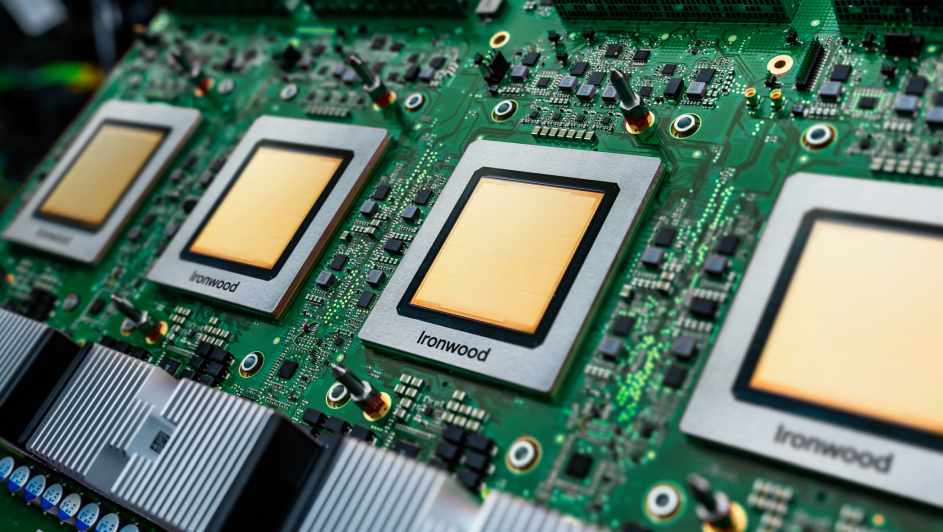
Google TPUs (Credit: Google)
The Wall Street Journal first reported details of the partnership ahead of Blackstone’s official announcement, reporting that Blackstone is expected to hold a majority stake.
For Google, the partnership marks a much bigger push to turn its in-house AI chips into a direct commercial weapon against Nvidia.
Google began developing TPUs nearly a decade ago and has quietly used them to run many of its internal AI systems, including Gemini. Companies such as Anthropic and Citadel Securities already use Google’s TPUs for AI workloads, though Nvidia’s GPUs still dominate most of the market.
The timing matters.
Nvidia became the face of the AI boom after OpenAI’s ChatGPT launch sent demand for GPUs soaring across the tech industry. Its chips became the default infrastructure layer for training and deploying AI systems, helping propel Nvidia into the position of the world’s most valuable company in 2024.
Google wants a larger piece of that market.
Its TPUs are purpose-built for machine learning tasks and agentic AI applications, giving Google an opening to pitch them as a lower-cost or more efficient alternative for certain workloads. The company still relies on Nvidia GPUs in parts of its cloud business, though executives have spent years trying to reduce that dependence by developing custom silicon.
Amazon Web Services has taken a similar path with its Trainium and Inferentia chips as hyperscalers look for ways to reduce reliance on Nvidia’s hardware stack.
The Blackstone deal gives Google something it has lacked in the AI infrastructure race: a giant financial partner willing to pour billions into the physical backbone required to scale AI compute.
That is becoming one of the defining themes of the current AI boom.
Wall Street firms, private equity giants, infrastructure investors, and sovereign wealth funds are pouring money into data centers, energy projects, fiber networks, and semiconductor supply chains as AI demand pushes existing infrastructure close to its limits.
Earlier this month, Blackstone launched another AI-focused venture with Anthropic, signaling that the firm is positioning itself as one of the biggest financial players behind the AI buildout.
The company manages more than $1.3 trillion in assets and has aggressively expanded its data center footprint over the past several years.
The latest partnership could ease some of the pressure on enterprises seeking access to advanced AI infrastructure without having to spend billions to build their own facilities.
It could also shift the balance of power in the cloud market.
For years, Nvidia’s chips have served as the foundation of the AI economy. Google is now trying to build an alternative stack around its own silicon, cloud platform, and infrastructure partnerships. Blackstone’s capital gives that effort far more scale.
Shares of Alphabet and Blackstone both rose about 1% in premarket trading following the announcement, CNBC reported.