Why writing by hand may matter more in the age of AI: What a 20-year study by a neuroscientist found
 Daniel Levi
Posted On May 18, 2026
Daniel Levi
Posted On May 18, 2026
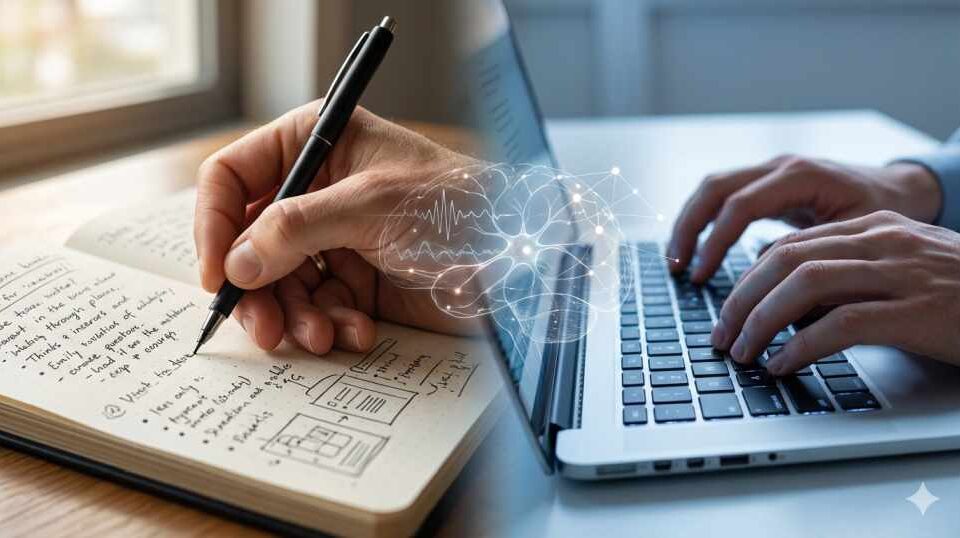
The modern tech industry has spent decades making life faster.
AI can summarize meetings in seconds. Students take notes on tablets instead of notebooks. Workers move from Slack to ChatGPT to email to Notion all day without touching paper once. The keyboard became the default interface for work, communication, and learning.
At the same time, a growing body of neuroscience research is raising a harder question: What happens to human learning when every layer of friction disappears?
That question sits at the center of a 2024 study by Norwegian neuroscientist Audrey van der Meer. After years of studying how the brain responds to handwriting and typing, van der Meer and her research team reached a conclusion that runs counter to the direction modern technology has been moving in.
Writing by hand appears to activate the brain in ways typing does not.
What researchers discovered inside the brain during handwriting
When writing by hand, brain connectivity patterns were far more elaborate than when typewriting on a keyboard, as shown by widespread theta/alpha connectivity coherence patterns between network hubs and nodes in parietal and central brain regions
The study, published in the journal Frontiers in Psychology, examined what happens inside the brain as handwriting increasingly gives way to tablets, laptops, and other digital tools. Researchers monitored the brain activity of 36 university students using high-density EEG caps fitted with 256 sensors as participants alternated between writing words by hand with a digital pen and typing the same words on a keyboard.
What they found stood out immediately.
“When writing by hand, brain connectivity patterns were far more elaborate than when typewriting on a keyboard.”
The researchers observed broader and more coordinated neural activity during handwriting, particularly in regions associated with memory formation, sensory processing, and learning.
Handwriting triggers broader brain connectivity than typing
The researchers found that handwriting triggered significantly broader and more connected patterns of brain activity than typing, particularly in regions linked to memory, sensory processing, and learning.
“When writing by hand, brain connectivity patterns were far more elaborate than when typewriting on a keyboard.”
The difference was not small. During handwriting, multiple brain regions lit up simultaneously in coordinated activity patterns linked to memory formation, sensory processing, movement, and visual interpretation. During typing, much of that connectivity dropped sharply.
Same words. Same students. Same brains. Two very different neurological events.
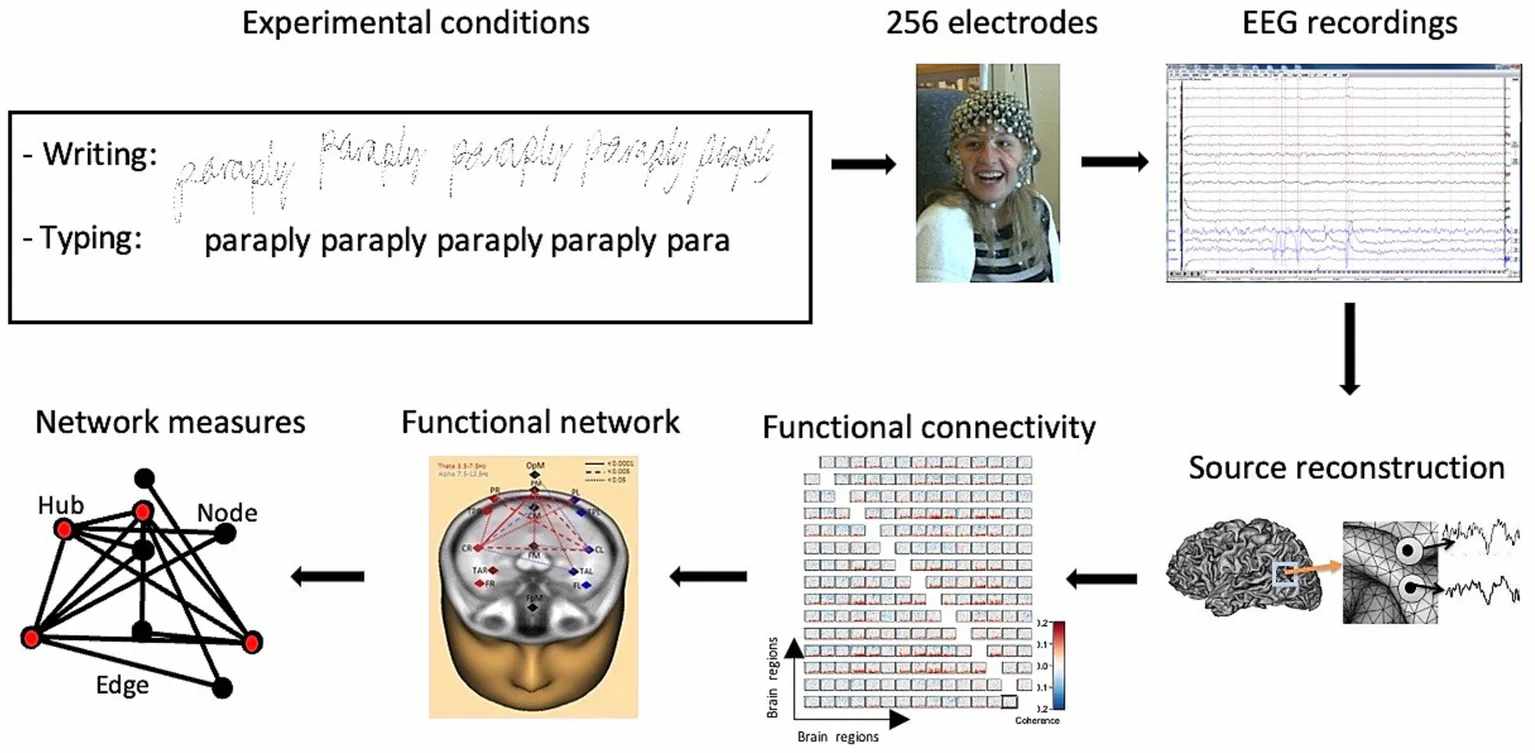
Task design, behavioral performance, and sequence of the connectivity analyses. Visually presented words were either written by hand with a digital pen or typed on a keyboard while participants were wearing a 256-channel sensor array. EEG recordings were analyzed in terms of their functional connectivity, resulting in detailed network measures.
The findings landed at a moment when schools and workplaces are leaning harder into screen-based learning than ever before. AI tools are making typing and digital interaction even more central to daily life. Students now use chatbots to summarize readings, organize notes, generate essays, and answer questions instantly.
Van der Meer’s research points in the opposite direction. It suggests that the physical act of producing letters by hand may play a deeper role in learning than many educators and technology companies assumed.
The reason appears to come down to movement.
Handwriting is not a single repeated action. Every letter requires a slightly different sequence of fine motor coordination. Fingers, wrist movements, vision, spatial awareness, and memory systems work together continuously as the brain calculates shapes and positions in real time.
Typing removes much of that variation. Pressing keys on a keyboard involves simpler and more repetitive motions with fewer sensory and spatial demands.
The brain, according to the research, responds differently to those two experiences.
Van der Meer’s study is not the first to raise concerns about digital note-taking replacing handwriting. More than a decade earlier, researchers Pam Mueller and Daniel Oppenheimer at Princeton University examined how students learned when taking notes on laptops compared to writing by hand.
Their findings became among the most widely discussed in modern education research.
The hidden difference between typing notes and writing them by hand
Students using laptops tended to capture more words from lectures almost verbatim. Students writing by hand captured fewer words but processed the material more deeply. Since handwriting is slower, students had to decide what mattered, summarize ideas in their own language, and actively interpret information as they listened.
That mental filtering appeared to improve conceptual learning and retention.
The keyboard optimized note-taking for speed. The brain may not learn best at maximum speed.
That idea carries new weight in the AI era.
Modern software keeps removing effort from cognitive tasks. AI systems summarize meetings, generate outlines, rewrite documents, answer questions, and compress hours of reading into short responses. Productivity software increasingly promises instant output with minimal friction.
For busy professionals, founders, and students, the appeal is obvious.
Yet studies like van der Meer’s hint at a deeper tension inside modern computing. Human learning may depend in part on the very effort that technology keeps trying to eliminate.
The issue is not that typing is bad. Digital tools remain indispensable for modern work, accessibility, communication, and collaboration. AI systems are already changing medicine, research, programming, customer support, and education at massive scale.
The question is narrower and more human.
If learning, memory, and deep comprehension are tied to physical engagement and mental effort, what happens when more of daily thinking becomes automated, summarized, and frictionless?
That concern is becoming harder to ignore in classrooms.
What laptops changed about the way students learn
Many schools shifted heavily toward tablets and laptops over the past decade, especially after the pandemic accelerated the adoption of digital learning. Some educators and researchers now worry that younger students are losing important cognitive and motor experiences tied to handwriting.
Van der Meer has spoken publicly about children struggling to distinguish letters such as “b” and “d” when writing instruction becomes heavily screen-based. Her argument is not nostalgic. It is neurological. Producing letters physically may help children internalize them more deeply than tapping keys on a flat screen.
The broader conversation reaches far beyond handwriting itself.
For years, Silicon Valley has built products around a simple assumption: faster and easier is always better. The success of smartphones, search engines, AI assistants, and automation platforms largely came from reducing time, reducing effort, and reducing friction.
That logic transformed the global economy.
Still, neuroscience research is beginning to suggest that some forms of friction may carry hidden cognitive value. Slowness forces selection. Effort forces engagement. Physical movement may anchor memory more deeply than passive interaction.
The old tools may still matter.
Writing notes by hand forces the brain to engage differently
A notebook cannot summarize a meeting in seconds. A pen cannot generate code or answer questions instantly. Handwriting will never compete with AI on speed.
That may not be the point.
As artificial intelligence reshapes education, work, and communication, van der Meer’s research raises a possibility that feels strangely old-fashioned in a screen-first era: the human brain may still learn best when it has to work for it.
Study details
The research referenced in this article was published in 2024 in the journal Frontiers in Psychology under the title:
“Handwriting but not typewriting leads to widespread brain connectivity: a high-density EEG study with implications for the classroom.”
The study was conducted by neuroscientists Audrey van der Meer and F.R. van der Weel at the Norwegian University of Science and Technology. Researchers analyzed brain activity from 36 university students using a 256-channel EEG sensor array as participants alternated between handwriting and typing tasks.
The full study can be read here: https://www.frontiersin.org/journals/psychology/articles/10.3389/fpsyg.2023.1219945/full