OpenAI launches GPT-5.5 with advanced coding, pushes deeper into AI agents and autonomous work
 Nickie Louise
Posted On April 23, 2026
Nickie Louise
Posted On April 23, 2026
OpenAI has released GPT-5.5, its latest artificial intelligence model, advancing its push into systems that can handle real-world work with less human input.
The new model lands less than two months after GPT-5.4, underscoring how quickly the AI race is moving. Each release is starting to feel less like an upgrade cycle and more like a steady reshaping of how software gets built, tested, and used.
“GPT‑5.5 understands what you’re trying to do faster and can carry more of the work itself. It excels at writing and debugging code, researching online, analyzing data, creating documents and spreadsheets, operating software, and moving across tools until a task is finished. Instead of carefully managing every step, you can give GPT‑5.5 a messy, multi-part task and trust it to plan, use tools, check its work, navigate through ambiguity, and keep going, OpenAI said in a statement announcing the launch.
Announcing the launch on X, OpenAI said:
“Introducing GPT-5.5
A new class of intelligence for real work and powering agents, built to understand complex goals, use tools, check its work, and carry more tasks through to completion. It marks a new way of getting computer work done.”
Introducing GPT-5.5
A new class of intelligence for real work and powering agents, built to understand complex goals, use tools, check its work, and carry more tasks through to completion. It marks a new way of getting computer work done.
Now available in ChatGPT and Codex. pic.twitter.com/rPLTk99ZH5
— OpenAI (@OpenAI) April 23, 2026
GPT-5.5 Launch Signals Next Phase of AI: OpenAI Focuses on Agents and Real Work
That framing points to a shift that’s becoming harder to ignore. These models are no longer pitched as assistants that wait for instructions. The goal now is systems that can take a vague objective, break it down, and carry tasks across the finish line with minimal back-and-forth.
“What is really special about this model is how much more it can do with less guidance,” OpenAI President Greg Brockman said during a briefing with reporters on Thursday. “It can look at an unclear problem and figure out just what needs to happen next. It really, to me, feels like it’s setting the foundation for how we’re going to use computers, how we’re going to do computer work going forward.”
“GPT-5.5 understands what you’re trying to do faster and can carry more of the work itself,” OpenAI said. The model can write and debug code, research online, analyze data, and operate software across tools until a task is finished. Instead of guiding every step, users can hand it a messy task and let it plan, act, and keep going.
GPT-5.5 Model Capabilities
OpenAI is positioning GPT-5.5 as part of a broader push into agentic AI, where systems can take on more of the work traditionally handled by humans. The company has been investing heavily in the infrastructure behind that shift, aiming to make these tools usable across industries and workflows.
Over the past year, AI has already started to change how software gets built. With GPT-5.5 now integrated into Codex and ChatGPT, that momentum is beginning to extend into areas like scientific research and everyday computer-based tasks.
OpenAI says GPT-5.5 is not just more capable but also more efficient at solving problems. The model often produces higher-quality results with fewer tokens and fewer retries, a signal that performance gains are starting to come from execution, not just scale.
On Artificial Analysis’s Coding Index, GPT-5.5 delivers state-of-the-art performance at roughly half the cost of competing frontier coding models, according to the company.
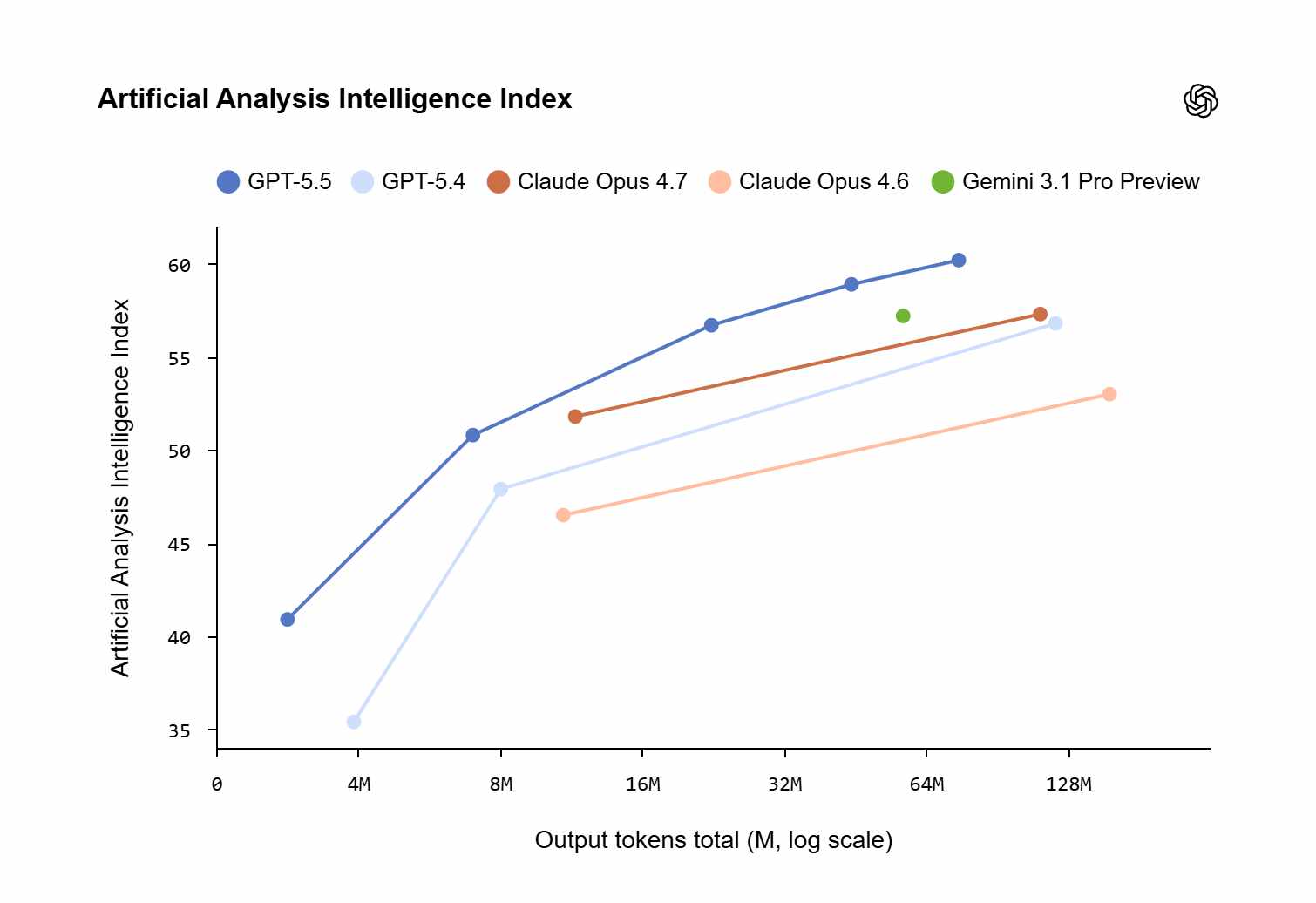
Artificial Intelligence Index for GPT 5.5
The timing of GPT 5.5 is not accidental. OpenAI is moving in step with rivals like Google and Anthropic, both of which are racing to define what the next generation of AI systems should look like. Anthropic’s latest model, Claude Mythos Preview, has already drawn attention across Wall Street, raising fresh questions about how far these systems can go.
GPT-5.5 leans into that pressure. OpenAI says the model is stronger at analyzing data, writing and debugging code, operating software, researching online, and producing documents and spreadsheets. The focus is clear: less prompting, more execution.
That same capability comes with scrutiny. OpenAI said GPT-5.5 does not exceed its “Critical” cybersecurity risk threshold, a level associated with the potential for severe harm. It meets the bar for a “High” risk classification, which indicates it could amplify existing threats if misused.
“Mia Glaese, OpenAI’s vice president of research, said during the briefing:
“GPT-5.5 underwent extensive third-party safeguard testing and red teaming for cyber and bio [risks], and we’ve been iterating on our cyber safeguards for months with increasingly cyber capable models,”
The warning signs have been building across the industry. Earlier this month, Anthropic limited the rollout of its Mythos model after internal testing showed it could identify weaknesses in software systems with unusual precision. That decision added weight to ongoing concerns among tech leaders and policymakers about how quickly these tools are advancing.
For now, GPT-5.5 is rolling out to paid users across ChatGPT, including Plus, Pro, Business, and Enterprise tiers. It is available inside ChatGPT and OpenAI’s coding assistant Codex, with API access expected soon. OpenAI says those deployments will come with a different set of safeguards.
The bigger picture is coming into focus. AI is starting to move past chat and into execution. The companies leading this shift are no longer competing on who can answer questions better. They’re competing to get work done.