Blue Origin successfully lands reusable New Glenn booster, but satellite fails to reach orbit
 Daniel Levi
Posted On April 20, 2026
Daniel Levi
Posted On April 20, 2026
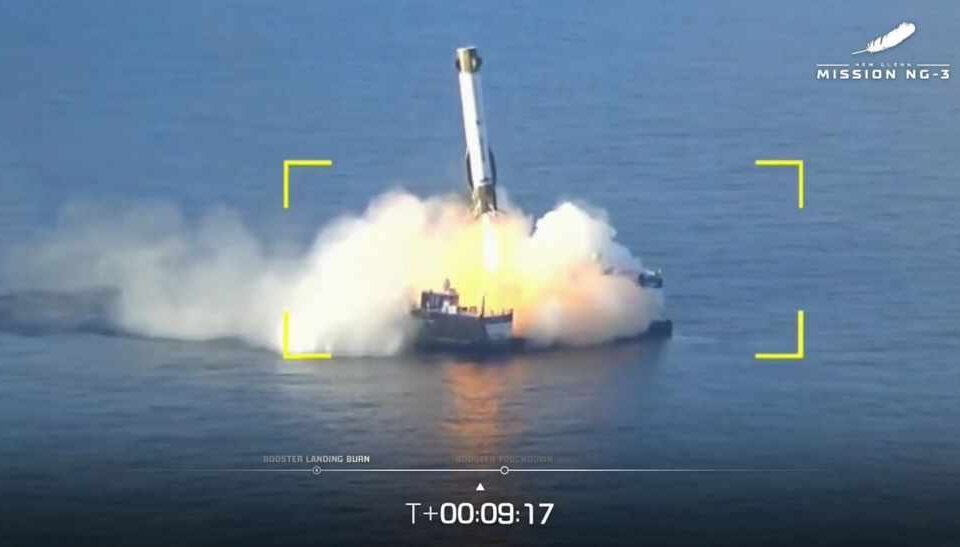
Blue Origin took a meaningful step forward in the launch race on Sunday. For the first time, the company brought a New Glenn booster back from orbit and landed it cleanly at sea. Minutes later, the mission slipped off course when the rocket’s second stage failed to place its payload into the right orbit.
The 320-foot rocket lifted off from Cape Canaveral and climbed as planned. After stage separation, the first stage flipped, fired its engines, and guided itself to a precise touchdown on the drone ship Jacklyn in the Atlantic. The booster, nicknamed “Never Tell Me The Odds,” reignited all seven BE-4 engines for the landing burn and settled onto the deck—an outcome Blue Origin has chased for years.
Shortly after the landing, Jeff Bezos shared a video on X showing the New Glenn booster descending and touching down on the drone ship, offering a first look at the milestone moment.
— Jeff Bezos (@JeffBezos) April 19, 2026
That landing matters. Reusing boosters is the lever that lowers launch costs and increases flight cadence. Blue Origin has long pointed to vertical landing as core to its strategy, drawing on lessons from its New Shepard program. This flight shows the company can manage the heat, speed, and control demands of an orbital return.
Then came the miss
Blue Origin Reaches Reusability Milestone with New Glenn, but AST SpaceMobile Satellite Mission Falls Short
The upper stage did not deliver AST SpaceMobile’s BlueBird 7 satellite to its planned orbit. Telemetry and early company updates indicate the spacecraft was released into a lower trajectory than required for operations. At that altitude, the satellite cannot reach its intended orbital plane. The likely outcomes range from a shortened lifespan to reentry.
For AST SpaceMobile, the setback lands hard. The Texas-based startup is building a space-based cellular network that connects directly to standard smartphones. BlueBird 7 was meant to extend its early constellation, part of a path to more than 25 satellites for initial service. The company has faced delays and funding pressure; this mission was a key step forward. It has not outlined recovery options or insurance impacts yet.
Blue Origin framed the flight as a partial success. The company proved it can recover an orbital-class booster, a milestone few have reached. At the same time, the result highlights a familiar truth in rocketry: landing the first stage is one piece of the job. The second stage, payload deployment, and orbital precision carry equal weight.
The comparison with SpaceX is unavoidable. Early in the Falcon 9 program, SpaceX saw its share of upper-stage and fairing issues before settling into a steady rhythm. Blue Origin is earlier on that curve with New Glenn. This mission places it in a small group that can bring back large boosters, with more work ahead on end-to-end reliability.
New Glenn is built to compete across commercial, civil, and national-security launches. The methane-fueled BE-4 engines rank among the most powerful in their class. The vehicle is sized for heavy payloads, including satellite constellations and future lunar missions. A reliable, reusable alternative to SpaceX would open the market and give satellite operators more options.
The stakes stretch beyond one flight. Lower-cost launches shape what startups can build in orbit. Constellations, in-space manufacturing, and scientific missions all depend on predictable access to space. AST SpaceMobile sits at the center of that shift, betting on satellites to close connectivity gaps on Earth. A miss like this delays that timeline.
Blue Origin has not shared the root cause of the second-stage shortfall. The next New Glenn mission is already on the calendar. The company now faces two immediate tests: diagnosing the upper-stage issue and turning around the recovered booster for another flight.
Sunday’s outcome reads as progress with a caveat. The booster came home intact. The payload did not reach its destination. The path forward is clear—tighten the full stack so every mission ends with the satellite in the right orbit. For an industry racing toward a half-trillion-dollar future, that last step is the one that counts.