Cursor in talks to raise $2B at $50B valuation as revenue surges and AI coding wars heat up
 Nickie Louise
Posted On April 17, 2026
Nickie Louise
Posted On April 17, 2026

Cursor is back in the spotlight—and this time, the numbers are hard to ignore. The AI coding startup is in talks to raise at least $2 billion in fresh funding at a $50 billion valuation, according to Bloomberg, citing people familiar with the matter. The round is expected to include returning backers Andreessen Horowitz and Thrive Capital, with Nvidia and Battery Ventures likely joining the deal.
“Cursor, a leading artificial intelligence startup for coding, is in advanced talks with investors to raise about $2 billion in a funding round at a valuation of more than $50 billion, not including the investment,” Bloomberg reported.
Bloomberg also added that, “Andreessen Horowitz, an existing backer, is set to co-lead the funding round, said the person, who spoke on condition of anonymity as the information is not public. Nvidia is also planning to participate in the financing, according to two people familiar with the matter.” Thrive Capital is also in talks to participate, one person told Bloomberg.
If the deal goes through, it would mark a sharp jump from Cursor’s last valuation. Five months ago, the company raised $2.3 billion in a Series D round led by Accel and Coatue, with participation from Andreessen Horowitz, Thrive Capital, Nvidia, and Google. That round valued the company at $29.3 billion—already a massive leap from where it stood at the start of 2025.
The speed of that climb has caught the attention of investors and competitors alike. Cursor started as a side project built by four MIT graduates in their mid-20s. Today, it’s pulling in more than $1 billion in annualized revenue and is on track to push far beyond that. People familiar with the company’s projections say Cursor expects to exceed a $6 billion run rate by the end of 2026, a target that would triple its revenue in less than a year.
That kind of growth doesn’t happen in a vacuum. Cursor’s product landed early with developers seeking something faster and more intuitive than traditional coding tools. By embedding AI directly into the editor, the company made writing and editing code feel closer to working in a document than managing a complex development environment. The tool can generate, revise, and review code, adapting over time to each developer’s workflow.
From Side Project to $50B: Cursor Lines Up $2B Funding Round
What started as grassroots adoption among engineers soon reached the executive layer. Leaders at companies like Nvidia and Stripe publicly backed the product, giving Cursor credibility that most young startups struggle to earn.
At the same time, the business behind the product has been evolving. Like many AI startups that rely on third-party models, Cursor initially faced a tough cost structure. Running the product cost more than it generated. That changed after the company introduced its own Composer model and began leaning on lower-cost alternatives such as Kimi. Those moves helped push the company into positive gross margins for large enterprise customers, even as individual developer accounts remain less profitable.
That shift matters for one simple reason: control. By reducing its dependence on external AI providers, Cursor is trying to avoid a scenario in which its own suppliers become direct competitors. That risk is no longer theoretical. Rivals like Anthropic’s Claude Code and OpenAI’s Codex are moving quickly, each trying to become the default layer where developers write and manage code.
The current funding round is already oversubscribed, though final terms are still being negotiated and could change. Investors appear willing to bet that Cursor’s early lead, strong revenue growth, and improving margins will hold up as competition intensifies.
Cursor, formerly known as Anysphere, was founded in 2022 by Michael Truell, Sualeh Asif, Arvid Lunnemark, and Aman Sanger while they were at MIT. In just a few years, the company has gone from a student project to one of the most closely watched players in AI.
The next phase will test whether it can stay ahead in a market where the biggest names in tech are chasing the same goal: owning the future of how software gets written.
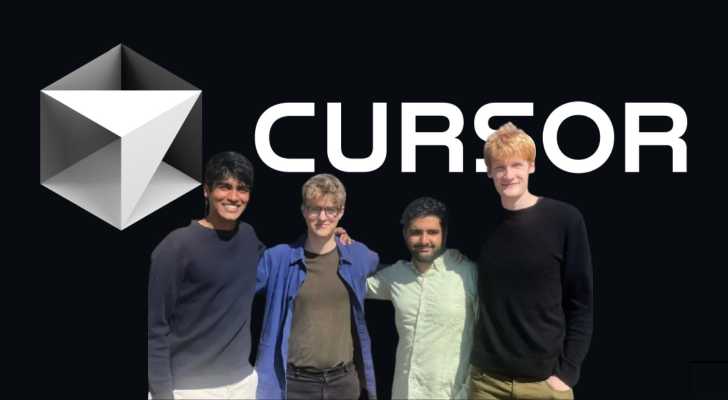
Cursor founders
Trending Now