SoftBank completes $40B investment in OpenAI, taking 11% stake in the AI giant
 Nickie Louise
Posted On January 1, 2026
Nickie Louise
Posted On January 1, 2026
SoftBank has finished wiring one of the largest bets in modern tech history.
The Japanese investment group has now completed its full $40 billion commitment to OpenAI, locking in an ownership stake of roughly 11% in the company behind ChatGPT, the company confirmed in a press release yesterday. The final tranche, totaling between $22 billion and $22.5 billion, was transferred late last week, according to people familiar with the transaction.
The timing raised eyebrows. Just weeks earlier, SoftBank quietly exited its entire position in Nvidia, selling a $5.8 billion stake that had once symbolized one of Masayoshi Son’s most successful early AI bets. Inside Silicon Valley and Tokyo, the move read less like a retreat and more like a reallocation of conviction.
SoftBank first disclosed the OpenAI investment in March, outlining a plan to commit up to $40 billion alongside outside backers. The structure unfolded in stages. An initial $7.5 billion went out in April through SoftBank Vision Fund 2. A larger second closing followed in late December, again through the same fund. Third-party investors added another $11 billion, bringing the total funding to roughly $41 billion, exceeding the original headline number.
CNBC previously reported back in February 2025 that the deal valued OpenAI at around $260 billion pre-money, making it among the most valuable private companies globally. The funding schedule stretched across multiple months, reflecting the scale of capital required to keep modern AI systems running.
Why SoftBank’s $40B OpenAI Investment Signals a New Phase of the AI Boom
A portion of that money is tied to infrastructure. OpenAI has been investing in Stargate, a joint effort with Oracle and SoftBank that aims to meet the massive compute demands of large-scale AI models. Across the industry, spending on data centers, chips, and power has turned into a defining feature of the AI race.
OpenAI’s own commitments underscore that shift. The company has lined up more than $1.4 trillion in long-term infrastructure agreements, including deals with Nvidia, Advanced Micro Devices, and Broadcom. These are not experimental budgets. They reflect AI moving from research labs into a permanent industrial footing.
Masayoshi Son framed the investment as a statement of belief.
“We are deeply aligned with OpenAI’s vision of ensuring AGI benefits all of humanity.”
OpenAI CEO Sam Altman echoed that sentiment.
“SoftBank saw the potential of AI early and committed with a deep belief in its impact on humanity. Their global leadership and scale help us move faster and bring advanced intelligence to the world.”
The OpenAI bet sits alongside a broader reshaping of SoftBank’s portfolio. The company recently agreed to pay $4 billion for data-center investor DigitalBridge, another signal that infrastructure now sits at the center of its AI strategy.
OpenAI continues to pull capital from across the tech ecosystem. Microsoft remains its largest strategic partner, backing the company with billions over multiple funding rounds. Talks have surfaced around a potential investment exceeding $10 billion from Amazon. Disney recently joined the cap table through a $1 billion equity deal tied to licensed content access for OpenAI’s video generator, Sora.
An IPO is widely expected, even if no timeline has been confirmed.
SoftBank’s move closes one chapter and opens another. Nvidia’s exit closed the book on the past decade of AI hardware gains. The OpenAI commitment signals where Son sees the next era forming: fewer bets, larger checks, and a belief that the most valuable layer of AI will sit above the chips.
This time, the wager is not on who builds the tools. It is a question of who controls the intelligence.
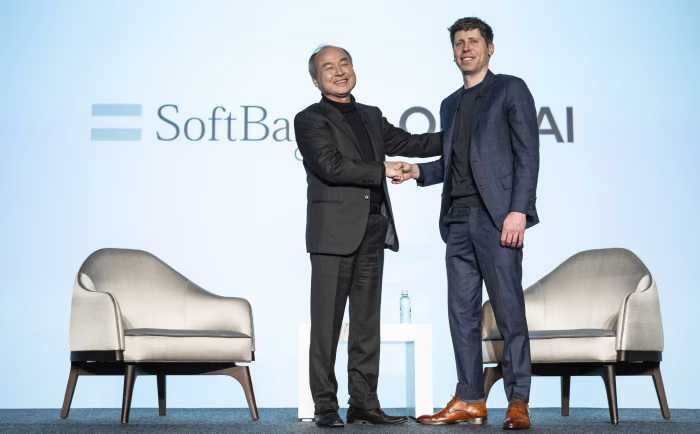
Photo Credit: Aaron Schwartz/Bloomberg News