
Why Standard Channels Stop Working in High-Ticket B2C
 Rinat Tagirov
Posted On January 17, 2025
Rinat Tagirov
Posted On January 17, 2025

Rinat Tagirov
Expert in Revenue Growth & Sales Process Optimization for High-Resistance & Traditional Industries
Abstract
This article examines non-traditional customer acquisition channels in high-ticket B2C segments and the specific considerations for evaluating them through a sales economics lens. It analyzes professional communities, referrals, and partner networks as tools for reaching audiences with established demand and high trust. It focuses on building a partner network as a manageable sales channel and evaluating its effectiveness through conversion, revenue, LTV, and margin contribution.
Keywords: B2C, high-ticket, customer acquisition, non-traditional sales channels, partner network, referrals, conversion, LTV, revenue growth.
The Transformation of the Customer Journey and New Requirements for Customer Acquisition
For high-ticket B2C products, customer acquisition involves a more complex decision-making process: buyers need time to compare options, verify information, and build trust in a company. Therefore, the business objective goes beyond increasing advertising reach—it is important to be present at the touchpoints that influence the purchasing decision even before the customer contacts a salesperson.
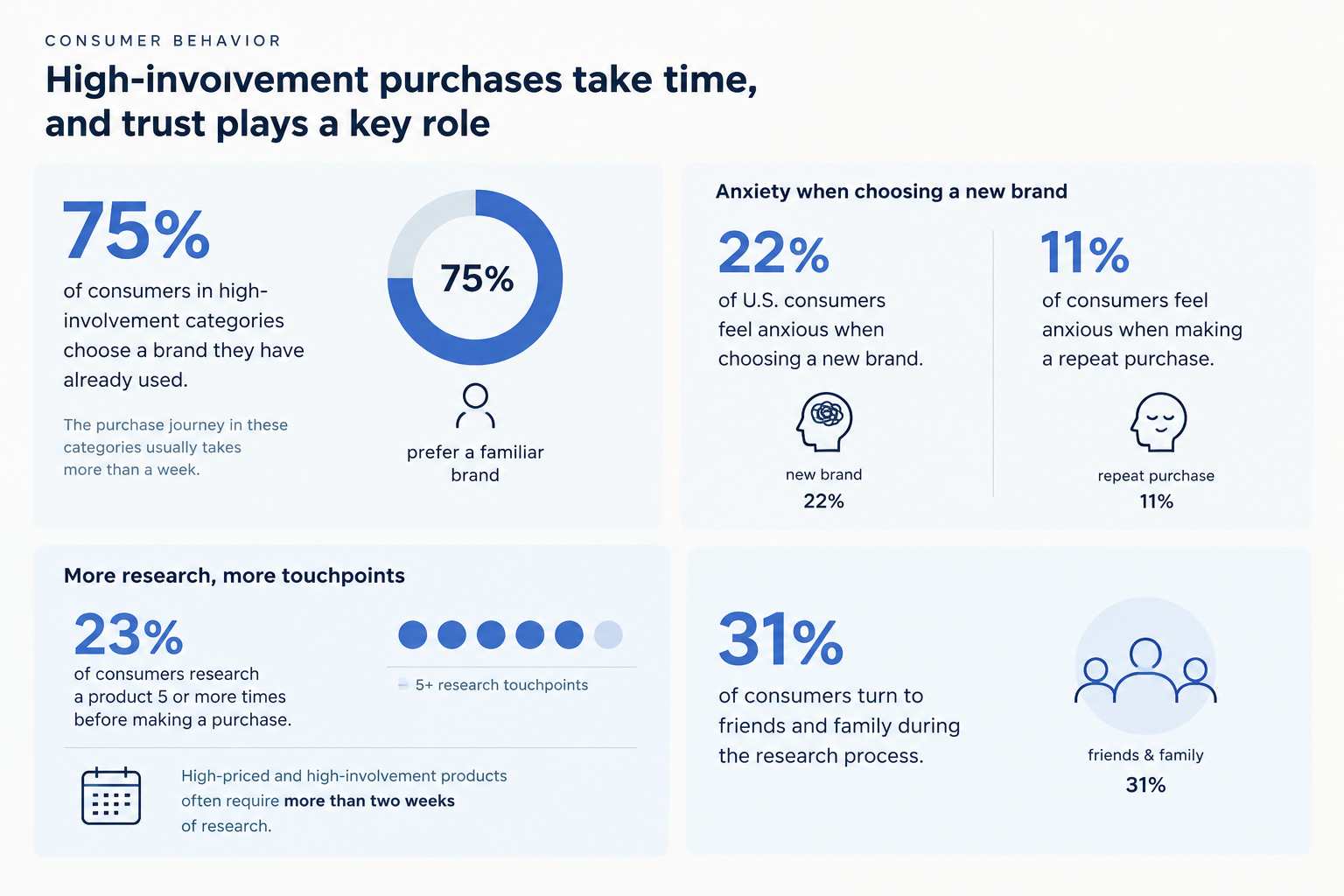
A Nielsen study shows that in high-involvement categories, where the path to purchase typically takes more than one week, 75% of consumers choose a brand they have used before. When choosing a new brand, 22% of U.S. consumers experience anxiety, compared with 11% when making a repeat purchase. At the same time, a longer decision-making process also increases the number of touchpoints. According to EMARKETER and impact.com, 23% of consumers research a product five or more times before buying, and high-priced, high-involvement products are more likely to require more than two weeks of research. In addition, 31% of consumers turn to friends and family while researching a product.
For companies with a high average transaction value, this creates a specific commercial challenge: an advertising touchpoint may generate interest, but the purchasing decision often depends on subsequent sources of information and trust. Therefore, acquiring customers through referrals, professional communities, adjacent companies, and partner networks can expand access to audiences already in the purchase decision process.
Non-Traditional Channels: Where to Find Customers When Advertising No Longer Delivers the Right Economics
In high-ticket B2C, the choice of channel should start with why a customer doesn’t buy immediately. If trust is the main barrier, an additional advertising touchpoint rarely solves it. If the customer has already developed a need but does not know whom to turn to, value is created by giving the audience access at the point of decision-making. If the product requires consultation, the channel should provide access to a person or setting capable of providing that consultation.
Problem 1: An expensive advertising lead does not convert into a sale. A company sells a product priced at $10,000–$20,000 and receives inquiries generated through advertising, but a significant share of customers stop communicating after the initial contact. In this situation, increasing the advertising budget only scales lead volume while keeping the conversion rate the same. Therefore, a channel should be evaluated based on customer acquisition cost per sale, conversion rate, and revenue per customer, since a more expensive lead may ultimately be more profitable if it has a significantly higher probability of converting into a purchase.
Problem 2: The target audience exists, but it is dispersed. For example, buyers of premium equipment or complex services may be concentrated around professional communities, clubs, events, and specialized platforms. Advertising within such a community solves the reach problem but does not necessarily build trust. A stronger model is a joint product, an expert-led event, or a special offer for community members. Here, the partner serves as a segmentation mechanism: the company gains access to an already-selected audience instead of purchasing broad advertising reach.
Problem 3: The customer requires multiple touchpoints before making a decision. In this case, you cannot evaluate a channel based on the outcome of the first contact. Expert content, referrals, offline events, and joint communications work as a sequence of touchpoints that gradually reduces uncertainty. Therefore, for these channels, it helps to distinguish initial acquisition from subsequent conversion by tracking the source of the first contact, repeat interactions, progression to a consultation, conversion to sale, and resulting revenue.
This creates a channel matrix: source → audience quality → cost per contact → conversion to sale → average transaction value → LTV. It makes it possible to identify situations in which a channel with a higher initial contact cost proves more profitable than mass advertising because of a higher conversion rate and greater customer value.
A Partner Network Is a Sales System, Not a Source of Individual Referrals
A partner network becomes a sales channel when a company begins managing its economics. For each partner, clearly define the customer source, referral terms, conversion rate, and financial results.
The greatest value comes from partners who contact the customer before the customer selects a supplier. Depending on the category, these may include designers, architects, real estate agents, financial advisors, integrators, service companies, or sellers of complementary products. Their advantage lies in access to audiences with established demand and a high level of trust.
Therefore, 50 active partners may be more valuable than 500 registered ones.
For example, a company sells equipment with an average transaction value of $15,000. Acquiring a qualified customer independently costs the company $1,200, and 8% of such inquiries convert into sales. The company engages industry-specific partners and pays a 7% commission on completed sales. If a partner refers a customer after an initial consultation and the conversion rate reaches 20%, the commission amounts to $1,050 per sale. With the same number of qualified inquiries, the partner channel in this model can generate substantially more sales at a comparable acquisition cost.
In this model, the key metric is the economics of the completed sale: how much revenue and margin a partner generates, accounting for conversion, average transaction value, and the cost of the partner’s compensation. The number of referred contacts matters only in conjunction with these metrics. At the same time, the compensation structure should correspond to the partner’s contribution. For one segment, a commission on a completed sale may be optimal; for another, a fixed payment per qualified customer, reciprocal referrals, or a joint product may be more appropriate. Revenue share makes sense where a partner is systematically involved in creating and monetizing customer demand.
The main weakness of most partner programs comes after the company receives the contact. If a lead is referred through a messenger without recording its source, the company loses the ability to evaluate the partner’s performance; if a sales manager contacts the customer two days later, part of the commercial value has already been lost. Therefore, a partner channel requires its own operating procedures: lead registration, an assigned sales manager, a defined response time for the first contact, deal statuses, and rules for confirming the outcome.
Scaling such a system should replicate a proven model rather than mechanically adding partners. First, identify the profile of a high-converting partner; then identify similar companies and professionals, and offer them standardized terms and a clear client referral process. The resulting analytics should show the entire chain: partner → qualified lead → sale → revenue → commission → margin contribution. This makes it clear who is actually generating additional revenue and who is merely increasing the size of the partner base.
Conclusion
In high-ticket B2C, customer acquisition effectiveness depends on access to the customer and the economics of the transaction as a whole. Non-traditional channels and partner networks let companies leverage established trust and reach targeted audiences, while systematic analysis of conversion, revenue, and LTV turns individual referrals into a manageable growth channel.
Sources
EMARKETER. What Marketers Need to Know About the Customer Journey in 5 Charts. 2023.
https://www.emarketer.com/content/what-marketers-need-know-about-customer-journey-5-charts
Nielsen. Build Trust to Build Trial: Trustworthy Channels Can Help. 2022.
https://www.nielsen.com/insights/2022/build-trust-to-build-trial-trustworthy-channels-can-help/
EMARKETER. 5 Key Stats on the Shopping Journey. 2025.
https://www.emarketer.com/content/5-key-stats-on-shopping-journey