OpenAI and Cisco launch Shirudo, an open-source AI cyber defense tool to block exploits in real time
 Daniel Levi
Posted On November 24, 2026
OpenAI and Cisco are targeting one of cybersecurity’s most persistent problems: protecting vulnerable systems before a permanent security patch is ready. The two companies have launched Shirudo, an open-source AI cyber defense tool that helps security teams block exploits against running Linux systems without interrupting critical services.
In a controlled test, a security shield generated by OpenAI’s Codex successfully blocked a Java4Shell exploit attempt against a running Elasticsearch service without requiring a restart. The demonstration offers an early look at how AI could move beyond discovering software vulnerabilities to actively defending systems against them.
The project addresses a costly problem for enterprises. Testing and deploying security patches can take days or weeks, leaving organizations exposed to attacks. Taking critical applications offline isn’t always an option, particularly for businesses operating financial infrastructure, cloud services, healthcare systems, and telecommunications networks.
Shirudo, Japanese for “shield,” aims to close that security gap by letting defenders deploy temporary, targeted protections until permanent fixes are ready.
OpenAI President and Co-founder Greg Brockman explained the reasoning behind the partnership in the company’s announcement.
“We’re giving defenders better models and tools to find and fix vulnerabilities faster, but finding a bug today doesn’t mean you can patch every system tomorrow. We are partnering closely with Cisco on Shirudo to help teams protect the systems they need to keep running while they build and roll out a fix. So many teams rely on the same software that it makes sense to build these tools in the open. Now when one team finds a better way to protect a system, others don’t have to start from scratch.”
How Shirudo Blocks Exploits Without Taking Systems Offline
Shirudo uses eBPF (extended Berkeley Packet Filter), a Linux technology that lets small programs run at designated points within the operating system. Security teams can use it to observe kernel and network activity and apply targeted protections without restarting applications.
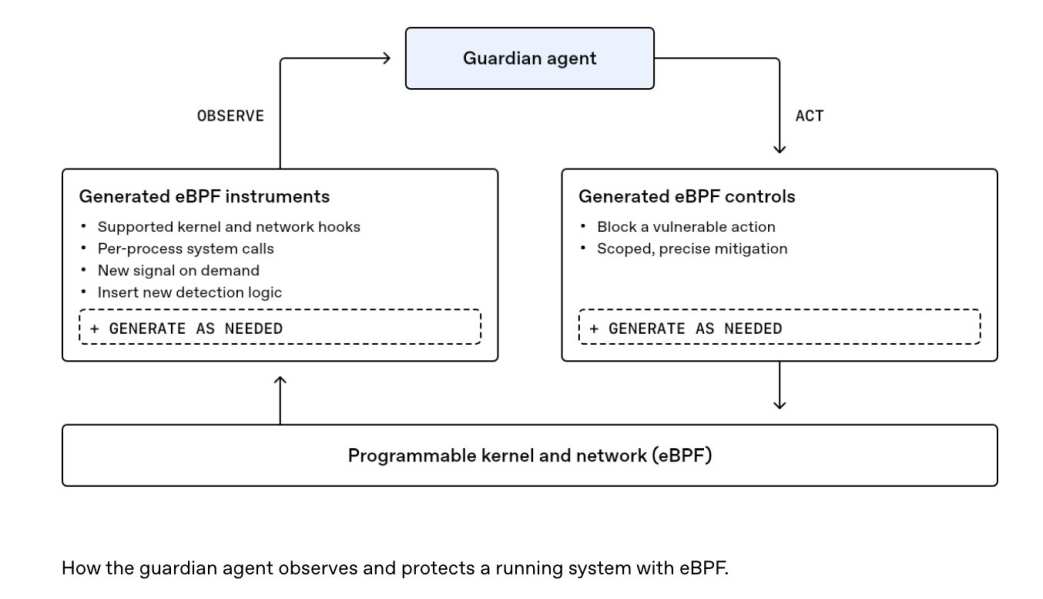
How the guardian agent observes and protects a running system with eBPF. (Image credit: OpenAI)
Rather than blocking an entire operation that legitimate applications might depend on, Shirudo helps security teams isolate the behavior that makes a vulnerability exploitable.
In the Java4Shell experiment, Codex generated a shield that introduced an input validation check into Java’s Base64 decoder. The protection was attached directly to a running Elasticsearch process, rejecting malicious input without interrupting the service.
Security teams can evaluate how proposed shields affect legitimate workloads before activating them. Human operators retain control over deployment, and shields are cryptographically signed and verified before loading.
The project incorporates hardware-backed verification through a Trusted Platform Module (TPM), giving operators a way to verify which protections have been installed or removed.
OpenAI and Cisco have released Shirudo’s source code on GitHub under the BSD 2-Clause license, with its BPF programs dual-licensed under BSD and GPL.
Their long-term goal is to make tested shields available alongside vulnerability disclosures, potentially reducing the time organizations remain exposed to known security flaws.
Why Shirudo Is a Warning to Cybersecurity Startups
Shirudo’s commercial implications could extend well beyond its technical capabilities. Cybersecurity startups that have spent years developing proprietary exploit mitigation, virtual patching, and runtime protection technologies could eventually find themselves competing against freely available AI-generated alternatives.
Unlike traditional competitors, OpenAI and Cisco don’t necessarily need to build a standalone business around Shirudo to benefit from its adoption. The project could strengthen their broader AI and infrastructure ecosystems without requiring customers to pay licensing fees for the open-source runtime.
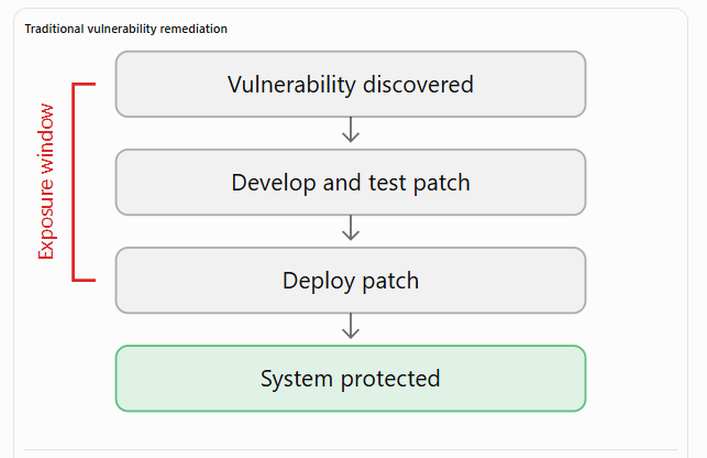
Traditional vulnerability remediation
That creates an uncomfortable question for cybersecurity founders and their investors: How much is a proprietary security capability worth when an increasingly capable open-source alternative becomes available?
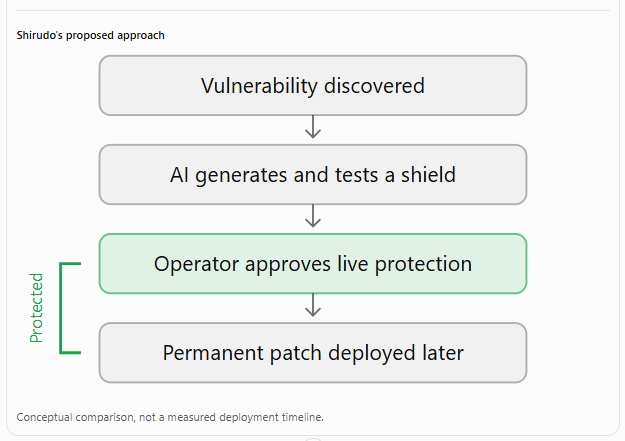
Shirudo’s proposed approach
The threat isn’t limited to losing customers. Open-source competition could put pressure on licensing fees, profit margins, startup valuations, and future fundraising. Companies built around a narrow technical capability may face greater exposure than those offering comprehensive security services, proprietary threat intelligence, deep enterprise integrations, and regulatory expertise.
Shirudo is still an early-stage project. A successful controlled experiment does not establish reliability across complex production environments. Enterprises will need evidence of consistent performance, compatibility, and operational safety before deploying AI-generated protections at scale.
The announcement is not a death sentence for cybersecurity startups. It could create new opportunities for companies building commercial services around open-source security infrastructure.
For founders, the lesson extends beyond cybersecurity. Building a technology that solves a difficult problem is one achievement. Building a business that remains valuable after that technology becomes freely available is another.